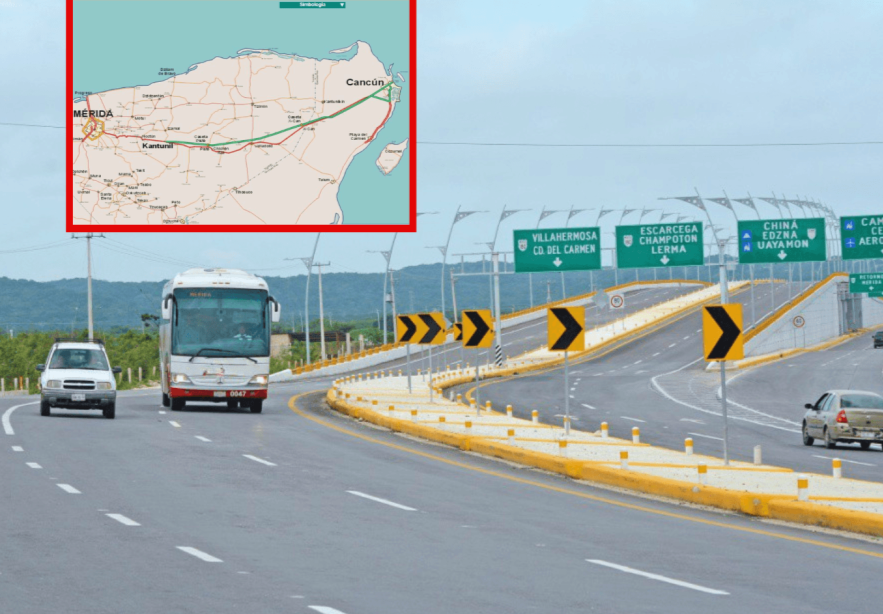

If you’re driving around the Yucatán Peninsula, be prepared! It has one of the most expensive toll highways in Mexico, and it’s not operated by Capufe. However, with the stunning scenery you’ll see in the region, you’ll think it’s worth it.
Capufe operates more than a third of Mexico’s toll roads; however, it doesn’t cover the entire southeast of the country.
According to the Mexican Transportation Institute (IMT), the country has 10,923 km of toll roads; of these, Capufe operates just over 3,700 km, including access to toll bridges: 18 national and 12 international.
Following the adjustment of toll rates in Mexico on April 13, 2026, the Mérida-Cancún highway increased its cost by 4.6% and is now the third most expensive.
The highway has toll plazas in Quintana Roo and Yucatán, managed by EXI Operadora Quantum, whose concession is valid until 2050, according to the Mexican government.
It should be noted that toll costs depend on various factors, such as the length of the road, the type of vehicle, its dimensions, and the number of axles.
The only highways more expensive than the one on the Yucatán Peninsula are operated by Capufe: the Durango-Mazatlán and the Tehuacán-Oaxaca.
Which are the most expensive highways in Mexico?
The tolls on the Mérida-Cancún highway are among the most expensive in the country in 2026, following the rate increase that took effect this April, and it is not operated by Capufe. It ranks third.
Durango-Mazatlán: 820 pesos for cars and 410 pesos for motorcycles
Tehuacán-Oaxaca: 702 pesos for cars and 313 pesos for motorcycles
Mérida-Cancún: 675 pesos for cars and 337 pesos for motorcycles
Cuernavaca-Acapulco: 670 pesos for cars and 335 pesos for motorcycles
La Tinaja-Cosoleacaque: 560 pesos for cars and 280 pesos for motorcycles
Estación Don-Nogales: 542 pesos for cars and 271 pesos for motorcycles
Barranca Larga-Ventanilla: 490 pesos for cars and 244 pesos for motorcycles
Las Choapas-Ocozocoautla: 317 pesos for cars and 158 pesos for motorcycles
Córdoba-Veracruz: 282 pesos for cars and 141 pesos for motorcycles
Torreón-Saltillo: 276 pesos for cars and 138 pesos for motorcycles

What What to see between Cancún and Mérida?
This route forms the main tourist corridor of the Yucatán Peninsula, as it passes through archaeological sites, “Pueblos Mágicos” (Magical Towns), and cenotes, considered sacred in ancient times.
Izamal, a Magical Town: a picturesque yellow city, known for its Mayan convent and pyramids. It’s not exactly on the route, but you can reach it by taking a detour near Kantunil.
Valladolid, a Magical Town: a beautiful colonial city halfway along the route, ideal for visiting the Zací cenote, convents, and sampling the local cuisine.
Chichén Itzá Archaeological Zone: one of the 7 Wonders of the Modern World, featuring Mayan ruins, accessible by taking the turnoff towards Pisté.
Cenotes in the area: Near Pisté and Valladolid, cenotes like Ik-il and Saytún stand out. Tintal (branch to Playa del Carmen)
Connection to the Cancún airport, 15 kilometers long.
Traveling on the Peninsula will be more expensive in 2026. The toll increase confirms that traveling this key route in southeastern Mexico will mean higher costs for tourists and residents.
If you plan to travel between Mérida and Cancún, factor the toll costs into your budget and check the updated rates before you leave to avoid surprises.

Source: yucatan