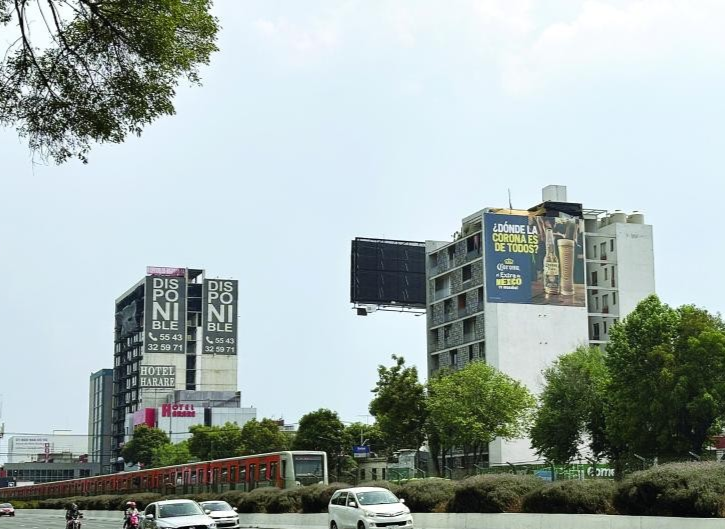

The excitement surrounding the World Cup has led to a significant setback in the regulation of Mexico City’s urban landscape.
Jorge Carlos Negrete, president of the Foundation for the Rescue and Recovery of the Urban Landscape (FRRPU), warned that advertising companies have taken advantage of the Outdoor Advertising Law to saturate restricted corridors such as Reforma, Periférico, and Insurgentes with illegal structures.
According to the organization, the city government has prioritized political aesthetics over regulating a sector that operates outside the law, right under the noses of brands and advertisers.
“The government is more concerned with painting the city purple than with actually bringing advertising companies into line and preventing the enormous disaster we are seeing throughout Mexico City,” he said.
Negrete estimated that the World Cup euphoria has caused illegal advertising to increase by 20% in the capital.
Furthermore, he stated that there are currently approximately 50,000 illegal billboards, 800 advertisements on blank walls, and about 1,800 spectacular billboards.
“Regardless of the existing (illegal advertising)… We are estimating a 20% increase in illegal structures, so that is truly worrying in the sense that we don’t see when this government is going to take the problem of outdoor advertising seriously,” he lamented.
With the World Cup just days away, advertising companies are taking advantage of the lack of enforcement of the law to exploit a business that generates approximately 5 billion pesos annually, he added.
“The arrival of the World Cup has served as a catalyst for this advertising frenzy. Sponsoring brands, eager to capture consumer attention, have found in the lack of enforcement the ideal scenario to deploy large-scale, spectacular, and immersive advertisements, even in restricted areas such as the Reforma corridor and other major thoroughfares like Periférico, Viaducto, Insurgentes, Circuito Interior, and Tlalpan,” he warned.
The violation of the law is evident in the capital, since the regulation establishes a minimum distance of 250 meters between each advertisement to avoid visual chaos; however, in reality, it is common to see billboards, fences, and walls saturated with advertising less than 50 meters apart, especially on primary roads, Negrete noted.
And they place World Cup advertisements with logos of the Mexico City government, he maintained.
A wraparound billboard was placed on a blank wall of a building on Calzada de Tlalpan at the intersection with Miguel de Cervantes Saavedra Street in the Moderna neighborhood of the Benito Juárez borough.
The monumental banner features the logo of the Mexico City Government.
It includes the image of a former Mexican national soccer player, as part of the murals of players that have been painted along this thoroughfare in anticipation of the World Cup.
The wraparound billboard on the blank wall was placed next to, but on the same building, another one that was placed on the building’s facade. However, this billboard covers the facade and windows of the building, which would be a violation of the law.
The distance between the two billboards also constitutes another irregularity.
“The dimensions cannot exceed two-thirds of the total wall area, because if it does, it’s illegal.
Additionally, the placement—that is, whether it contains this state propaganda at the end of the day—must also comply with the Outdoor Advertising Law. In other words, we can’t have one wall and then another advertising structure; there must be 250 meters between them,” Negrete said.
Source: excelsior