
At a time when Mexico is capturing the world’s attention as a host of the 2026 FIFA World Cup, Oaxaca has decided to take advantage of this global showcase to share what has made it one of the country’s most renowned cultural destinations: the talent of its people.
Through Casa Hecho en Oaxaca, located in Mexico City, more than 50 artisans, producers, traditional cooks, master chocolatiers, coffee growers, distillers, and entrepreneurs from the state’s eight regions are presenting a sample of the cultural, gastronomic, and productive diversity that distinguishes Oaxaca. The initiative transforms the nation’s capital into a gateway to one of Mexico’s most culturally rich territories.
Casa Hecho en Oaxaca: A World Cup Showcase
Casa Hecho en Oaxaca, located at Shakespeare 68, Colonia Anzures, serves as Oaxaca’s World Cup showcase, where tradition and innovation coexist. The space will remain open until June 28, from 10:00 a.m. to 7:00 p.m., with free admission for both national and international visitors.
More than an exhibition space, it is a meeting point where visitors can connect with the stories, traditions, knowledge, and products born in Oaxacan communities, which now find in the World Cup an exceptional platform to reach new audiences.
The initiative places the spotlight on the people who make this cultural richness possible: producers, artisans, and entrepreneurs who not only preserve ancestral traditions but also generate economic development, strengthen local value chains, and project Oaxaca’s identity beyond its borders.
The Protagonists: Artisans and Producers with a Story
The heart of the initiative lies in its creators, with more than 50 participants present in Mexico City.
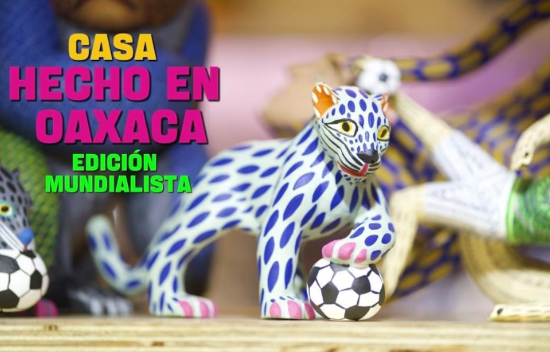
Among them is Roque Manuel Jiménez, a leather artisan from San Antonio Arrazola and a third-generation member of a family that has been pioneering wood carving since 1927. For the World Cup, he created unique pieces featuring coyotes performing chilenazos and jaguars playing soccer, blending Oaxacan mystical imagery with a passion for football in a way rarely seen anywhere else in the world.
Other participants include:
- Virginia Orozco, a chocolate artisan working with Oaxacan cacao in various forms, from traditional chocolate tablets to bars containing 80% cacao.
- Flor García Mendoza, who weaves palm-fiber handbags using techniques passed down through generations.
- José Alberto Martínez, a master papier-mâché artisan.
- Fernando Cruz, a pottery artisan.
- Juan Manuel García Tamayo, a bamboo craftsman.
- José Antonio Andrade, a textile specialist.
- Alberto Pérez Alcántara, a producer of Oaxacan distilled spirits.
They are joined by producers of craft beer, mead, mezcal, specialty coffee, and a representative of traditional medicine.
Each participant holds an artisan credential and Hecho en Oaxaca certification, guaranteeing the authenticity and origin of every piece and product. Behind each creator are communities, families, and trades that have been passed down through generations and now form part of Mexico’s living heritage.
Products That Showcase Oaxaca’s Diversity
Visitors can discover everything from regionally sourced coffees to chocolates made with Oaxacan cacao, artisanal honey, traditional mole sauces, gourmet salsas, fermented beverages, amaranth products, agave-derived goods, handcrafted cosmetics, and a wide selection of mezcals produced by small family-owned distilleries.
The product catalog is remarkably diverse and includes:
- Powdered mole sauces
- Gourmet salsa macha varieties, including versions made with chapulines and tabiche
- Frozen tamales
- Nixtamalized corn tostadas
- Freeze-dried mango and banana snacks
- Whole-grain chickpea and black bean flours
- Amaranth products in multiple presentations
- Artisanal chocolates with varying cacao percentages
- Organic specialty coffee
- Kombucha
- Pure honey
- Agave syrup
- Handmade cosmetics based on nopal cactus and calendula
- Artisanal mezcals produced from agaves such as espadín, tobalá, cuishe, tepeztate, and arroqueño
Oaxaca on the World Stage During the World Cup
The initiative takes on special significance within the context of the World Cup. As thousands of fans travel throughout Mexico to follow the world’s most important football tournament, Oaxaca presents itself as an essential destination for those who wish to experience Mexico’s cultural diversity beyond the stadiums.
Oaxaca is home to 16 Indigenous peoples, preserves some of the country’s most celebrated artisanal traditions, and is internationally recognized for its gastronomy, archaeological sites, community traditions, mezcal routes, beaches, and one of Latin America’s most dynamic cultural scenes.
From the black pottery of San Bartolo Coyotepec to the alebrijes of the Central Valleys; from stone-ground chocolate to textiles woven on backstrap looms, the state brings together cultural expressions that have crossed borders and now form part of Mexico’s image around the world.
Orgullo Oaxaca Initiative
The initiative is part of Orgullo Oaxaca, promoted by the Oaxaca State Government’s Secretariat of Economic Development. Its objective is to strengthen the visibility of certified producers, artisans, and entrepreneurs while expanding commercial opportunities for their products in national and international markets.
A Promotional Network Connecting Oaxaca with the World: Guadalajara Also Celebrates Oaxaca
Oaxaca’s presence during the 2026 World Cup extends beyond Mexico City.
The initiative also has a venue at the historic Museo Cabañas in Guadalajara, a UNESCO World Heritage Site located in another of the tournament’s host cities. There, both national and international visitors can experience the state’s cultural and productive richness.
This venue will remain open until August 3, from 10:00 a.m. to 7:00 p.m.
In addition, various activities are being carried out throughout Oaxaca, creating a network that connects producers with national and international markets while bringing the state’s culture, creativity, gastronomy, and tourism offerings closer to those visiting Mexico during one of the world’s most significant events.
During the 2026 World Cup, Oaxaca is not only welcoming visitors—it is sharing with the world the talent, creativity, and identity of the people who help make Mexico great every day.
Source: cronica