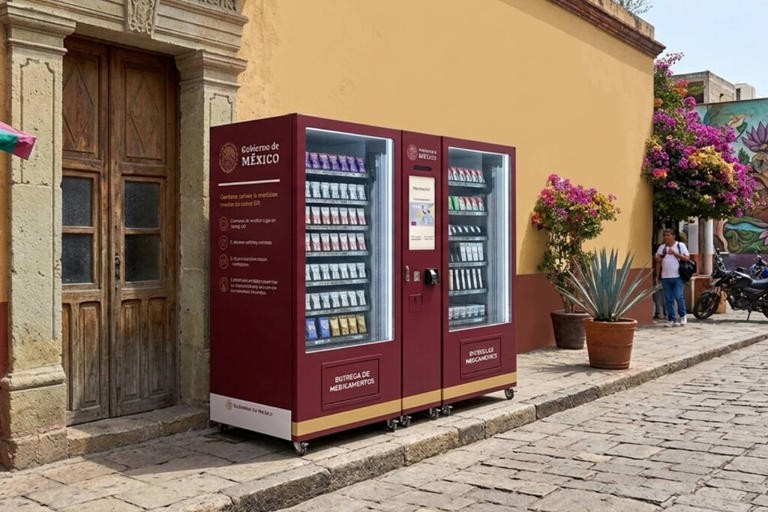

The Mexican government is preparing a new strategy to distribute free medications nationwide. The aim is to allow people to pick up their medicines close to home—whether from automated dispensers in cities or through “Food for Well-being” stores in rural communities. All of this will form part of the Salud Casa por Casa (Health, House by House) program and the future Universal Health Service, which is set to launch in 2027.
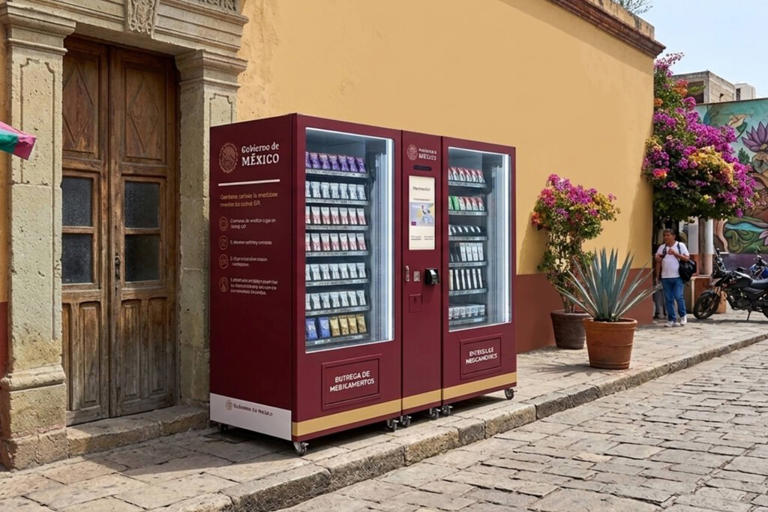
During President Claudia Sheinbaum’s morning press conference, Eduardo Clark, Undersecretary for Sectoral Integration and Coordination of Healthcare Services, explained that automated dispensing machines will be available in urban areas, offering medications for 22 different conditions. These will include treatments for minor ailments—such as the flu or diarrhea—as well as maintenance medications for conditions like hypertension or diabetes.
As Clark explained during the conference, individuals will need to scan a QR code, enter an additional verification code, and provide an email address to select and retrieve their medication free of charge. Additionally, the government plans to launch a mobile app to help users locate the nearest dispenser.
This initiative is linked to the Salud Casa por Casa program, one of the current administration’s flagship projects. This scheme involves home-based medical visits for older adults and people with disabilities. According to official data from the Programas para el Bienestar (Well-being Programs) office, nearly 20,000 nurses and physicians are currently participating in the program, conducting periodic check-ups and providing clinical follow-up care directly in patients’ homes.
During the presidential press conference, Sheinbaum confirmed that the individuals receiving these home visits will now begin receiving their medical prescriptions directly at their residences.
“I pledged that, during these visits, they would receive their prescriptions so they could go pick up their medication. That process is now set to begin nationwide.”
The Goal: A Universal Health System
The automated dispensers are part of a broader initiative: the Universal Health Service. The federal administration aims to ensure that anyone can receive medical care at public hospitals and clinics, regardless of whether they are affiliated with the IMSS, ISSSTE, or IMSS-Bienestar systems.
The President also announced that the government is currently in the process of issuing identification credentials to older adults. With this credential, she stated, individuals will be able to visit any health center or hospital, regardless of their original institution.
This strategy is not new. As early as April 2026, Sheinbaum had announced the creation of the Universal Health Service—a system designed to enable the sharing of digital medical records among public institutions. The goal is to have a single credential—valid across the IMSS, ISSSTE, and IMSS-Bienestar networks—in place by 2027.
At Xataka México, we reported that the government was planning to establish a National Health Registry and a unified medical record system to integrate the clinical data of all Mexicans. The objective is to enable hospitals and clinics to share digital medical histories, thereby facilitating patient care at any public institution.
For rural areas, there will be no automated dispensers. In these instances, the government will utilize “Alimentación para el Bienestar” (Food for Well-being) stores as medication distribution points. As Clark explained, there are approximately 5,500 such establishments distributed throughout the country—many of which are located closer to residents than the nearest hospitals or health centers.
The aim is to reduce travel burdens for older adults and people with disabilities, particularly in remote communities where reaching a hospital can take several hours.
The strategy also seeks to alleviate one of the most persistent issues plaguing the Mexican healthcare system: medication shortages. We previously reported that the federal government affirmed it conducts weekly reviews of tenders, procurement, and the distribution of medical supplies in an effort to improve supply levels within public institutions.
Source: msn