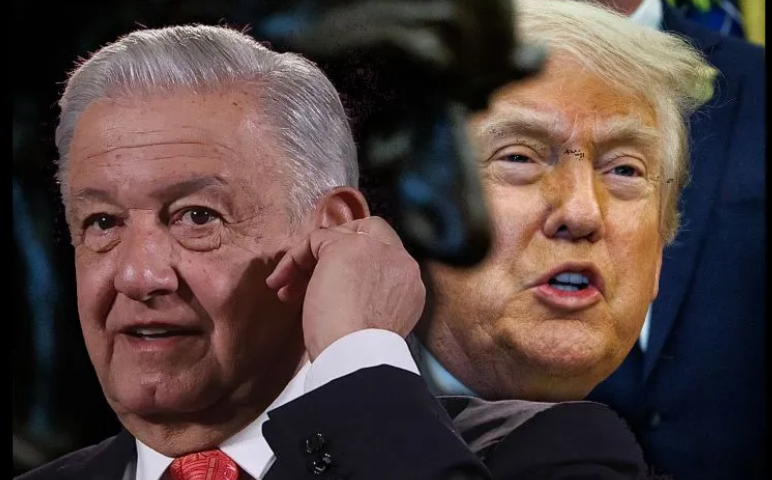

Experts deemed the letter from former President Andrés Manuel López Obrador regarding the security policy of the U.S. government—led by Donald Trump—to be ill-advised. On one hand, they note that it reveals the former leader’s fear regarding investigations launched against Morena politicians; on the other, they point out that it places President Sheinbaum in a dilemma—forced to choose between “heeding Tabasco or Washington”—amidst pressure from both political figures.
López Obrador’s letter accuses President Donald Trump of aligning himself with far-right figures during this second term—individuals intent on “harming Morena,” the party he founded. He released the letter publicly on the very same day that U.S. Senator Markwayne Mullin expressed being “impressed” by the Mexican government’s cooperation on security matters.
“I just returned from Mexico City, where I spoke with President Sheinbaum and her cabinet about cooperation, and I can tell you we have been impressed by how cooperative they have been—far more cooperative than the previous administration,” that of Andrés Manuel López Obrador, Mullin noted.
Leonardo Curzio, a journalist specializing in international affairs and a political analyst, stated that the letter reveals “a frightened López Obrador,” fearful that the investigations launched by the United States against Mexican politicians could implicate him and his children.
“What Obrador is doing is clearing the ball out of the penalty area and back to midfield; in other words, we are about to get bogged down in a massive political dispute. He is once again raising the issue of interference—claiming the U.S. has a plan to influence the Mexican electoral process—which poisons the chances for better relations.
“We are seeing a frightened López Obrador.” “I believe that moving his son out of the Organization Secretariat and into a candidacy is about securing him legal immunity, because they feel the investigations could implicate them,” said Curzio.
Pía Taracena, a researcher and lecturer on international affairs at the Universidad Iberoamericana, dismissed the idea that the letter would be taken seriously by President Donald Trump’s administration, but she highlighted its “paternalistic and even misogynistic” tone toward President Claudia Sheinbaum.
“I do consider it a highly paternalistic letter, and I would venture to say it also carries a certain misogynistic and chauvinistic undertone—the sentiment being: ‘I have to step in and shield you because you aren’t doing things right.’ He practically stopped just short of saying, ‘It was thanks to me being there that things were more lenient toward Mexico.’ But that isn’t true, either.
“I don’t think they’ll attach much importance to it because, ultimately, it’s clear that the teams are working together; that’s why Mullin’s statement was so significant—acknowledging that Mexico is willing to cooperate but, above all, is fiercely protective of its sovereignty and that this must be respected,” the international relations expert stated.
According to Luis Leal, an international relations specialist at the University of Copenhagen and the Universidad de las Américas Puebla, López Obrador’s letter is actually aimed at a domestic audience: the activists within his movement and the Mexicans who voted for Morena.
“The letter will have its greatest impact here at home; obviously, it won’t have much effect in the United States. Rather, it is a call—a warning—from the former president to the Mexican people regarding two things: first, to remain united; and second, not to lose faith in his movement,” Leal observed.
Omar Loera, an international relations specialist and professor at the Center for Research and Teaching in Economics (CIDE), asserted that while the Mexican government gains an advantage in the short term with this letter, it could lose out over time, even though the move strengthens its negotiating position vis-à-vis Washington.
Source: informador