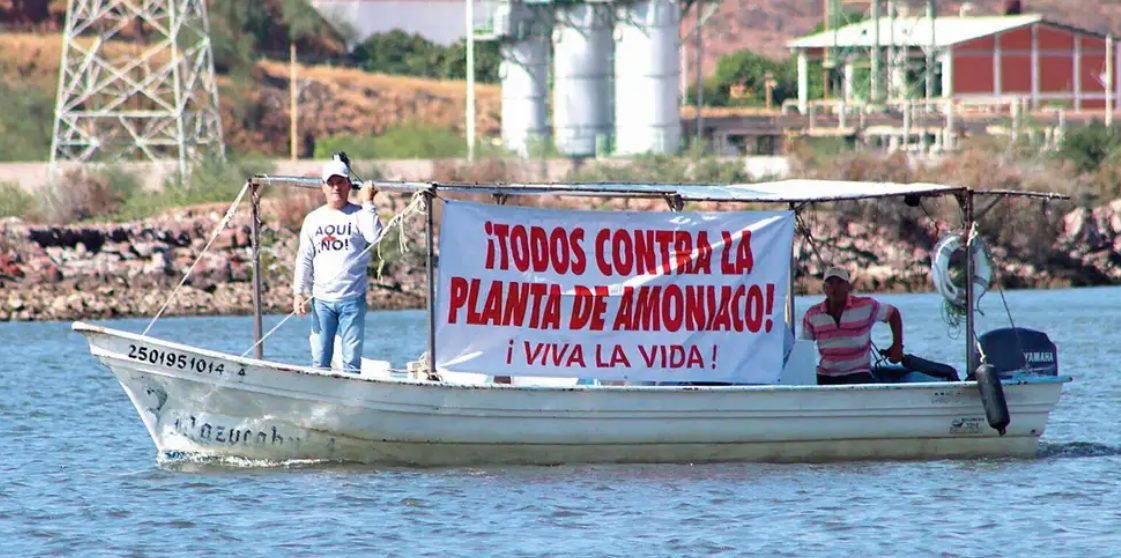

A Swiss-German consortium is building one of the world’s largest ammonia plants in Sinaloa with financing from the German public bank KfW. Indigenous communities, scientists, and the United Nations have raised serious objections.
On the night of June 4, the white wall surrounding the German Embassy in Mexico City was covered with protest graffiti, excrement, and even a swastika. The disturbing scene was condemned by the embassy on social media, calling the act unacceptable. The source of the anger lies nearly 1,500 kilometers away, in a bay in northern Mexico that until recently was known mainly for its migratory birds and the calm waters where dolphins taught their young how to hunt: Ohuira Bay, in the port of Topolobampo, Sinaloa.
There, the Swiss company Proman, through its Mexican subsidiary Gas y Petroquímica de Occidente (GPO), is constructing one of the largest ammonia plants in the world, with the capacity to produce 2,200 metric tons per day, primarily for chemical fertilizer production. The project has financial backing from the German public bank KfW IPEX-Bank, part of a consortium that has contributed approximately $860 million.
What initially appeared to be an agricultural-industrial project intended to benefit Mexican farmers has, in recent weeks, become one of the most significant socio-environmental conflicts of President Claudia Sheinbaum’s administration. The controversy has generated mass demonstrations, a permanent blockade of the construction site, more than 135,000 signatures opposing the project, and warning letters sent by nine United Nations special rapporteurs to the governments of Mexico, Germany, and Switzerland.
The night of the embassy protest, around one hundred people—including Mayo-Yoreme Indigenous community members, environmental groups, and young activists—gathered outside the German Embassy chanting, “Topolobampo is not for sale, the sea must be defended!” and “Not Here!” The demonstration was intentionally scheduled during the visit of German Foreign Minister Johann Wadephul to increase diplomatic pressure.
The Traditional Governor: Sacred Territory and Unwavering Resistance
Felipe Montaño Valenzuela, the traditional governor of Ohuira and highest authority of the Mayo-Yoreme community in the bay, speaks with the calm rhythm of someone accustomed to making his words last.
“All of this is because of the many irregularities surrounding this company and this project,” he says. “It was established inside a Ramsar site and on sacred Indigenous territory. They obtained fraudulent land ownership documents.”
According to his estimates, approximately 6,000 Indigenous people living in nearby communities could be affected by the project.
A Ramsar site is a wetland of international importance protected under an international convention signed by Mexico. For Montaño, building a massive industrial plant within such a protected area represents the first of many illegal actions associated with the project, which began in 2014 under a previous federal administration.
The second issue, and the one that angers him most, concerns the Indigenous consultation process.
“First, they did not carry out a prior consultation. Then, when the Supreme Court required one, they conducted a fraudulent consultation in 2024,” he explains.
According to Montaño, the consultation included communities located as far as 45 kilometers away, many of whom would not be directly affected by the project.
“They handed out food, money, bought support, and took advantage of the fact that many people were not informed and do not even live in the bay area.”
As a result, the four communities closest to the project voted against it, while eight more distant communities voted in favor.
The accusation is significant because the right to free, prior, and informed consent (FPIC) is recognized under international law through Convention 169 of the International Labour Organization (ILO), which Mexico has ratified.
Montaño argues that traditional fishing areas have already become inaccessible.
“We can no longer approach the shoreline that was our traditional shrimp and crab fishing area.”
He describes how construction has transformed the landscape.
“Twenty-eight hectares of wetlands have already been filled in. Mangroves have been cut down. Birds that used to nest and feed there are now appearing in nearby communities or have simply left.”
He believes authorities have sacrificed Indigenous communities for corporate profits.
“Construction continues because the law here is interpreted in favor of whoever brings the most money.”
On June 7, thousands of people marched 24 kilometers from Los Mochis to Topolobampo and symbolically shut down the facilities.
“The Indigenous peoples have agreed that we will not take a single step backward. Even if one of us loses their life, we will continue defending our territory and our sacred seas.”
The Biologist: The Destruction of the Dolphins’ Nursery
Diana Escobedo, a researcher at the National Polytechnic Institute (IPN), has studied Ohuira Bay for three decades.
Ironically, ten years ago she was hired by the company itself to prepare an environmental assessment. What she found turned her into one of the most prominent critics of the project.
“It is illegal because it is located within the Ramsar area and within the federal maritime zone,” Escobedo says. “Under Mexican law, they should have a special permit. They do not have one.”
According to Escobedo, the central technical issue involves water use.
“They will extract 2,000 cubic meters of seawater every hour without exclusion systems in an area with high concentrations of fish, shrimp, crab, and oyster larvae.”
She believes the consequences for fishing communities could be severe.
When she attempted to publicize these findings, she says the company sought to prevent the information from being released. Escobedo also reports receiving threats, as have Indigenous leaders and activists opposing the project.
The bay itself is shallow, averaging only two meters in depth, and water remains in the system for approximately thirty days.
“Any contaminant stays there for a long time.”
After using seawater for cooling processes, the plant would discharge it back into the bay at higher temperatures and increased salinity.
“The increase in temperature and salinity is something marine organisms cannot easily adapt to.”
The area is also home to a resident dolphin population that has inhabited the bay for more than twenty years.
“The mothers bring their calves here to feed and teach them how to hunt during the tides. They will lose their habitat because of ecosystem changes, increased noise, and shipping activity.”
Escobedo also highlights safety concerns identified in the project’s own hazard and operability analysis (HAZOP).
The study outlines eight scenarios that could potentially cause ammonia leaks due to corrosion, operational accidents, sabotage, or pipeline deterioration. In each scenario, the consequence could be an explosion accompanied by the release of a toxic cloud.
According to Escobedo, nearby hills could prevent the gas from dispersing, increasing the danger to nearby populated areas.
“How is it possible that KfW agreed to finance a project with this level of risk?” she asks.
The Company: All Permits Obtained, All Lawsuits Won
The company, which reports that construction is 88% complete, has repeatedly defended the project, stating that it possesses all required national and international environmental and social permits and relies on four decades of global experience.
When large absorption towers arrived at the port and images spread widely online, the company explained that the equipment is intended to capture carbon dioxide under environmental standards aligned with international best practices.
In a written response, KfW IPEX-Bank stated that all legal proceedings have been resolved in favor of the project.
For Felipe Montaño, however, legal victories do not necessarily mean justice.
“We are not interested in legal formalities. The law is not on the side of Indigenous peoples. It is a colonial legal system.”
Concerns about the consultation process extend beyond local communities.
In September 2025, nine United Nations special rapporteurs—including experts on Indigenous rights, environmental protection, housing, and human rights defenders—sent formal communications to the Mexican government, GPO-Proman, KfW IPEX-Bank, and the governments of Germany and Switzerland expressing concern about reported rights violations and alleged harassment of activists.
KfW rejected the conclusions of the UN report, stating that after a thorough review, it found no serious procedural violations and concluded that financing complies with applicable national and international laws and standards.
However, the bank acknowledged that it has commissioned a new independent review of the consultation process as a precautionary measure.
The German Embassy stated that German companies are required to comply with environmental and social standards abroad but emphasized that responsibility for evaluating compliance ultimately rests with Mexican authorities.
A Government Caught Between Contradictions
Ignacio Martínez Cortés, a researcher at the National Autonomous University of Mexico (UNAM), views the controversy as a complex political dilemma.
“Mexico is a net importer of fertilizers. This plant could significantly reduce imports and lower agricultural production costs,” he explains.
Sinaloa, often referred to as Mexico’s breadbasket, plays a crucial role in national agriculture. The location near the Port of Topolobampo would also facilitate maritime distribution to other regions.
At the same time, Martínez notes substantial political costs.
“The social and environmental impact could be enormous, affecting communities that are traditionally aligned with the ruling party.”
Questions regarding corruption allegations and links involving former state officials further complicate the situation.
The project originated more than a decade ago under previous administrations.
“We do not know under what conditions the permits and benefits were originally granted,” Martínez says. “The entire process should be reviewed to eliminate doubts about possible corruption.”
He compares the situation to other major projects halted due to environmental concerns.
“This plant faces similar issues, and the same standards should be applied.”
Possible Alternatives
According to Martínez, canceling the project could expose Mexico to international arbitration claims under foreign investment treaties, potentially resulting in demands for billions of dollars in compensation.
However, he notes that if evidence emerged showing that permits or contracts were obtained through corruption or fraudulent land titles, those agreements might not be protected under international investment rules.
Biologist Diana Escobedo believes another solution exists.
“No one is opposed to the plant itself. The problem is the location.”
She argues that the project could be relocated to a less environmentally sensitive area.
According to Escobedo, relocation has been proposed to the company, but the response has been negative.
“They say it is cheaper here because they do not need to build a dock, the highway already exists, there is rail access, and there is a nearby city where workers can live.”
The conflict over Ohuira Bay has potential solutions. Scientists have identified them. Policymakers could pursue them. Legal mechanisms could support them.
What remains uncertain is whether the Mexican government and GPO-Proman will seek those alternatives—or continue advancing a project opposed by communities that insist they will not back down.
Source: dw