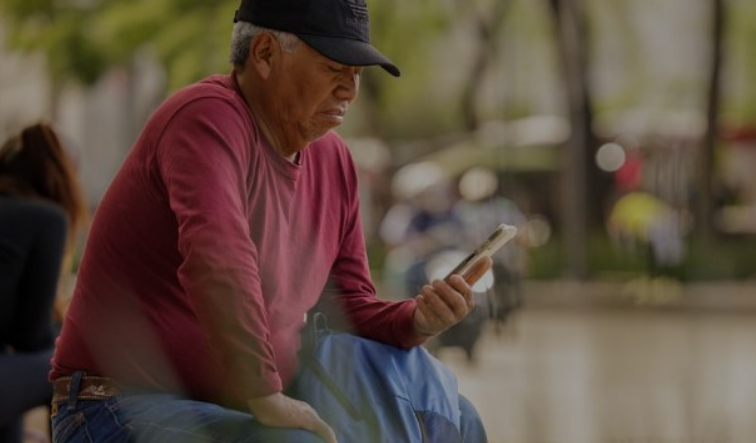

As the risks associated with the use of Artificial Intelligence (AI) for creating false or fraudulent content continue to grow, and as internet users increasingly rely on digital services, the creation of an official digital identity has become a crucial step in protecting citizens’ information. In response to this urgency, the registration of mobile phone lines is emerging as a unique opportunity to finally advance the development of a reliable and secure identity document.
“What Mexico is doing this year with mobile line verification is on a scale rarely seen elsewhere in the world,” said Jordi Torres, Managing Director of Veridas Latin America, in an interview with DPL News. For the biometric technology company, mandatory registration should not be viewed as government overreach or a data theft risk, but rather as an essential shield against crimes such as extortion and identity theft.
One of the main cultural barriers to the mass adoption of these registration systems is public fear of database breaches or even permanent government surveillance. It is worth remembering that this would be the Mexican government’s third attempt to create a database of mobile users. The previous two efforts were plagued by irregularities, poor planning, and even reports of data leaks, which ultimately fueled public distrust and led to a constitutional challenge before the Supreme Court of Justice of the Nation (SCJN).
In this new attempt, Torres is confident that modern technologies and encryption techniques can provide significantly higher levels of security and the trust demanded by users.
The registration deadline is June 31. As of May 28, it was estimated that only 35% of users had completed the process despite campaigns by mobile operators and the Mexican government. Some providers, such as Movistar, have launched incentive programs offering additional gigabytes of data or free access to services such as YouTube.
Technology Against Fraud
According to Torres, the greatest fraud risk no longer comes from traditional one-to-one identity theft but from injection attacks and automated deepfakes generated by algorithms. However, he insists that the best defense against technology is technology itself.
“Even though deepfakes exist, AI does not fool AI. AI is capable of detecting when a video or image is fake,” he said.
Furthermore, modern identity verification techniques ensure that personal information always remains under the user’s control and that “personal data does not travel anywhere,” guaranteeing a process that is secure by design.
When a user activates a mobile line, they capture an image of their official identification document (such as a voter ID card or passport) and take a selfie to prove they are a real person holding the document. The technical process operates under strict security measures:
- No images in transit: When verifying information with the National Electoral Institute (INE) as a second validation factor, neither the user’s face photo nor the ID image is transmitted.
- Encrypted alphanumeric codes: Only the INE identification code (SIC) and a biometric vector are transmitted. This vector does not contain reversible physical characteristics such as nose size or eye color.
- Revocable biometric references: The system calculates how a user’s face compares to a statistical average of millions of faces. If the code is lost or stolen, it is useless to third parties because it does not define the person’s face, can only be interpreted by the original system, and can be completely revoked and regenerated.
Under this principle, requiring every mobile SIM card to be linked to a real, verified biometric identity dramatically raises barriers against criminal activity. In theory, a system based on unique physical traits that cannot be stolen would prevent the creation of synthetic or anonymous identities used for illegal purposes.
A Step Toward a National Digital Identity
Compared to other Latin American countries, Mexico is positioned with a competitive and institutional advantage. While Brazil relies largely on standalone facial recognition systems and Colombia uses digital credentials with lower levels of reliability, Mexico’s mobile registration initiative could serve as the foundation for a comprehensive national identity document, according to Torres.
“If we can achieve this, we will have real-world proof that, as a country, we are capable of creating an identity document that everyone must have and that exists in both physical and digital formats,” he said.
He also highlighted the importance of extending secure identification systems to individuals under 18 years of age.
The Mobile Device as an Identity Document
Mobile devices are no longer simply containers of identity but have become secure verification channels thanks to metadata such as camera usage, location, and routing information. This robustness is enabling sectors such as banking to migrate transactions directly into mass messaging platforms like WhatsApp, which serves approximately 70% of Mexico’s population.
Beginning this year, Meta integrated webview functionality into its major applications, allowing developers to open webpages without requiring users to leave the app. This feature enables new use cases such as displaying medical appointment calendars, event seating maps, or airline travel preferences.
For Veridas, the ability to access contextual information and metadata makes this a reliable tool for identity verification.
The company explained that the feature enables secure data capture during authentication processes because the entire verification workflow—including web pages, camera access, and biometric sensors—can be executed within the same application and session. This makes native facial biometric verification possible without requiring users to switch apps.
Reducing Friction and Expanding Digital Banking
The functionality also helps maintain user engagement and attention. According to Veridas, requiring customers to download an external application for authentication resulted in a 75% drop in conversion rates due to distrust or inconvenience.
By integrating secure webview technology directly into Meta applications such as Facebook, Instagram, and WhatsApp, users no longer need to leave the platform, increasing conversion rates by as much as 85%.
Torres highlighted the opportunity this creates for traditional banking institutions. With a secure channel and verified user identity, platforms such as WhatsApp could potentially be used for routine financial transactions.
“This level of interaction and the use of WhatsApp to transform traditional banking into conversational banking is only possible if we can run identification and authentication processes that verify who is actually ordering that bank transfer,” he concluded.
Source: dplnews