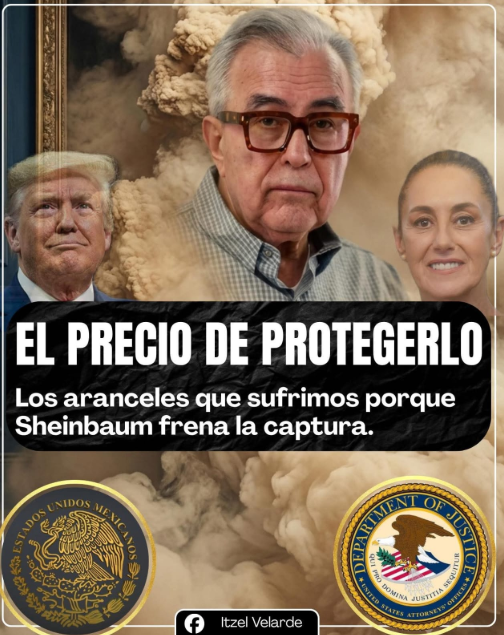

Is it fair for your household economy to suffer the consequences of the political decisions of a few? While those in power debate sovereignty, ordinary citizens are the ones who end up paying the real price through an unprecedented level of commercial pressure. The White House has activated a strategy of direct economic coercion against our country over the alleged lack of judicial action within Mexico.
Understand How This Conflict Affects Us All
1. Tariffs as a Geopolitical Bargaining Tool
For the Donald Trump administration, 25% or 30% tariffs are not an end in themselves but a tool of coercion. Every time the White House perceives inaction or resistance from the Mexican government regarding border security, it uses the threat of economic pressure to force unilateral concessions.
This increases the cost of basic goods, generates inflation, and puts thousands of Mexican jobs at risk.
2. The Direct Link to the Rubén Rocha Moya Case
The stalled extradition of former Sinaloa governor Rubén Rocha Moya is presented as a key piece on Washington’s strategic board.
According to the text, the U.S. argument is straightforward: Donald Trump has publicly maintained that drug cartels and politicians linked to organized crime in Mexico operate within the same structure. After the 60-day period expired without Mexico executing the arrest warrant against Rocha Moya—citing a “lack of physical evidence”—Washington is said to be using tariffs as direct punishment for what it considers a lack of judicial cooperation.
The U.S. message, according to the text, is clear:
“There can be no free trade without cooperation on security.”
3. The Prelude to the USMCA Review
The imposition of tariffs and trade measures under special investigations (such as Section 301 or Section 232) coincides with the formal review process of the United States-Mexico-Canada Agreement (USMCA).
By linking trade to the fentanyl crisis and alleged political impunity, the White House is described as entering the negotiations from a position of strength, seeking to pressure Mexico into strengthening its criminal policies and surrendering officials sought by U.S. federal courts.
4. Exemptions as an Incentive
The strategic purpose is further illustrated by the exemptions. According to the text, the Office of the United States Trade Representative (USTR) generally specifies that the percentage of Mexican goods fully complying with rules of origin and demonstrating clean supply chains—free from organized crime involvement or forced labor—remain exempt from the tariffs.
According to the text, this approach segments the pressure by targeting government finances and vulnerable sectors in an effort to compel the administration of Claudia Sheinbaum to surrender internationally wanted fugitives.
THE DEADLINE HAS EXPIRED: WASHINGTON PREPARES UNILATERAL ACTIONS
The scenario of maximum diplomatic and legal tension has erupted. According to the text, after the expiration of the critical 60-day period established under Article 11 of the Bilateral Extradition Treaty, U.S. agencies have adopted an uncompromising position regarding the case of former Sinaloa governor Rubén Rocha Moya and other senior state officials.
The text claims that, because the provisional arrest warrants requested from the Mexican government were not carried out, the U.S. Department of Justice will proceed unilaterally by formally declaring those involved to be “fugitives from U.S. justice.”
What Would This Declaration Mean for Those Involved?
According to the text, designation as a “federal fugitive” by U.S. courts would activate an international enforcement protocol that includes:
- Immediate Financial Isolation: A total and irreversible restriction on operating within the international banking network through the SWIFT system. No formal financial institution would be able to provide services without facing severe penalties from the U.S. Treasury.
- Asset Seizure: The immediate freezing, confiscation, and liquidation of any assets, property, or financial resources located abroad.
- Reward Program Activation: According to the text, U.S. sources indicate a high probability that the Department of Justice will offer multimillion-dollar rewards for information leading to the individuals’ exact whereabouts.
The text concludes by asking:
- Do you believe it is fair for the entire population to bear the economic consequences of tariffs because the government refuses to surrender the requested officials?
- Is this a defense of national sovereignty, or political protection?
Participate respectfully and share this update. Let’s stay informed.
Source: mexicodailypost