
Mexican President Claudia Sheinbaum, along with the Tamaulipas state government, accused The New York Times on Monday of lying in its Saturday article alleging that at least ten politicians from the Morena party, including governors and legislators, had become informants for the United States against other members of the ruling party. They join Alfonso Durazo, governor of Sonora, who sent a letter to the American newspaper on Saturday demanding a retraction. According to the report, both Durazo and Américo Villarreal Anaya, his counterpart in Tamaulipas, are the primary targets. This information was published two months after the United States requested Mexico arrest the governor of Sinaloa, Rubén Rocha Moya, for alleged ties to a cartel.
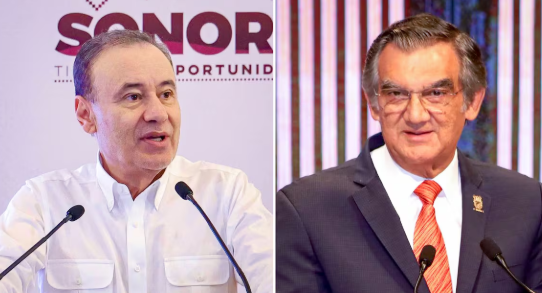
“How can there be a story like this in a newspaper? I was told that someone said there are people from Morena who are providing information,” Sheinbaum criticized during her Monday press conference. The governor asserted that her administration has no information on the matter. The Tamaulipas government also published a statement in a national newspaper with a similar message. “The governor categorically, absolutely, and emphatically denies the allegations made public; there is no accusation or legal proceeding to support them,” the statement reads. In his letter, Durazo argues that “the decision to publish assertions as fact without providing a single piece of verifiable evidence carries a high degree of speculation” and asks the newspaper to correct the information.
The statement was published this past weekend and is signed by the head of his office in Mexico, one of his reporters specializing in crime and justice, and an independent contributor. The article claims, citing “a dozen people” who spoke on condition of anonymity, that “at least a dozen elected officials in Mexico—including governors and members of Congress—have been in contact to discuss sharing information about other politicians.” According to the American newspaper, these officials “are trying to get ahead of investigations they fear may soon focus on them.” The article alleges that it is U.S. authorities who are approaching Mexican politicians.
The publication focuses on two specific targets: the Morena governors of Sonora and Tamaulipas, Durazo and Villarreal, “according to five people familiar with the investigations who were not authorized to speak publicly.” In the case of Villarreal, governor of the border state of Tamaulipas, there are several allegations that supposedly link him to organized crime, including the book Neither Revenge nor Forgiveness, a Friendship on the Edge of Power, a kind of political memoir by Julio Scherer Ibarra, who was legal counsel to former President Andrés Manuel López Obrador. According to this According to the text, his campaigns were financed by Sergio Carmona, a businessman nicknamed “The King of Huachicol” (fuel theft), who was murdered by a hitman in late 2021.
This week marks two months since a New York judge requested the Mexican government to arrest Rocha Moya and nine of his associates in the Sinaloa state government for extradition purposes due to their ties to the Sinaloa Cartel. There is some disagreement as to whether the Mexican government had 60 days as the maximum deadline to respond to the U.S. justice system or if this deadline does not apply in this case. This accusation was made public after the deaths of two U.S. agents during an operation on Mexican soil, something prohibited by U.S. law. Two of the accused have already surrendered to the United States, presumably to cooperate by providing information in exchange for more lenient sentences.
Source: elpais