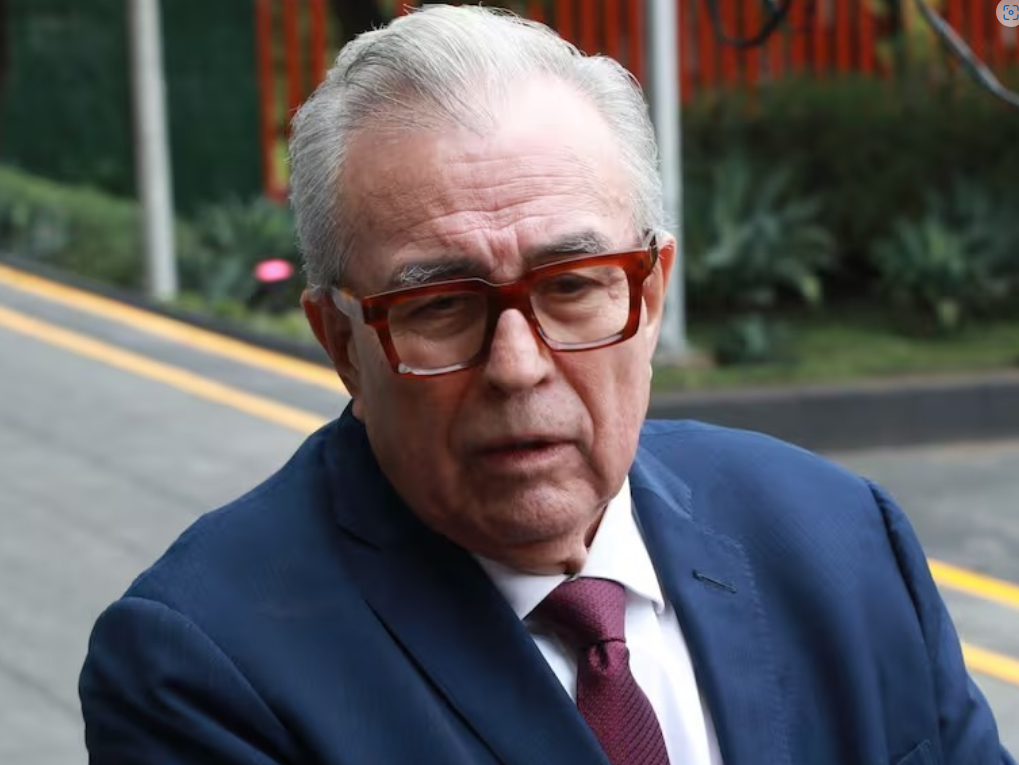

New reports claim that Sinaloa Governor on leave Rubén Rocha Moya has been detained and is no longer in the state of Sinaloa. According to these versions, he has allegedly been transferred to a temporary detention facility in Mexico, where he would remain in custody before a possible handover to U.S. authorities.
The information, based on investigative reporting, alleges that Rocha Moya is under custody and could be transferred within the coming hours or days to the U.S. Marshals Service, the agency responsible for executing federal court orders in the United States.
These reports emerge amid increasing pressure surrounding the U.S. government’s request for his arrest for extradition purposes. Various reports indicate that more than two months have passed since the extradition request became public without Mexican authorities carrying out an arrest, raising questions about the progress of the legal process.
Rocha Moya is under investigation in the United States for alleged ties to “Los Chapitos,” a faction of the Sinaloa Cartel. According to U.S. prosecutors, the former governor allegedly accepted bribes, provided institutional protection to members of the criminal organization, and facilitated drug trafficking operations into the United States.
As the investigation continues, authorities have also reportedly made progress in cases involving individuals close to his administration. In recent days, reports emerged that a former Secretary of Finance from his government was arrested in Europe and is also under investigation for alleged financial irregularities.
In the political arena, lawmakers from the National Action Party (PAN) have demanded Rocha Moya’s immediate arrest, his extradition to the United States, the initiation of impeachment proceedings, and the dissolution of state powers in Sinaloa, arguing that evidence points to possible infiltration of organized crime into state institutions.
For its part, the Mexican government has previously stated that the request for arrest for extradition purposes falls under the jurisdiction of the Mexican Judiciary.
So far, neither the Office of the Attorney General of Mexico (FGR), the U.S. Department of Justice, nor the U.S. Marshals Service has officially confirmed the alleged transfer of the former governor or provided a date for any possible handover. Therefore, these reports remain unconfirmed by official authorities.
BACKGROUND
Rubén Rocha Moya, Governor of the state of Sinaloa, has become the focus of a major judicial case in the United States. The U.S. Attorney’s Office for the Southern District of New York has filed a criminal indictment identifying the governor as a key figure in the protection and logistical network of the Sinaloa Cartel. According to the court filing, Rocha Moya allegedly used his position to allow the criminal organization to traffic large quantities of narcotics into the United States, effectively turning state institutions into operational facilitators of drug trafficking.
The indictment, assigned to Judge Katherine Polk Failla, alleges that the governor’s cooperation was not an isolated incident but rather part of a systematic strategy. Federal investigators claim that under Rocha Moya’s administration, immunity channels were established that enabled the unrestricted movement of drug shipments and strengthened the cartel’s operational infrastructure throughout the region. As a result, he faces charges related to conspiracy to distribute controlled substances and other associated offenses.
The indictment also includes several members of his administration and security leadership, in what the Drug Enforcement Administration (DEA) has described as an alleged “institutional capture” by organized crime. Among those named are Enrique Inzunza Cázarez and Gerardo Mérida Sánchez, who allegedly acted under directives from the state administration to protect the cartel’s interests. According to prosecutors, this command structure helped Sinaloa remain the primary hub for exporting synthetic drugs to the United States.
The seriousness of the case increases with allegations involving extreme violence linked to Rocha Moya’s alleged criminal network. The indictment states that subordinates, including Juan Valenzuela Millán, also known as “Juanito,” participated in the kidnapping and murder of a DEA informant and one of the informant’s relatives. U.S. authorities argue that these acts were made possible by the operational impunity allegedly provided by the state administration to cartel gunmen and financial operators.
This legal proceeding represents a significant development in U.S.-Mexico security relations, as it directly targets a sitting governor. Others named in connection with Rocha Moya’s administration include Enrique Díaz Vega, Dámaso Castro Zaavedra, and Juan de Dios Gámez Mendívil, among others. According to U.S. authorities, the objective is to dismantle not only the armed wing of drug trafficking organizations but also the alleged political structure that protected their activities.
VOLUNTARY APPEARANCE BEFORE THE FGR
Rubén Rocha Moya previously announced that he voluntarily appeared before the local office of the Office of the Attorney General of Mexico (FGR) in Culiacán to formally respond to the allegations made against him abroad.
His appearance followed charges announced on April 29 by the U.S. Department of Justice, which accuses the Sinaloa politician of maintaining alleged illicit agreements with “Los Chapitos,” a faction of the Sinaloa Cartel.
In a statement posted on social media, Rocha Moya said he fully answered all questions asked by the Federal Public Prosecutor and reaffirmed his willingness to cooperate with any future requests made by investigating authorities.
The governor on leave also expressed confidence in Mexico’s judicial system and the rule of law. In his statement, he argued that the Fourth Transformation movement had strengthened and legitimized the country’s justice institutions through major reforms.
Rocha Moya concluded by stating that he would continue seeking the truth while supporting President Claudia Sheinbaum’s leadership and defending Mexico’s national sovereignty against external accusations.
INTERPOL RED NOTICE
Rubén Rocha Moya is reportedly the subject of an INTERPOL Red Notice, issued as a result of the accusations filed against him in the United States for alleged ties to drug trafficking.
According to the reports, the international notice was activated after U.S. authorities issued legal requests that triggered international search and possible detention mechanisms.
The reported Red Notice would allow Rocha Moya to be detained if he were to leave Mexico and be located by law enforcement authorities in another country.
According to the information provided, the governor on leave currently remains in Sinaloa while investigations continue. The case has attracted significant political and public attention due to the international scope of the allegations and Rocha Moya’s prominence in Mexican politics.
Source: solyucatan