

Between 2016 and 2023, Mexico experienced a rapid transition from the use of semi-synthetic drugs, such as heroin, to synthetic drugs, including amphetamine-type stimulants—commonly known as methamphetamine, ice, and crystal meth—as well as synthetic opioids.
According to the 2026 World Drug Report by the United Nations Office on Drugs and Crime (UNODC), the number of people receiving treatment for methamphetamine use increased 25-fold between 2015 and 2023, reflecting growing nationwide harm.
Researcher María Elena Medina-Mora, from the Ramón de la Fuente Muñiz National Institute of Psychiatry, emphasized that although Mexico does not report high levels of amphetamine-type stimulant consumption, it is among the world’s leading producers.
She noted that Mexico is also among the countries with the lowest treatment coverage for health problems resulting from the use of these substances.
The Evolution of Drug Use in Mexico
The specialist explained that heroin was present in 30 Mexican states by 2016.
Between 2017 and 2018, heroin was consumed in two main forms:
- Black tar heroin (“chiva negra”)
- White powder heroin (“China White”)
In 2019, fentanyl was documented in Mexico.
By 2020, fentanyl became more widely available.
In 2022, both fentanyl and crystal meth continued to expand.
By 2023, overdose deaths had increased significantly, and xylazine, a veterinary sedative, was detected in overdose cases.
Typical Progression of Drug Use
Medina-Mora cited a study coordinated by researcher Clara Fleiz Bautista, in which she also participated, showing a typical progression in drug use:
- Marijuana: around 15 years old
- Inhalants: 15
- Crystal meth, injected crystal meth, and cocaine: 16
- Other injectable drugs: 17
- Crack cocaine: 18
- Anti-anxiety medications, club drugs, and heroin: 19
- Synthetic opioids: 21
- Opiates: 22
- Fentanyl: approximately 24
Methamphetamine Use in Mexico
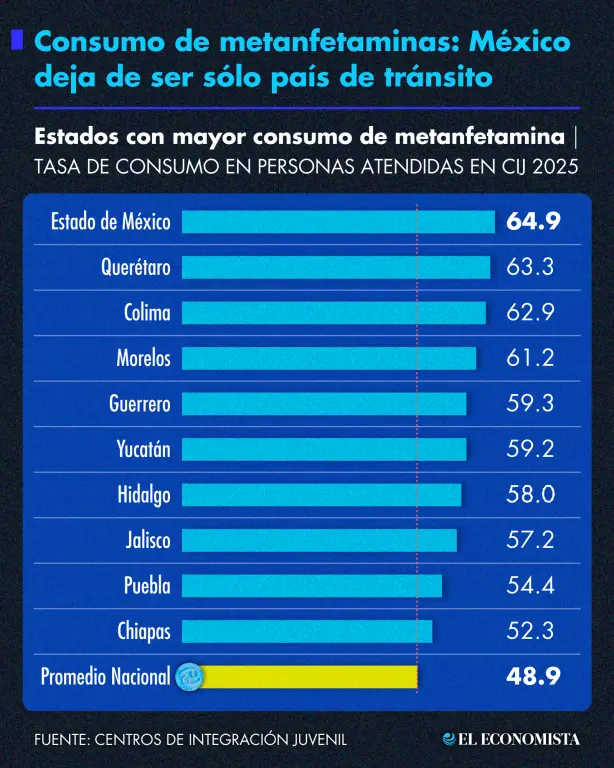
According to the 2025 Epidemiological Report on Drug Use in Mexico from the Youth Integration Centers (Centros de Integración Juvenil), during the second half of 2024, the national average rate of methamphetamine use reached 48.9%.
The report indicates that the following states recorded rates exceeding 60%:
- State of Mexico
- Querétaro
- Colima
- Morelos
An additional 16 states were above the national average.
Mexico Is No Longer Just a Transit Country
According to the 2026 World Drug Report published by UNODC, the capacity for harm has increasingly extended into Mexico, where the domestic drug market continues to develop.
Medina-Mora noted that Mexico was once primarily a transit country for illegal drugs, but traffickers now actively encourage drug use beginning at early ages.
Similarly, the 2025 National Drug Threat Assessment by the U.S. Drug Enforcement Administration (DEA) states that criminal organizations traffic psychoactive substances throughout various regions of Mexico.
These substances include:
- Heroin
- Xylazine
- Chemical precursors
- Tusi (“pink cocaine”)
- Ketamine-cocaine mixtures
- Methamphetamine
- Fentanyl
Declining Opium Production Boosted the Methamphetamine Market
Researcher Silvia L. Cruz, from the Department of Pharmacobiology at the Center for Research and Advanced Studies (Cinvestav) of the National Polytechnic Institute (IPN), explained that during the second half of the twentieth century, opium poppies were cultivated to produce opium, which naturally contains morphine.
Through a simple chemical process, morphine is converted into heroin, a semi-synthetic drug that is illegally traded.
Historically, the primary opium-producing countries have included:
- Afghanistan
- Myanmar
- Laos
- Thailand
- Iran
- Pakistan
- Mexico
However, political decisions have significantly reduced global opium production.
The 2026 World Drug Report notes that Afghanistan’s 2022 ban on opium cultivation has continued to severely restrict illegal opium and heroin production.
Although production in Myanmar exceeded 1,000 tons in 2025, increases there, together with production in countries such as Laos and Mexico, have not offset Afghanistan’s decline, which exceeded 6,000 tons of opium in 2022.
The same report states that synthetic opioids accounted for 3% of opioid production in 2015, rising to 11% by 2024.
According to Cruz, one consequence of this shift has been the growing use of amphetamine-type stimulants such as ice and crystal meth.
Researchers have identified approximately 1,400 synthetic stimulants, of which 755 are currently circulating.
Among these are 11 synthetic opioids that produce effects similar to heroin and morphine.
Health Effects of Synthetic Stimulants
These stimulants are highly toxic.
They stimulate the release of adrenaline and noradrenaline, making users appear extremely excited or frightened.
Their effects include:
- Increased alertness
- Euphoria
- Greater motivation
However, they are also associated with:
- Anxiety
- Paranoia
- Insomnia
- Addiction
Compared with many other drugs, users often develop physical damage much more rapidly because of the high concentrations of active ingredients.
These substances can quickly cause:
- Cognitive impairment
- Functional disorders
- Psychosis
- Seizures
- Hemorrhages
Some users even experience the sensation of insects crawling beneath their skin.
Controlling Chemical Precursors Is Extremely Difficult
The other major category of synthetic drugs in Mexico consists of synthetic opioids, the best known of which are fentanyl compounds.
According to the Cinvestav researcher, these drugs are extremely difficult to stop because they are synthesized from chemical precursors found in many commonly used products.
For example:
- Methamphetamine production requires P2P (phenyl-2-propanone).
- Fentanyl production requires ANPP (despropionyl fentanyl).
When authorities succeed in restricting illegal precursor trafficking, criminal organizations simply obtain pre-precursors, which they use to manufacture P2P and ANPP themselves.
In addition, many essential chemicals involved in drug synthesis—including binders, catalysts, solvents, reagents, and dyes—are widely used for legitimate industrial and commercial purposes.
Because these individual chemical compounds have numerous lawful applications, regulating them becomes extraordinarily difficult, making synthetic drug control a major challenge.
For example, one precursor used in fentanyl production is norfentanyl, while its pre-precursors include benzylfentanyl and sodium cyanide. Essential chemicals involved in the synthesis include sodium carbonate, methylene chloride, and sorbitol, all of which are commonly found in products used for a wide variety of everyday purposes.
Source: eleconomista