
Mexico’s economy grew by 0.7% in 2025. However, behind that figure lies a more concerning reality: eight out of every ten pesos of economic growth came from the informal economy.
According to an analysis by ITESO, based on data from Mexico’s System of National Accounts, the country’s economic growth was driven not by large investments or formal employment, but by millions of people working without contracts, social security, or tax registration.
The Gross Value Added (GVA) generated by the informal economy—covering economic activity that operates outside the oversight of Mexico’s tax authority (SAT) and the Mexican Social Security Institute (IMSS)—grew 2.3% in 2025.
By comparison, Mexico’s Gross Domestic Product (GDP) increased only 0.7%, meaning the informal economy expanded at more than three times the pace of the country’s overall economic growth.
Although the informal sector represents only one-quarter of Mexico’s total production, it contributed eight out of every ten pesos of economic growth in 2025. Meanwhile, the formal economy—the portion that pays taxes and contributes to social security—continues to struggle.
“The current economic model is not creating the conditions for much more productive growth,” explained Mireya Pasillas, professor and editor of the ITESO School of Business Economic Analysis Bulletin.
The Informal Economy Goes Beyond Street Vendors
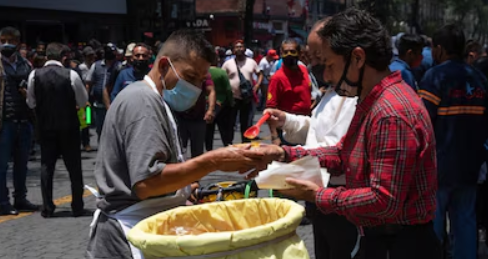
For years, informality has extended far beyond street food stands.
Mexico’s National Institute of Statistics and Geography (INEGI) divides the informal economy into two categories.
The first is the informal sector, which includes:
- Small family businesses
- Self-employed workers
- Street vendors
- Home workshops
The second consists of other forms of informality, including:
- Employees working for legally registered companies without contracts or employment benefits
- Freelancers
- Paid domestic workers
- Agricultural workers
Small Businesses and Freelancers Are Driving Informal Growth
In 2025, more small informal businesses opened than ever before.
- Microbusinesses grew 3.3%
- Freelancers increased 1.1%
This reflects a trend in which not only are existing jobs becoming more precarious, but new businesses are increasingly operating outside the formal legal framework.
Informal commerce remains the largest component of the informal economy, accounting for 38% of its total value added.
Perhaps more notable is the rapid expansion of professional and technical services provided informally, which grew 9.6%.
The informal economy is no longer limited to neighborhood shops or street vendors. It also includes professionals—such as graphic designers or consultants—who receive electronic payments but do not issue tax invoices.
Geographically, informality is no longer concentrated in rural communities.
The State of Mexico and Mexico City together accounted for more than one-fifth of the country’s informal value added, representing 11.4% and 10.2%, respectively.
Why Is Informality Growing in Mexico?
According to ITESO, the growth of informality is closely tied to the weakening of the formal economy.
The institute identifies three major factors.
Declining Investment
Investment has been falling for 19 consecutive months.
During the first three months of 2026, investment declined by:
- 2.3%
- 3.5%
- 3.1%
respectively.
Fewer Registered Employers
In May 2026, Mexico had 1,015,999 employers registered with the IMSS, representing a 2.5% decrease compared with the previous year.
Microenterprises employing 2 to 5 workers were the most affected, declining by 3.4%, equivalent to 13,183 businesses.
This could indicate that businesses have either closed or continued operating informally, without providing labor benefits or reporting income to the SAT.
Foreign Investment Focused on Existing Companies
Foreign Direct Investment (FDI) reached $23.59 billion USD during the first quarter of 2026, setting a new record.
However, 94.2% of that amount consisted of reinvested earnings by companies already operating in Mexico.
Truly new investment projects accounted for only $1.705 billion USD.
As a result, the informal economy filled the gap left by lower investment, fewer formal businesses, and limited new industrial development.
What Does Rising Informality Mean for Mexico?
When roughly one-quarter of everything produced in Mexico remains outside the reach of the SAT, the government collects less revenue for:
- Hospitals
- Roads
- Public security
- Other public services
For millions of workers, informal employment also means lacking access to IMSS health coverage and other social protections if they become ill or injured.
At the same time, small businesses face increasing difficulty remaining compliant with formal legal and tax requirements.
A Potential Vicious Cycle
According to the analysis, the situation could become a self-reinforcing cycle.
If investment continues to decline and more formal businesses close, the formal economy will not generate enough jobs to absorb the growing labor force each year.
The result would be even greater reliance on informal employment across Mexico.
Source: elfinanciero