
Oaxaca’s cultural delegation left its mark at the opening of the “The States at Los Pinos” program, an event that brings the public closer to the country’s cultural, gastronomic, and artisanal diversity, where Oaxaca’s roots and traditions took center stage.
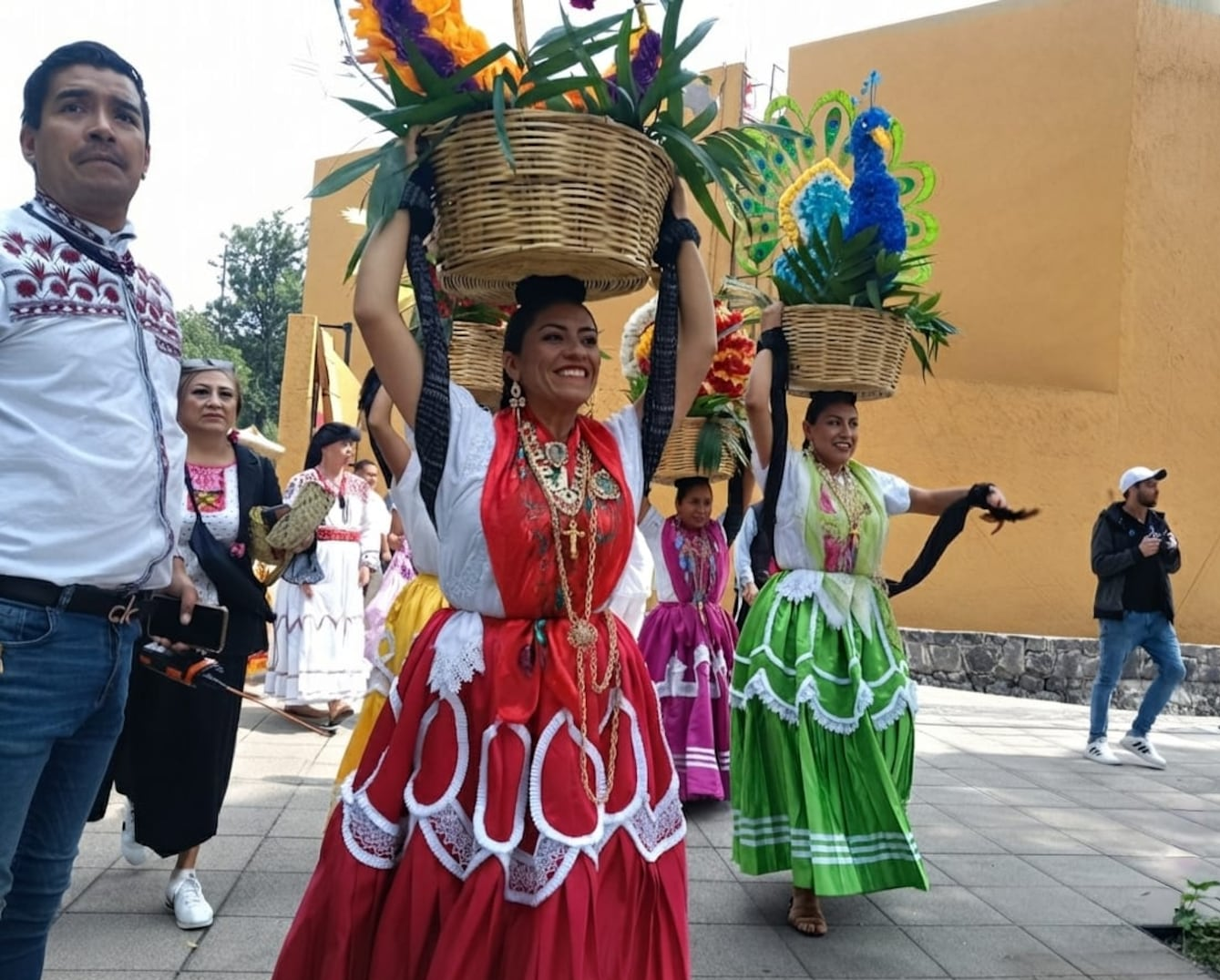
Before the speeches even began, the atmosphere already made it clear that Oaxaca had arrived at Los Pinos. The first notes of traditional music filled the air as dozens of dancers advanced with smiles on their faces, balancing enormous baskets on their heads decorated with colorful flowers, peacock figures, crosses, and monumental floral arrangements. Their dresses, in shades of red, green, blue, yellow, purple, and pink, contrasted beautifully with the surroundings of the Cultural Complex and immediately captured the attention of families gradually filling the venue’s walkways.
The procession was greeted with applause and dozens of raised cell phones. Parents, children, young people, and older adults searched for the best angle to record the arrival of the Oaxacan delegation. As the dancers twirled to the rhythm of the music, some participants began throwing candy into the air. The sweets soared above the crowd as attendees laughed and stretched out their hands to catch them, while others kept their phone cameras raised so they would not miss a single moment of the parade.
Leading the procession were large white balloons decorated with papel picado and the word “Oaxaca,” guiding the musicians, artisans, and representatives from different communities. Behind them came the traditional women of the Isthmus of Tehuantepec, who demonstrated their remarkable skill by dancing without dropping the heavy baskets balanced on their heads. Some baskets were decorated with fresh flowers, while others featured peacock figures and elaborate floral arrangements that drew expressions of amazement from spectators.
Every step of the parade was accompanied by applause. The skirts swayed with the music, while necklaces, embroidery, and ribbons showcased the richness of Oaxaca’s traditional attire. The dancers’ smiles blended with the excitement of families who followed the procession to avoid missing a single detail.
Oaxaca at “The States at Los Pinos”
This marked the beginning of Oaxaca’s participation in the “The States at Los Pinos” program, an event that introduces visitors to the cultural, gastronomic, and artisanal diversity of Mexico’s states. During July 4 and 5, Oaxaca presented an extensive showcase of its cultural heritage through dance performances, music, gastronomy, and handicrafts.
During the opening ceremony, officials from the Los Pinos Cultural Complex stated that the initiative has welcomed more than 82,000 visitors throughout 2026 and has featured nearly 1,000 artisans, traditional cooks, artists, and local producers, helping preserve and promote Mexico’s living cultures while encouraging appreciation for the country’s diverse cultural heritage.
They also highlighted that more than one hundred bearers of Oaxaca’s cultural traditions participated during the two-day festival, sharing artistic performances, gastronomy, music, poetry, and workshops designed for people of all ages.
Oaxaca’s Secretary of Culture and Arts, Flavio Sosa Villavicencio, thanked the Los Pinos Cultural Complex for supporting this edition of the program and emphasized that Oaxaca’s presence in Mexico City provides an opportunity to showcase the richness of its Indigenous peoples and artisan communities.
The official explained that artisans, traditional cooks, musicians, and dancers from various regions of the state traveled to the capital to share a glimpse of Oaxacan identity. He added that visitors could explore textiles, huaraches, black pottery, red pottery, and many other handcrafted works created using techniques passed down from generation to generation.
He also noted that the culinary offerings featured traditional cooks from municipalities including Santa Ana del Valle, San José Camotinchán, San Sebastián Ixcapa, San Juan Bautista Cuicatlán, and Ciudad Ixtepec, who prepared some of the state’s most representative dishes.
Art, Crafts, and Gastronomy
As the band’s music gradually faded, the experience was only beginning. Following the inauguration, hundreds of visitors entered the different areas of the Los Pinos Cultural Complex to discover another side of Oaxaca—one reflected in every handcrafted piece and every aroma coming from the traditional kitchens.
Inside one of the galleries, visitors leisurely explored an exhibition featuring some of the state’s most representative artistic expressions. Shelves displayed hand-embroidered huipiles, cotton shirts, rebozos, woven bags, hats, basketry, loom-woven garments, and items crafted from natural fibers. A black-and-white mural inspired by Oaxaca’s flora and fauna served as the backdrop for a traditional costume displayed on a mannequin, making it one of the exhibition’s most photographed attractions.
Each garment and handcrafted piece seemed to tell its own story. Some artisans patiently explained the textile-making process and the meaning behind the embroidery, while both domestic and international visitors admired the intricate details before deciding which pieces to purchase as souvenirs.
Outside, the atmosphere was entirely different. Stalls selling coffee, chocolate, mole, mezcal, and other traditional products became major gathering points. The aroma of freshly brewed coffee and traditional chocolate guided visitors toward the food area, where they could sample beverages and dishes prepared using recipes handed down through generations.
The flavors of Oaxaca captivated both international tourists and Mexican visitors, who lined up to taste the products or purchase coffee, chocolate, mole, mezcal, and handcrafted goods made by local producers. Between tastings, conversations, and photographs, the festival sparked curiosity about Oaxaca’s rich culinary traditions among many people visiting Los Pinos for the first time.
Performances and Cultural Preservation
In addition to the artisan and gastronomic exhibitions, the program included poetry readings, traditional music, dance performances, children’s workshops, eleven musical performances, and five dance presentations, showcasing the cultural diversity of Oaxaca’s various regions.
During his remarks, Flavio Sosa Villavicencio also emphasized the importance of protecting Oaxaca’s cultural expressions in light of recent cases of cultural appropriation. He reiterated that preserving these traditions means defending the work of Indigenous communities and safeguarding the heritage of the state’s artisans.
For many families, the visit represented much more than attending a festival. It was an opportunity to experience Oaxaca’s traditions without leaving Mexico City, interact with artisans, listen to traditional music, taste authentic cuisine, and appreciate the work of those who keep their communities’ customs alive.
Thus, through music, monumental baskets, colorful dresses, candy flying over the heads of spectators, galleries filled with art, the aromas of coffee and chocolate, and the warmth of its artisans, Oaxaca transformed the Los Pinos Cultural Complex into a small corner of southern Mexico for two days, demonstrating that its cultural heritage remains one of the country’s most vibrant, colorful, and representative expressions.

Source: cronica