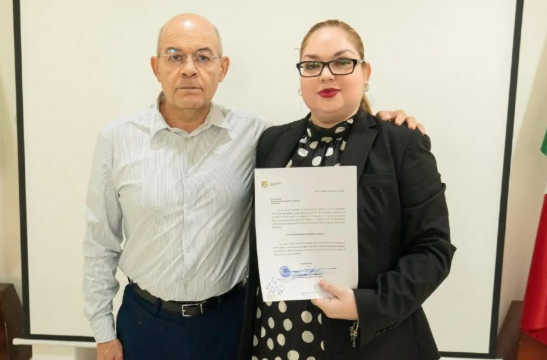

The Nayarit State Congress received a request for impeachment proceedings filed by members of the SUTSEM union, activists, and citizens who consider themselves victims of the Nayarit State Attorney General’s Office and the Nayarit State Judiciary. The petition is directed against Attorney General Ludmila Heredia Verdugo, former Attorney General Petronilo Díaz Ponce Medrano, judges Juan Valentín Escobedo Lázaro and Luis Corona, and also includes allegations of negligence against the President of the Congress, Salvador Castañeda Rangel.
The request was filed after a demonstration held outside the Congress building, where the petitioners maintained that the Nayarit Attorney General’s Office and the Nayarit State Judiciary have acted, according to them, through criminal proceedings lacking sufficient grounds, affecting union members, activists, and citizens.
Cases Presented Before the Nayarit Congress
The protest included the Secretary General of SUTSEM, Óscar Flavio Cedano Saucedo, as well as individuals who publicly shared the legal proceedings they are facing or have faced.
Among them were members of the Guzmán Franco family from Rincón de Guayabitos, who stated that two of their relatives remain imprisoned in a case related to FIBBA; columnist Ulises Rodríguez, who reported facing legal proceedings after publishing investigations into alleged irregularities; relatives of two ministerial agents who died in the Venustiano Carranza prison; businesswoman Izarol Lépez Rodríguez, who denounced an alleged attempt to seize her properties; and activist Isaac Chakin Cárdenas, who claimed to have been arbitrarily detained and accused of crimes he denies committing.
The petitioners explained that the impeachment request is based on a ruling issued by a federal judge, who determined that the Nayarit State Attorney General’s Office did not provide sufficient evidence to substantiate the charges against SUTSEM union members for allegedly obstructing roads during a protest.
According to the protesters, the judge concluded that the evidence presented by the Attorney General’s Office consisted primarily of social media posts and news articles, and also acknowledged that the workers were exercising rights protected by the Constitution.
They further stated that the judge noted that local judges failed to apply constitutional review before deciding whether to formally charge the workers, a situation that, in the petitioners’ view, constitutes an irregularity that must be reviewed.
During the demonstration, participants asserted that the Nayarit Prosecutor’s Office has been used as a tool to persecute citizens, activists, and union members through criminal investigations, precautionary measures, and labor restrictions they consider excessive.
Among the measures mentioned are the suspension of salaries, restrictions on leaving the state, the obligation to periodically sign in with the authorities, and prohibitions on going to their workplaces or maintaining contact with colleagues.
The attendees also made various accusations of alleged acts of corruption, abuse of power, and asset stripping attributed to current and former state officials. These claims correspond to the complaints made by the protesters and, to date, have not been substantiated by a court ruling.
What’s next regarding the impeachment request?
Following its presentation, the Nayarit State Congress will analyze whether the impeachment request meets the legal requirements for processing and, if so, refer it to the appropriate legislative bodies to determine the admissibility of the proceedings.
With this action, the case once again places the conduct of the Nayarit State Attorney General’s Office and the Nayarit Judiciary at the center of public debate, awaiting the official response from the authorities in question.
Source: tribunadelabahia