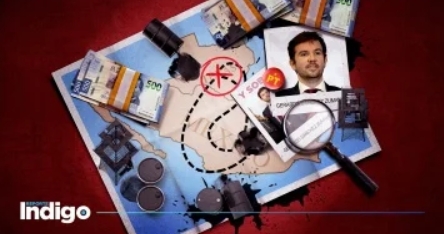

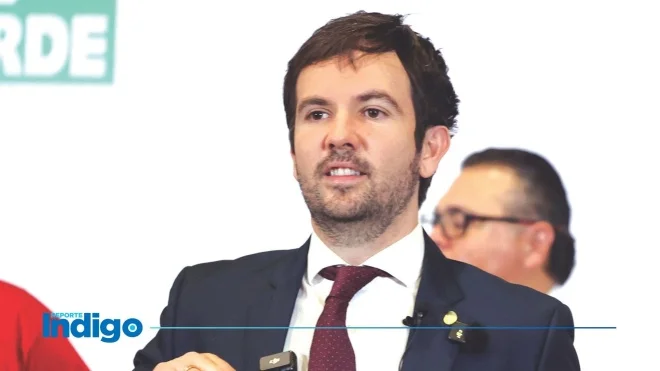
A suspected network dedicated to money laundering, tax fraud, and the illegal extraction, transportation, and commercialization of hydrocarbons from Petróleos Mexicanos (Pemex) has placed businessman Gerardo Sánchez Zumaya, an aspiring candidate for the governorship of San Luis Potosí, under federal scrutiny.
The allegations describe an operation capable of moving petroleum products without leaving an apparent trace, issuing invoices worth billions of pesos without industrial infrastructure, creating companies that conducted business exclusively with one another, and linking the entire operation to companies incorporated in Texas.
The businessman from San Luis Potosí is identified as the alleged leader of an organization that reportedly used a network of companies to launder money, defraud tax authorities, and conceal the illegal extraction, transportation, and commercialization of hydrocarbons and petrochemical products obtained from Pemex facilities.
According to an ongoing investigation reviewed by Reporte Índigo, the case file contains hundreds of tax receipts, corporate records, and financial documents. It alleges that the network used shell companies and nominees to conceal the origin of the products being sold. According to the documents, the operation allegedly generated profits exceeding $1.1 billion between 2019 and 2024.
These allegations significantly expand upon previous accusations involving Sánchez Zumaya, whose application to seek the governorship under Morena was rejected before receiving support from the Labor Party (PT). He is identified as the alleged leader of the organization known as Grupo GESA.
Money Allegedly Distributed Among Multiple Individuals to Make It Harder to Trace
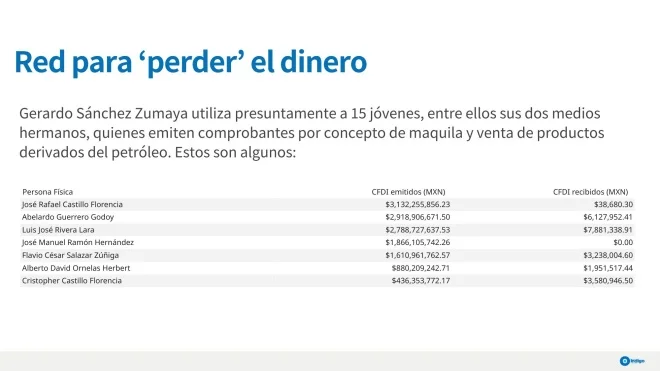
One of the alleged schemes involved the use of at least 15 individuals—including relatives, half-siblings, and people close to the businessman—to issue tax invoices totaling billions of pesos for the sale and processing of specialized chemical products.
According to the document, this distribution of large financial transactions made tracing the movement of funds more difficult.
The investigation states that between 2022 and 2024, this group allegedly issued invoices totaling more than 15 billion pesos, despite reportedly lacking industrial infrastructure, assets, or the financial capacity to perform those activities.
The complainants highlighted several unusual cases.
One involved a 24-year-old who allegedly issued tax invoices totaling 1.8 billion pesos without reporting any business expenses during the same period.
Another individual, 25 years old, allegedly invoiced more than 1.2 billion pesos while reporting expenses of only 46,000 pesos.
The complaints also describe a multilayered invoicing structure among companies belonging to the same corporate group, allegedly intended to conceal the origin of financial resources.
Among the principal companies mentioned are Petrogesa, Ban GESA, Químicos Industriales Sazu, Edjora, Industrias GESA del Sureste, and Safnat.
According to the case file, these companies later transferred operations to a second group of businesses located primarily in Nuevo León and Coahuila, where invoices shifted from chemical product sales to purported engineering and telemetry consulting services.
Operations Allegedly Conducted Inside Pemex Facilities
The documents reviewed state that the organization allegedly gained access to strategic Pemex facilities, including:
- Dos Bocas Maritime Terminal.
- Salina Cruz Refinery.
- Cantarell Complex.
- Lázaro Cárdenas Refinery.
- Independencia Petrochemical Complex.
According to the allegations, petroleum derivatives such as naphtha, crude oil, and specialized petrochemical products were extracted from these facilities.
The reported operations allegedly occurred without official records documenting entry or exit and without contracts authorizing private individuals to operate within facilities considered strategically important to the Mexican government.
If confirmed, investigators argue that the case would go beyond traditional fuel theft (“huachicol”), suggesting possible logistical infiltration into state-owned energy facilities and the use of tax mechanisms to give the products an appearance of legality.
Petrogesa allegedly operated as a contractor providing Pemex with supply networks and specialized services involving chemical products and petroleum derivatives used to remove contaminants from heavy crude oil and light oils.
The reported services included:
- Transportation.
- Crane rental.
- Sale, installation, and maintenance of pumps and injection equipment.
- Injection, monitoring, and logistics services.
- Laboratory rental.
- Rental of Pressure and Vacuum Units (UPV).
Based on these findings, the complainants requested that authorities investigate possible offenses including fuel theft, money laundering, and tax fraud.
At this time, the reviewed documents consist of complaints and allegations whose accuracy and any resulting legal responsibility must be determined by the appropriate authorities as the investigation progresses.
Texas: The Alleged Final Destination of More Than $1.1 Billion
According to the investigation, Grupo GESA allegedly operated a scheme involving the illegal extraction and commercialization of hydrocarbons that extended beyond Mexico.
The documents reviewed state that the final stage of the operation allegedly involved companies established in Texas, through which more than $1.1 billion was reportedly transferred.
According to the case file, the organization allegedly created a network of companies and individuals to simulate commercial transactions, conceal the origin of hydrocarbons allegedly extracted from Pemex facilities, and transfer funds through companies located near the U.S.-Mexico border.
After an initial phase involving transactions among companies linked to Grupo GESA, the operations were allegedly transferred to a second group of businesses associated with businessman Salvador Vigil Jordán, located in Nuevo León and Coahuila.
At that stage, petroleum products were allegedly reclassified on paper as independent professional engineering services, a practice investigators believe was intended to obscure the origin of the products.
The investigation identifies four Texas-based companies that allegedly maintained commercial relationships with this second group:
- Concordia Chemical LLC.
- Smart Logistics Commerce LLC.
- Espada Group LLC.
- Catros Intech LLC.
Together, these companies allegedly received invoices exceeding $1.1 billion, which investigators identify as the financial benefit generated by the alleged network between 2019 and 2024.
Alleged Links to Suspicious Companies in the United States
One company highlighted in the investigation is Smart Logistics Commerce LLC.
According to the report, its registered address corresponds to a small residential property in San Antonio, Texas, lacking the characteristics expected of a business engaged in industrial operations or international trade. Investigators present this as a possible indicator of a shell company.
The report further alleges that the U.S. companies share characteristics commonly associated with shell corporations and may form part of a structure designed to facilitate money laundering and conceal the origin of funds through invoicing among related entities.
The document also suggests that the logistical network may have supported not only the transportation of chemical products but also alleged hydrocarbon smuggling and tax-related fuel fraud, using ground transportation and storage infrastructure to move energy products between southern Mexico and the U.S. border.
Gerardo Sánchez Zumaya Seeks Governorship After Morena Rejects His Registration
Gerardo Sánchez Zumaya’s political aspirations suffered a setback when Morena refused to register him as a candidate for the State Coordination for the Defense of the Transformation, a position that precedes the party’s selection of its gubernatorial candidate for the 2027 elections.
Hours later, the Labor Party (PT) accepted his registration into its own internal selection process.
During Morena’s registration event, only candidates approved by the national leadership received official documentation from party president Ariadna Montiel and Citlalli Hernández, head of the National Elections Commission.
Sánchez Zumaya was not included in that process.
After Morena officials concluded the event, PT leaders established their own registration table and accepted his application.
Political observers in San Luis Potosí interpreted the episode as an effort by Morena to distance itself from the businessman because of the controversy surrounding previous allegations linking him to companies accused of issuing fraudulent invoices and participating in tax-related fuel theft schemes—accusations that Sánchez Zumaya has denied.
He has argued that the allegations are part of a political campaign against him, maintained that his business activities are lawful, and denied any involvement in illegal operations related to Pemex.
Following his acceptance into the PT, the political landscape leading up to the state succession process began to shift.
Previous Investigations Ended Without Criminal Charges
Complaints filed in 2024 linking Gerardo Sánchez Zumaya to an alleged hydrocarbon theft scheme involving Pemex have not resulted in criminal charges.
This year, the Office of the Attorney General of the Republic (FGR) decided not to pursue criminal prosecution in two investigations after determining that there was insufficient evidence to support the alleged offenses.
The allegations originally involved an alleged network for the illegal extraction and commercialization of fuel, along with possible money laundering and fraudulent invoicing operations.
Business leaders from the energy sector had publicly requested that the FGR continue investigating the case.
A second investigation in Tabasco, involving allegations of money laundering, invoicing for nonexistent transactions, and unlawful firearm possession, also concluded without criminal prosecution due to insufficient evidence.
Although both investigations were closed, Sánchez Zumaya’s name has reappeared in new documents alleging his involvement in another suspected network dedicated to the illegal extraction and commercialization of hydrocarbons. Those allegations have not yet resulted in a final judicial ruling.
Source: reporteindigo