
The conservation of the Kemp’s ridley sea turtle continues to yield historic results in Tamaulipas. During the current administration of Governor Américo Villarreal Anaya, 12,129 nests have been protected, 992,196 eggs safeguarded, and 590,030 hatchlings of this endangered species have been released. These actions strengthen the world’s largest population of Kemp’s ridley sea turtles and contribute to preserving one of the state’s most important natural heritages.
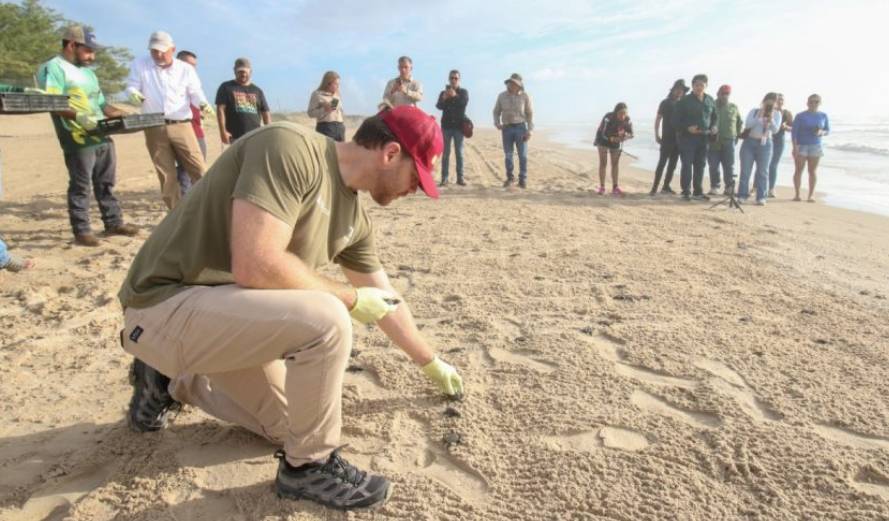
As part of this ongoing effort, the Secretary of Urban Development and the Environment, Karl Heinz Becker Hernández, led the release of 284 Kemp’s ridley sea turtle hatchlings at the La Pesca Sea Turtle Camp in Soto la Marina.
Later, accompanied by the Executive Director of the Parks and Biodiversity Commission, Luis García Reyes, he conducted a supervisory tour to verify the protection efforts being carried out during the current nesting season.
The head of SEDUMA (the Tamaulipas Ministry of Urban Development and Environment) highlighted that a high percentage of the world’s Kemp’s ridley sea turtle population arrives on Tamaulipas’ coasts to lay its eggs, making the state an international leader in the conservation of this species and reinforcing the responsibility to maintain and strengthen protection efforts.
In the 2026 season alone, staff from the La Pesca Sea Turtle Camp protected 622 nests, safeguarded 56,736 eggs, and released 36,948 hatchlings. This success is the result of continuous beach monitoring, the strengthening of incubation corrals, and the application of specialized protocols that increase the chances of survival.
Becker Hernández explained that transferring the eggs to protected corrals significantly reduces the risk of predation and promotes a higher number of successful hatchlings.
“This entire process is carried out following very strict protocols. We use gloves and specific materials to avoid disrupting the chemical exchange that the turtle leaves in the sand, which allows it to return, years later, to the beach where it was born to lay its eggs,” he stated.
He also noted that the increase in the number of hatchlings released is due to the strengthening of the infrastructure dedicated to conservation and the coordinated work with the Federal government.
“When we began this administration, we were releasing less than half the number of hatchlings we are releasing today. These results will be fully reflected in approximately ten years, when these turtles reach reproductive maturity,” he said.
Currently, the Parks and Biodiversity Commission operates six turtle camps located at Bagdad Beach and El Mezquital Port in Matamoros; La Pesca and Tepahuajes in Soto la Marina; Tesoro Beach in Altamira; and Miramar Beach in Ciudad Madero.
From these locations, ongoing monitoring, protection, and environmental education efforts are carried out, in addition to promoting citizen participation in conservation.
“When the arribada season begins, we maintain constant monitoring of the beaches to recover the nests. So far this season, we have rescued around 330,000 eggs and released between 220,000 and 230,000 hatchlings into the sea,” he explained.
Finally, Becker Hernández invited the public to join in caring for the beaches and to report any turtle sightings to the Secretariat of Urban Development and the Environment or the Parks and Biodiversity Commission, emphasizing that citizen collaboration is key to continuing to strengthen the conservation of this species.
“More and more people are reporting turtle sightings to us, and that makes us very happy because it shows that society is joining in the conservation effort. We invite everyone to take care of our beaches and notify us when they spot a turtle so we can provide it with the protection it needs,” he concluded.
Source: tamaulipas.gob