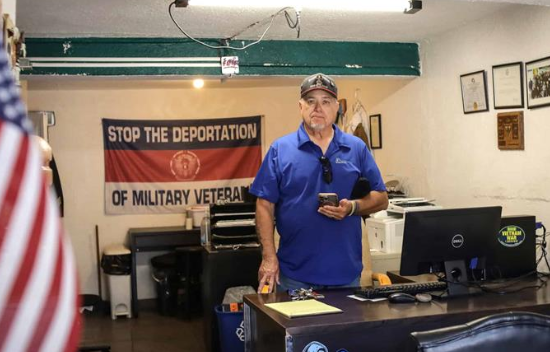

From the border city of Tijuana, Robert Vivar has dedicated himself to assisting U.S. military veterans who, for various reasons, have been deported to Mexico, with their stories reflecting the human impact of U.S. immigration policies.
Through the Unified U.S. Deported Veterans Resource Center, Vivar provides a safe space offering comprehensive legal assistance, basic medical services, and vital emotional support to veterans who feel abandoned by the country they once served before being deported to Mexico.
The organization helps veterans integrate into communities while living in exile and seeks pathways for their possible return to the United States through programs that include document assistance, immigration support, and job placement services.
The initiative also seeks to pursue civil and criminal legal action against the U.S. Department of Justice and the companies that operate U.S. Immigration and Customs Enforcement (ICE) detention centers. The objective is to go beyond traditional diplomatic responses following the death of Mexican national Lorenzo Salgado Araujo in Houston on July 7.
Speaking to EFE, Vivar offered the perspective of someone who witnesses the consequences of these immigration policies every day. He said that being separated from one’s family through deportation after serving a country “is something difficult that people don’t understand.”
Although Vivar himself never served in the U.S. military, he said the situation of deported veterans affected him deeply after arriving in Tijuana because both his son and grandson, who are U.S. citizens, serve in the armed forces.
The activist explained that, beyond whether physical violence occurs during ICE arrests, “there is harm that goes beyond the physical,” arguing that the greatest impact is the psychological terror experienced by immigrants and, especially, their families.
“Sometimes the reason they arrest even their own citizens is unknown.”
Vivar criticized nighttime immigration raids, saying they criminalize people who have lived in the United States for decades and who have no criminal records.
According to his testimony, immigration conditions between the United States and Mexico “were better before,” adding that the administration of Donald Trump has worsened the situation for Mexican families divided by the border.
“I remember families separated, touching each other’s hands through the fence dividing the United States and Tijuana.”
Vivar explained that he was eventually able to regularize his immigration status and obtain U.S. citizenship in 2021, following years of legal battles and separation from his family.
Despite what he sees as a worsening immigration environment, Vivar remains hopeful about the future repatriation of deported veterans. He believes that the racism experienced by many Mexicans comes from institutions rather than from the American people themselves.
Robert Vivar’s story is one example of two countries divided by a border but connected by thousands of displaced families—a reality that continues to affect countless households in both Mexico and the United States under an increasingly restrictive legal framework.
Source: udgtv