
Specialists from Mexico’s National Institute of Anthropology and History (INAH) have discovered 179 archaeological artifacts near the Arch of Time, one of the world’s largest natural stone arches, located within the La Venta River Canyon in the municipality of Cintalapa, Chiapas.
According to the INAH, the artifacts were found inside Mundo Zoque Cave, a site containing 13 pre-Hispanic ritual deposits. These deposits were intentionally created as ceremonial offering sites rather than serving as storage areas or places of habitation.
The institute described the discovery as one of the most significant archaeological finds in Chiapas in recent decades, citing both the exceptional state of preservation of the artifacts and the intact ceremonial context in which they were found.
Mundo Zoque Cave Remained Undisturbed for Centuries
The cave was discovered by local guide Jairo Díaz Barreiro, a member of the Alianza de Empresarios del Segmento de Naturaleza A.C., who reported the find to the INAH’s Chiapas Center in January 2026. Between February and June, specialists conducted verification and archaeological investigations.
Mexico’s Secretary of Culture, Claudia Curiel de Icaza, stated:
“The protection of cultural heritage begins when there is a relationship of trust between communities and the institutions responsible for researching and preserving it. The discovery of Mundo Zoque Cave demonstrates that this collaboration makes it possible to preserve archaeological contexts of exceptional value and expand our understanding of the cultures that have shaped Mexico’s history.”
The research forms part of the INAH’s project to document and analyze caves within the La Venta River Canyon. The project is led by researcher Josuhé Lozada Toledo, with the collaboration of archaeologist and professional climber Martha Arcelia García Sánchez and speleologist Gabriel Merino Andrade.
What Was Found Inside Mundo Zoque Cave?
According to Josuhé Lozada Toledo, the cave extends for more than 100 meters (328 feet), and access requires descending over 10 meters (33 feet) by rappel. This difficult access helped keep the site untouched and protected from looting for centuries.
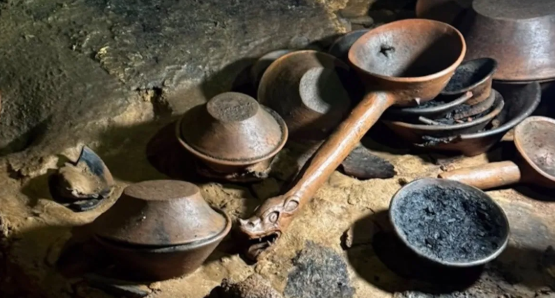
Inside the cave, archaeologists identified 13 ritual deposits containing:
- Incense burners
- Effigy urns
- Ceramic bowls
- Censers
Many of the artifacts feature representations of jaguars, owls, and snakes, animals that held profound symbolic significance in Zoque cosmology.
Lozada Toledo explained:
“In the Zoque worldview, these three animals are associated with the night and with caves. The jaguar (kank) symbolizes darkness and serves as the guardian of the underworld and the heart of the mountain; the owl is linked to the night and wisdom, while the snake represents strength and the cycle of life and death.”
Incense Burners Marked the Ceremonial Route
One of the most significant aspects of the discovery is that the incense burners, decorated with ceiba tree thorns—the ceiba being a sacred tree in Zoque culture—appear to outline the ceremonial path through the cave.
After passing through narrow corridors, researchers entered large chambers filled with stalactites and stalagmites, a landscape believed to have symbolized the underworld, or ts’uan.
Approximately 30 meters (98 feet) from the entrance lies a siphon that can only be crossed during the dry season. Beyond it, archaeologists discovered additional chambers containing ceramic bowls of various sizes, some with human-shaped effigy handles, as well as stalagmites that ancient Zoque inhabitants intentionally modified to resemble human figures.
The exploration culminates in a main chamber where archaeologists identified five ritual deposits containing abundant fine orange pottery.
Among the most remarkable artifacts is a censer decorated with a cross representing the quincunx, a Mesoamerican cosmological symbol associated with the cardinal directions and the structure of the universe. The object features a 32-centimeter (12.6-inch) handle ending in the figure of a snake with its jaws open.
Artifacts Date to A.D. 600–900
Based on the ceramic characteristics and iconographic representations, the INAH has preliminarily dated the materials to the Late Classic Period (A.D. 600–900).
According to Lozada Toledo, the arrangement of the offerings suggests that the cave was used for rituals related to rain and agricultural fertility, rather than as a place of habitation.
Research will continue through additional cave explorations, three-dimensional photogrammetry, and specialized studies to better establish the site’s chronology and cultural significance.
Laboratory analyses will also be conducted on the ceramic objects, which may still preserve chemical residues, traces of copal resin, ashes, or even human bone remains, thanks to their exceptional state of preservation.
The preliminary documentation of Mundo Zoque Cave was made possible through the support of the General Cárdenas community, along with coordinated efforts by the INAH, the State Tourism Police, and the Chiapas Ministry of Tourism.
Josuhé Lozada Toledo concluded that this discovery represents a major contribution to the understanding of the ancient Zoque civilization and strengthens the INAH’s efforts to investigate, preserve, and protect the archaeological heritage of both Chiapas and Mexico.
Source: debate