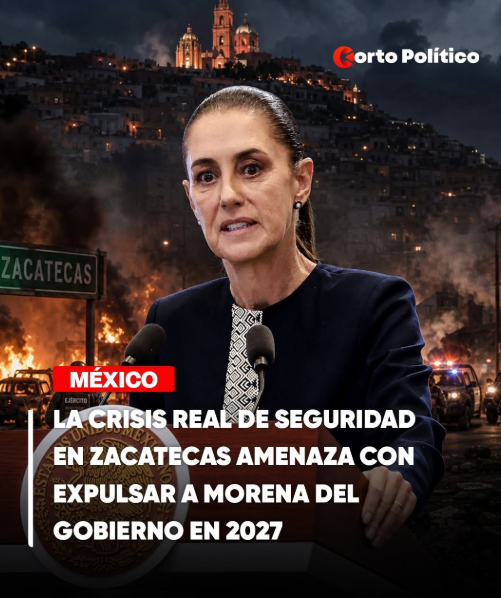

Ten men dead, five bodies displayed from a bridge, and several victims linked to local politics and business were enough to shatter the narrative that Zacatecas had left its worst years of violence behind.
The July 18 massacre not only opened a criminal investigation, but also confronted David Monreal’s government with an uncomfortable question: who really controls the territory?
Among the victims were a former mayor, municipal officials, business owners, and a cattle rancher. The Attorney General’s Office is investigating possible extortion rings and the involvement of public servants, although it has not yet determined whether some victims were voluntarily collaborating with the criminals or acting under duress. Five people have been arrested, but the full motive for the attack remains unclear.
The political blow to Morena stems precisely from this uncertainty. If organized crime could interfere in fairs, alcohol sales, construction, municipal permits, and public contracts, then the problem would no longer be just the presence of armed men, but the potential criminal infiltration of the local economy and institutions.
Monreal has figures to defend himself. Zacatecas registered 39 intentional homicides during the first half of 2026, a 61.8% reduction compared to the same period of the previous year. The decrease is real and should not be hidden.
But favorable statistics do not erase ten corpses or the brutality with which they were displayed.
Nor have they eliminated the fear. In June, 75.9% of residents in the urban area of Zacatecas and Guadalupe considered it unsafe to live in their city. In Fresnillo, the perception reached 73.1%. That is to say, despite the drop in homicides, almost three out of every four people continue to feel unsafe.
Therein lies the real risk for Morena heading into 2027: the gap between the numbers the government boasts about and the reality perceived by the population.
The massacre does not automatically mean that the party will lose the governorship. There are still no post-crime polls to measure its electoral impact, and the local election process will not formally begin until November 20, 2026.
But it does hand the opposition its most powerful argument: that the statistical reduction in violent incidents does not equate to regaining control of the state.
Morena’s electoral future now depends on what happens with the investigation. If the authorities identify those responsible, explain the extortion networks, and demonstrate that there is no political protection, the government will be able to contain the damage.
If the case ends amid contradictory accounts, anonymous accusations, and impunity, the ten bodies will cease to be presented as an isolated incident and will become the symbol of a state where crime still decides who trades, who governs, and who lives.
The violence has not yet condemned Morena to lose Zacatecas.
But it has already shattered any attempt to sell pacification as a completed task.
Source: mexicodailypost