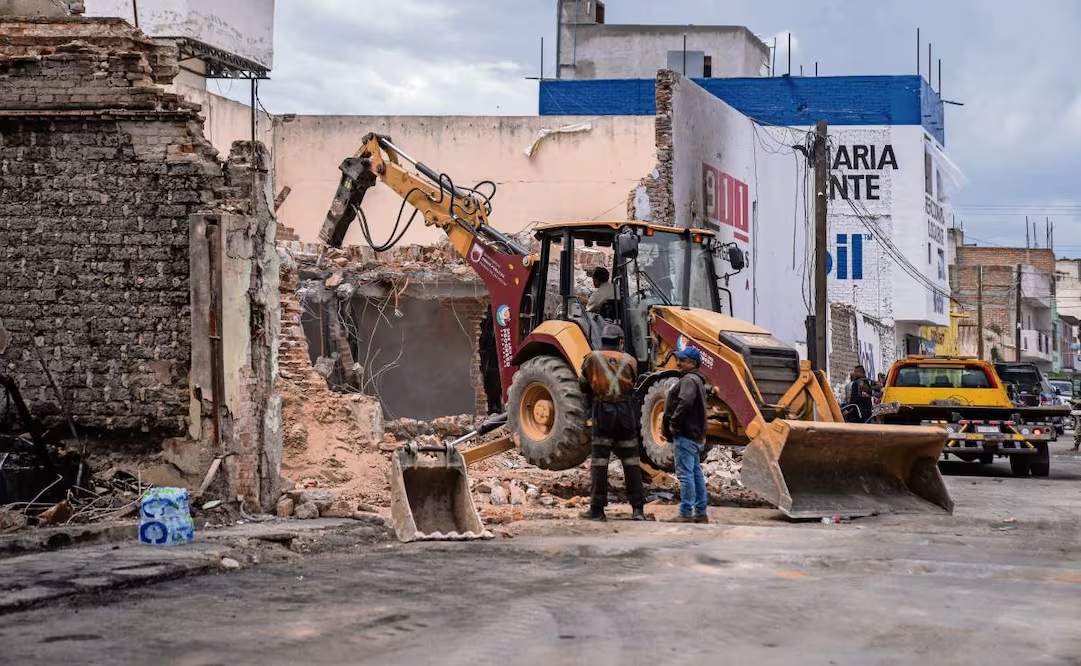

The explosion of a [car bomb] against the police headquarters in Ojocaliente, attributed to the Jalisco New Generation Cartel (CJNG), places the state in a scenario of uncertainty that could reactivate violence.
According to security specialist David Saucedo, the attack opens three possible hypotheses: a territorial advance by this criminal group, retaliation against its adversaries from La Mayiza. However, he points out that the most concerning scenario is the third possibility: that the state is being used as a pawn in what he described as a “war of the narco juniors.”
In an interview with EL UNIVERSAL, Saucedo dismisses the argument made by the government of Zacatecas that the recent explosive attacks in the south-southeastern region are a “desperate reaction” by the CJNG to the alleged success of official operations aimed at pushing them back.
The expert says that this version is insufficient and represents a “very generous victory narrative for itself” that attempts to describe “something that does not exist,” since the real objective of using explosives in populated areas is not because of being cornered, but to intimidate authorities and cause panic.
He considers that, if this third possibility is confirmed, the room for action available to local authorities would be overwhelmed. He explains that if the orders to detonate explosives in Zacatecan municipalities were not the result of a local dynamic, but instead came from “headquarters,” the CJNG leadership’s intention would be to “heat up the turf” in order to provoke a concentration of military troops and leave other regional fronts where they maintain fighting unprotected.
This would mean that the escalation of the conflict in the south-southeastern part of Zacatecas would function as a distraction to force the deployment of security forces and influence other fronts across the country: “La Mayiza has, in fact, been doing that in the vast narco-empire of the Jalisco Cartel; they attack them from Michoacán, the Guadalajara metropolitan area; the Jalisco Cartel responds by attacking southern Sinaloa. In other words, [it is possible] that this is not an event confined to Zacatecas, but rather that it has to do with the geopolitics of the decisions made by the cartels at the national level.”
“Right now, naturally, there will be a movement of troops to protect the south-southeastern region [of Zacatecas], a concentration of troops leaving other regions exposed,” Saucedo explains.
If this scenario materializes, the analyst warns, the attack would not only mark the definitive end of “the truce, the narco peace, or whatever existed in Zacatecas,” which for months had kept the homicide rate in the state under control, but would represent something more concerning, as it would inaugurate an unprecedented phase in the national confrontation resulting from the generational transition in cartel leadership.
He points out that the breakdown of old agreements, such as the alliances between Los Chapitos and the CJNG, or the internal reconfigurations within La Mayiza, have accelerated the rise of new leaders, such as Juan Carlos Valencia, known as El 03, in Michoacán and Zacatecas.
He warns that the situation could become more complicated. “It seems that in Michoacán, Zacatecas, perhaps Guanajuato, there will be an increase in violence, as a result of what is clearly already a war of the narco juniors. There have been changes in the leadership of both cartels: Juan Carlos Valencia in the Jalisco Cartel, and on the other side Mayito Flaco, who has controlled the organization for two years, but with the support of his brother, Mayito Gordo. So yes, it could be that we are now entering a next phase, another season: the war of the narco juniors,” the expert says.
The second hypothesis
Saucedo points out that the high-impact acts of violence recorded in the state must also be analyzed, such as the murder of 10 people in July, including six business owners and two officials from Fresnillo, acts attributed to the Sinaloa Cartel; although, he said, this would be a delayed reaction.
Another factor was the circulation on social media, on August 22, of a video allegedly showing a CJNG cell announcing a “cleanup” and making disparaging statements against security forces and local authorities.
When evaluating this context, he notes that the attacks fit the pattern of threats in which the armed group justifies its attacks against police facilities by claiming to be fighting security forces that it considers aligned with the opposing side.
Car bomb
Regarding the mechanism of the car-bomb attack in a populated area, Saucedo emphasizes that it fits the CJNG’s modus operandi, which it has carried out in Guanajuato, Michoacán, and Jalisco.
However, he considers that the main objective of these attacks is not the elimination of a commander, but rather the psychological impact and social destabilization.
“These are not bombs directed against specific authorities, but rather against authorities in general, with the purpose of causing panic (…) It is enough for the bomb to detonate, cause destruction, such as what we are seeing, and for it to occur near or in front of a government agency for this perception to be automatically created,” he maintains.
Regarding the level of sophistication of the device used in Ojocaliente, he indicates that official investigations by the Attorney General’s Office (FGR) are still pending to determine the type of explosive material and whether the activation mechanism was carried out remotely through radio waves or whether it was a device equipped with a timer.
Source: eluniversal