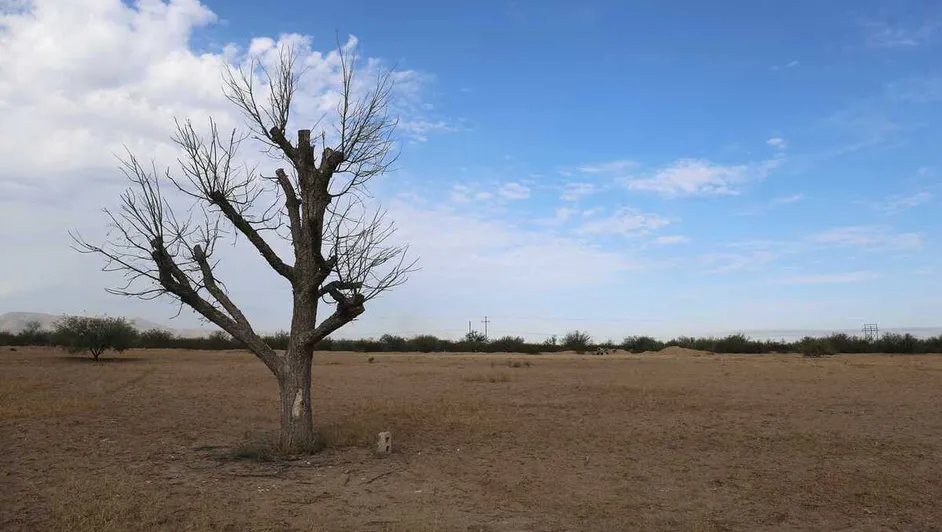

The absence of rainfall has caused 23 municipalities in Coahuila and 11 in Durango to be classified as abnormally dry, according to the Drought Monitor of the National Water Commission (Conagua).
In the case of Coahuila, the impact is more evident in cities located in the Comarca Lagunera, in addition to one municipality that has reached the moderate drought classification.
According to the Drought Monitor, during the first half of August there were rainfall levels close to the climatological average in the northwest, north, and north-central regions of the country, associated with low-pressure channels, cyclonic circulations, and upper-atmospheric troughs, as well as the Mexican monsoon.
However, “below-average rainfall was recorded in all regions of the country, particularly in the north and northeast, where a heat wave persisted for several days.”
Affected municipalities
In addition to this, precipitation deficits were also observed in the central-western, eastern, southern regions and the Yucatán Peninsula. In these areas, “despite the passage of six tropical waves and the presence of various low-pressure channels, precipitation remained below the climatological average, which caused an increase in abnormally dry conditions and moderate drought.”
In the Comarca Lagunera, the municipalities classified as severely dry are Francisco I. Madero, Matamoros, San Pedro, Torreón, and Viesca, in Coahuila. In Durango, they are Gómez Palacio, Lerdo, Mapimí, and Tlahualilo.
In Coahuila, the only municipality experiencing moderate drought is Acuña. Other municipalities, including Allende, Arteaga, Guerrero, Hidalgo, Morelos, Múzquiz, Nava, Ocampo, Parras, Progreso, Ramos Arizpe, Sabinas, Saltillo, San Buenaventura, San Juan de Sabinas, Villa Unión, Zaragoza, and Juárez, are classified as abnormally dry.
In Durango, the municipalities with that classification are Cuencamé, General Simón Bolívar, Guadalupe Victoria, Pánuco de Coronado, San Dimas, and Santa Clara.
Across Mexico, according to Conagua’s Drought Monitor, there are currently 145 municipalities experiencing drought, 676 municipalities classified as abnormally dry, and 1,657 municipalities without any impact.
It should be noted that this authority uses five classifications for the lack of rainfall: abnormally dry, moderate drought, severe drought, extreme drought, and exceptional drought.
Dams maintain low storage levels
In areas such as La Laguna, made up of municipalities in Coahuila and Durango, the lack of rainfall is also reflected in the reduced water levels of the Lázaro Cárdenas and Francisco Zarco dams.
The most recent Conagua report, dated Tuesday, September 1, shows that the dams have storage levels of 24.52 and 50.17 percent, respectively. This continues to put the definition of an agricultural cycle in the spring of 2027 in uncertainty.
However, the possibility of rainfall remains, and the rainy season does not conclude until November. Conagua’s historical records indicate that September is the month with the highest rainfall.
Source: milenio