
Abelardo De la Espriella, a businessman close to conservative sectors, won a narrow victory over progressive candidate Iván Cepeda in Colombia’s presidential election held on June 21. According to Reuters, De la Espriella received 49.66% of the vote, while Cepeda obtained 48.70%, a margin of less than one percentage point.
His victory was accompanied by a “tough on crime” discourse that goes beyond combating organized crime, proposing an expansion of the military and punitive power of the State over social life. During the campaign, he promised to resume aerial bombings against armed groups, build mega-prisons inspired by Nayib Bukele’s model, end the “Total Peace” policy, and strengthen cooperation with the United States on regional security.
This approach has been presented by his supporters as a response to citizens’ fear of violence. However, human rights and press freedom organizations have warned that his proposals could affect democratic guarantees, transitional justice, and civil liberties, especially in a country marked by armed conflict, social protest, and territorial disputes.
His public profile has also been questioned because of controversial statements. Colombian media have documented that, in an interview, he recounted episodes of animal cruelty involving cats and fireworks during his childhood. He has also directed hostile remarks toward Indigenous communities, accusing them of owning a significant portion of Colombia’s land and warning that under his government they would have to “become real citizens” or learn “how hard the tiger bites.”
Added to this are his statements regarding Gaza, where he defended the actions of Benjamin Netanyahu’s government by saying it was doing “what it had to do” to defend its people, adding that he would do the same in Colombia “no matter the cost.” The Foundation for Press Freedom also warned about his hostile rhetoric toward journalists after De la Espriella stated that some reporters “will not do well” under his administration.
With these results, Colombia would move from the first left-wing government in its recent history to a hard-right political project aligned with Donald Trump and centered on security, punishment, military cooperation, and the reactivation of oil and mining contracts.
Following his victory, De la Espriella announced that Colombia would join the so-called “Shield of the Americas,” a hemispheric coalition promoted by Trump under the argument of combating organized crime.
The Project Behind the Tough-on-Crime Agenda
To understand Abelardo De la Espriella’s political project, it is useful to look beyond public fear. His discourse forms part of a broader right-wing tradition linked to defending the existing order, private property, and economic, political, and moral hierarchies. As Norberto Bobbio argued in Right and Left: The Significance of a Political Distinction, the central difference between the right and the left lies in their relationship to equality. The left understands inequality as a historical construction that can be transformed. The right, on the other hand, tends to view inequality as something natural, inevitable, or functional to the social order.
This perspective feeds the defense of the “natural order,” a society organized around tradition, property, authority, family, or religion. In Latin America, this defense of order combines the free market with conservative morality. The internal enemy may be Indigenous peoples demanding land, organized communities protesting, the critical press, feminist movements, the LGBTQ+ population, or any group that challenges property, religion, the traditional family, authority, or corporate power.
Within this framework, “tough on crime” goes beyond a promise of security. It can translate into more prisons, greater military presence, and expanded punitive power over civil society. It can also function as performative punitivism, where punishment becomes a political spectacle designed to create a sense of control while leaving the structural causes of violence untouched. De la Espriella embodies several of these elements: defense of the free market, closeness to Donald Trump, affinity with the Bukele model, promises of mega-prisons, the return of aerial bombings, and hostile rhetoric toward journalists, Indigenous communities, and critical sectors. The key question is whom this security is designed to protect and against whom it directs its force.
Regional Shift
Beyond where Colombia’s president-elect is placed ideologically, what matters is that his victory is part of a broader trend reshaping the region’s political landscape.
In recent years, Latin America has undergone a process of ideological realignment that has altered the political map. Between 2021 and 2022, a new wave of progressive governments appeared to be consolidating after years of conservative administrations, neoliberalism, and social crisis.
In November 2021, Xiomara Castro won the presidency of Honduras. In December of that same year, Gabriel Boric defeated José Antonio Kast in Chile. In June 2022, Gustavo Petro came to power in Colombia. And in October 2022, Luiz Inácio Lula da Silva defeated Jair Bolsonaro in Brazil.
At that time, many analysts spoke of a new “Pink Tide,” but the political map changed rapidly.
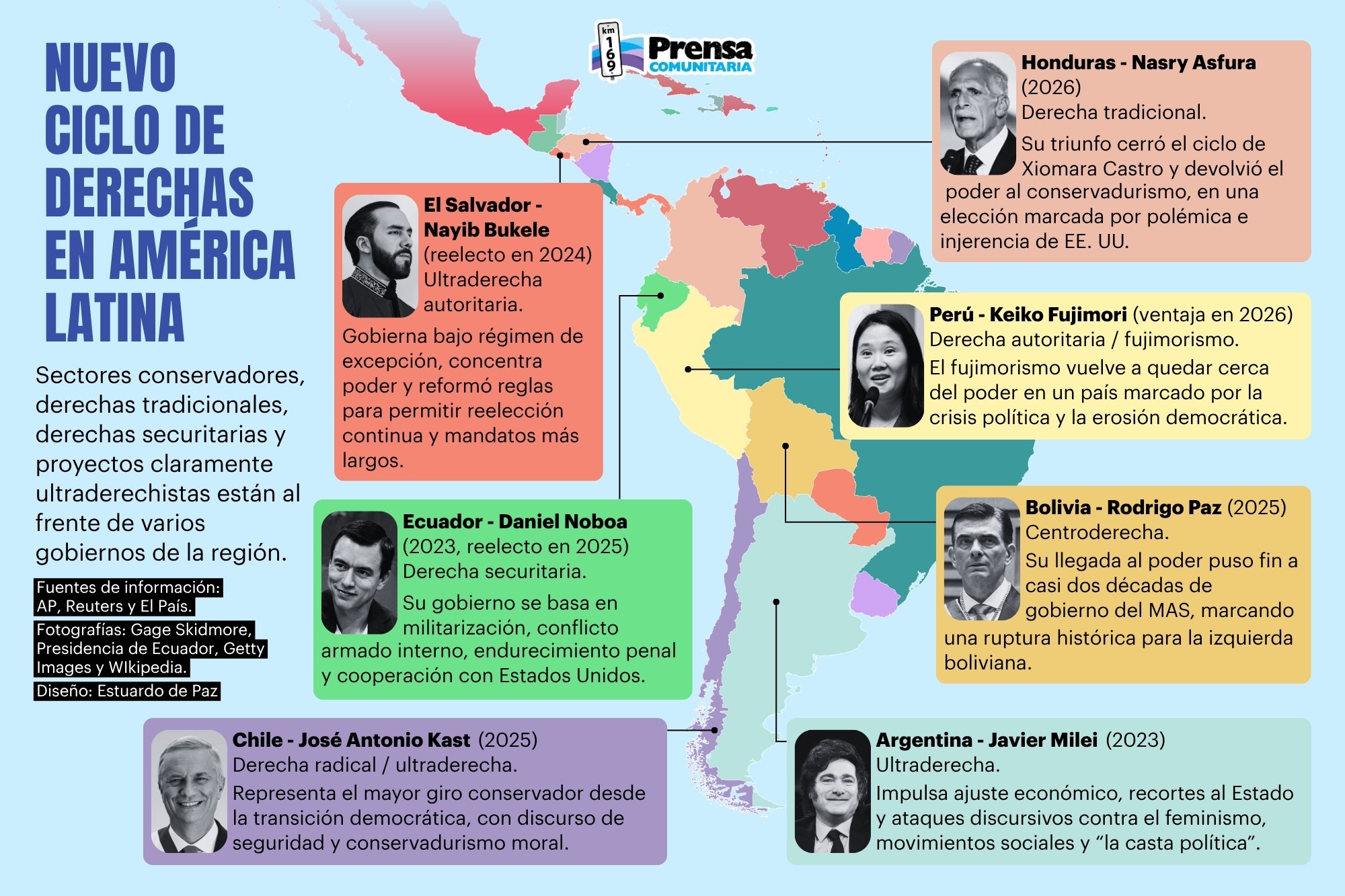
Image Credit: Estuardo de Paz
Sources: AP, Reuters, and El País
Put simply, Latin America entered a new cycle of heterogeneous right-wing governments, including conservative sectors, traditional right-wing parties, security-focused right-wing movements, and clearly far-right projects leading several governments.
Why Is the Right Advancing in Latin America?
To understand this regional shift, several experts warn that it is not enough to say that Latin America “turned to the right.” The phenomenon results from a combination of protest voting, social fear, economic crisis, the erosion of progressive governments, and the weakening of democratic memory.
Political scientist Daniel Zovatto, former director of IDEA International and researcher at the Wilson Center, argued in an interview with Diálogo Político, published on December 17, 2024, that between 2021 and 2024, protest voting against incumbent governments prevailed throughout Latin America. According to Zovatto, the electoral supercycle left a more heterogeneous regional landscape, with neither a dominant red nor blue wave, but one marked by political alternation, government fatigue, and social discontent.
According to Zovatto, protest voting is explained by governments’ inability to restore economic growth, create well-paid formal jobs, and respond to the rising cost of living. “Regardless of political color,” he says, from the voter’s perspective many elections operate under a logic of trial and error, with citizens seeking someone capable of solving problems and delivering results.
Political scientist Steven Levitsky, professor at Harvard University and specialist in democratization, authoritarianism, and political parties, explained in an interview with El País that today’s Latin American right is “a new right,” different from that of the early 2000s.
According to Levitsky, the earlier right, represented by figures such as Sebastián Piñera in Chile, Vicente Fox in Mexico, and Pedro Pablo Kuczynski in Peru, was more liberal, focused on economics and the free market, and maintained greater formal respect for democracy.
The new right, by contrast, combines market economics with discourses centered on security, migration control, anti-communism, and culture wars. From that position, it often attacks feminism, abortion rights, and LGBTQ+ rights, portraying them as threats to the social order.
For Levitsky, it is a less liberal right with a more fragile relationship with democracy: it may accept elections while simultaneously weakening institutional checks and balances, attacking minority rights, and questioning institutions whenever they limit its power.
Meanwhile, Henning Suhr, director of the Regional Program on Political Parties and Democracy in Latin America at the Konrad Adenauer Foundation, warned in an interview with Expediente Público that one of the greatest risks facing the region is the erosion of democratic institutions and the separation of powers.
According to Suhr, Latin America includes authoritarian governments, both left-wing and right-wing, that come to power through democratic mechanisms but later undermine constitutional order, weaken institutions, persecute opponents, restrict freedoms, and attack media outlets and journalists.
This analysis is reinforced by a generational concern: many young people did not directly experience the dictatorships, internal wars, and authoritarian regimes of the twentieth century. For many, those events are distant memories, while their daily political experience is shaped by corruption, violence, economic insecurity, stagnation, and broken promises.
This historical distance may make tough-on-crime rhetoric, strong leaders, and repressive solutions appear new, effective, or even “rebellious.”
The United States and Geopolitics
The rightward shift in Latin America is not only the result of electoral changes. In the region’s new political landscape, the United States has emerged as a key actor seeking to restore its influence through agendas centered on security, migration, anti-drug efforts, free markets, and geopolitical control.
This is nothing new. Throughout much of the twentieth century, the United States exercised predominant influence over Latin America. That relationship included economic cooperation, military alliances, support for certain governments, and, in some cases, direct or indirect interventions that deeply shaped the region’s history.
In Guatemala, the history of U.S. intervention dates back to the 1954 coup against Jacobo Árbenz, the counterinsurgency doctrine during the internal armed conflict, support for military and economic elites, and a long-standing interventionist policy whose language has changed over time.
In the current context, that influence has reemerged strongly under Donald Trump’s administration. In Venezuela, the United States captured Nicolás Maduro in January 2026.
The operation not only removed a ruler accused of authoritarianism and human rights violations; it also revived a historical question for Latin America: who decides political change in our countries—the people or a foreign power?
In Cuba, Reuters reported that the White House defended new sanctions against the island, while United Nations High Commissioner for Human Rights Volker Türk warned that such measures cause widespread harm to the population by affecting access to water, food, and healthcare.
Pressure is not exercised only through troops; it can also take the form of sanctions, energy blockades, trade threats, and financial isolation.
Additionally, the U.S. government has promoted a new regional security alliance called the “Shield of the Americas” to combat organized crime and drug trafficking.
Why Is the Left Losing Ground?
The left has lost ground for multiple reasons simultaneously. It is not simply that Latin America “turned to the right,” but rather that a combination of social, economic, and political grievances accumulated without progressive governments responding as quickly as citizens demanded.
Reuters published a report in February 2025 based on International Labour Organization (ILO) data warning that, although regional unemployment declined in 2024, nearly half of workers in Latin America and the Caribbean remained in informal employment, precarious jobs, or unstable income conditions.
This is compounded by weak economic growth. In April 2025, Reuters also reported that the Economic Commission for Latin America and the Caribbean (ECLAC) had lowered its growth forecast for the region. In this context, issues such as employment, housing, the cost of living, public services, and insecurity weigh heavily on voters.
The second reason is security. The Associated Press (AP) published an analysis in January 2026 explaining how rising crime, pressure from Donald Trump’s administration, and the popularity of Nayib Bukele’s model have pushed even progressive governments toward tougher security policies.
Reuters also reported in June 2026 that right-wing sectors in Brazil are using the so-called “Bukele model” to attract voters frustrated by crime through proposals involving mega-prisons, militarization, and immediate punishment. Although these responses do not address the structural causes of violence, they do create a rapid perception of protection.
In an interview with Cadena SER published in May 2026, historian and journalist Pablo Stefanoni argued that the far right has managed to appear more attractive and combative than the left. This capacity is reflected in its use of social media, provocation, memes, direct language, and constant attacks on opponents. Its leaders do not merely communicate proposals; they build emotion, identity, and an image of rupture with “the same old politicians.”
Another factor is generational and organizational. Reuters published an investigation in June 2026 about young Brazilians distancing themselves from Lula and the Workers’ Party. The report points to economic frustration, stagnant incomes, unmet expectations after attending university, and growing distrust toward the left as a force for change.
Added to this is a deeper democratic crisis. El País published an analysis in June 2026 based on the United Nations Development Programme (UNDP) report Democracies Under Pressure. The report warns that citizens not only want to vote; they also expect better living conditions, security, justice, and opportunities. When democracy fails to deliver these, dissatisfaction grows, creating space for authoritarian solutions promising immediate order.
As of June 2026, the clearest democratic left-wing governments remaining in power are Brazil, Mexico, and Uruguay: Lula in Brazil, Claudia Sheinbaum in Mexico, and Yamandú Orsi in Uruguay. In these three cases, they are left-wing governments that came to power through competitive elections and maintain, despite differences and criticisms, open democratic frameworks.
Cuba, Nicaragua, and Venezuela require a different analysis. Although their governments identify themselves with the left or revolutionary traditions, specialists and international organizations argue that they should not be analyzed in the same way as democratic left-wing governments. Javier Corrales, political scientist at Amherst College, stated in an interview with El País that Venezuela could retain authoritarian structures even without Maduro if there is no genuine democratization, meaningful release of political prisoners, or full inclusion of the opposition.
Similarly, Henning Suhr, director of the Regional Program on Political Parties and Democracy in Latin America at the Konrad Adenauer Foundation, stated in an interview with Expediente Público that there are authoritarian governments “of the left or right-wing populists” that come to power democratically but later attack constitutional order, the separation of powers, human rights, political opponents, media, and journalists.
This distinction also appears in international reports. Freedom House has identified Venezuela and Nicaragua as cases of authoritarian erosion; El País has documented the deterioration of press freedom under Ortega and Murillo in Nicaragua; and Reuters has reported prisoner releases and amnesties in Cuba amid continuing concerns about political prisoners and dissidents.
Therefore, not every political force that identifies itself as left-wing practices democracy. Cuba, Nicaragua, and Venezuela must be analyzed separately, not because of their anti-American or revolutionary rhetoric, but because of allegations concerning restrictions on freedoms, persecution of the opposition, shrinking civic space, political prisoners, and concentration of power.
Guatemala: Neither One Thing Nor the Other
Bernardo Arévalo’s government does not represent a transformative left in the style of Petro, Lula, Boric, or Xiomara Castro. Rather, its project is centered on democracy, anti-corruption, and institutional reform.
Its main struggle has not been against capitalism, extractivism, or economic elites as a whole, but against kleptocratic networks that captured state institutions.
Kleptocratic networks are structures that use the State to enrich themselves, guarantee impunity, control the justice system, and protect business interests.
In Guatemala, these structures do not operate only through political parties; they are also sustained by economic, judicial, military, media, and territorial alliances that have historically determined who has access to rights and who remains excluded.
Guatemala’s government is reformist but constrained by an opposition-controlled Congress, contested courts, and entrenched power structures seeking to block institutional transformation.
In this case, the central dispute cannot be understood simply as left versus right, but rather as democracy versus state capture.
That does not mean Arévalo’s government is beyond criticism. From a community-centered perspective, it remains necessary to ask how far it is willing to challenge the extractive, corporate, military, and racist interests that have historically sustained inequality in the country.
Defending democratic institutions is important, but it is not enough if democracy fails to reach local communities, fails to listen to Indigenous peoples, and fails to transform the material conditions of those who have historically lived under dispossession, poverty, and criminalization.
The advance of right-wing and far-right movements in Latin America shows that democracy does not always collapse overnight. Sometimes it shrinks gradually: when fear justifies militarization, when poverty becomes a crime, when protest is treated as a threat, when Indigenous peoples defending their territories are portrayed as obstacles to development, when rights become negotiable, and when security is used to demand obedience.
For that reason, the regional debate cannot stop at who wins elections. The deeper question is what kinds of societies are being built under the promise of order. If the price of security is giving up rights, accepting police abuses, handing territories over to the market, and remaining silent in the face of inequality, then the promise of order ultimately benefits those who have always concentrated power.
Source: prensacomunitaria.org