
On June 2, 2026, the state leader of Morena in Tabasco, Jesús Selván García, stepped onto a platform and announced two things that did not necessarily have to come together.
The first was that his party would file a complaint against the PRD and its leader, Rafael Acosta León, for distributing a list of alleged Morena candidates that Selván described as false. The second, almost as an aside, was that he himself would step down as state party leader.
It was not a personal split. Selván was leaving because the national party leadership had requested that same month that anyone seeking an elected position in 2027 step down from their current position, with registrations beginning on August 3. He himself will compete for the federal Fifth District coordination, an internal step toward a potential candidacy. Morena was founded as a national political party in 2014 and arrived in Tabasco a year later.
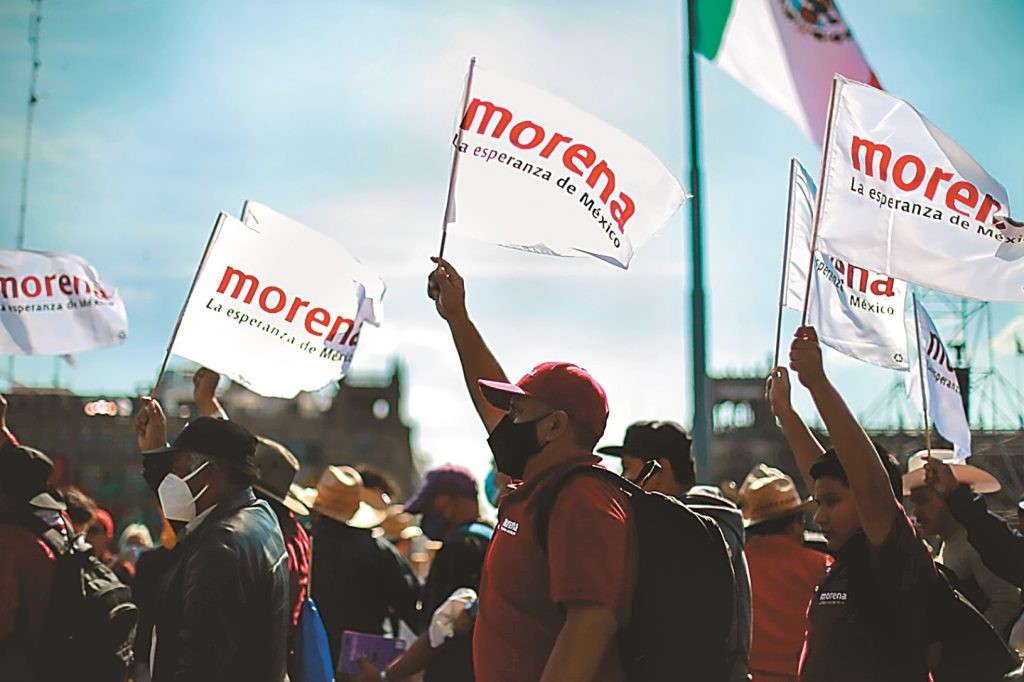
In 2018, it won the governorship for the first time in its history and retained it in 2024 with Javier May Rodríguez, who currently governs the state. In less than a decade, it went from having no electoral presence in Tabasco to winning two consecutive governorships.
Growth in Votes
In its first local election, in 2015, Morena received 115,405 votes for local deputies, representing 13.09 percent of the total valid vote. Six years later, in 2021, that figure increased to 486,860 votes, or 54.10 percent. This represents a 4.2-fold increase in absolute votes and a 41-percentage-point increase in a single midterm election.
Both measurements correspond to midterm elections—the same type of electoral process that Tabasco will experience again in 2027—which makes the comparison directly relevant to what will be at stake in the next election. Its 54.10 percent share is greater than the combined total of the other nine parties, although those parties do not constitute a unified opposition. Instead, they are divided into groups ranging from the PRD’s 14.09 percent downward, with none possessing enough independent strength to challenge Morena for power.
No other party with an established history in Tabasco multiplied its electoral strength so dramatically in such a short period of time, and none has ever surpassed the combined weight of the opposition.
In 2015, with only one year of electoral activity in the state, Morena won its first mayoral race in Comalcalco and four local legislative seats, two through plurality voting and two through proportional representation.
Power Gained
By 2021, that presence had multiplied: Morena controlled 14 of Tabasco’s 17 municipalities, all 21 plurality districts without exception, and 32 council seats, compared with 17 in 2015.
That was the highest level Morena has reached in the state. In the 2024 municipal election—the most recent one—the number of municipalities it governed directly fell from 14 to 11. However, it did not lose those municipalities to the traditional opposition: the three municipalities it stopped governing directly went to its own coalition ally, the Labor Party (PT).
Even so, this represents Morena’s first documented contraction in Tabasco since it began winning elections.
Increasing Dominance… and Resources
That territorial dominance is also reflected in the party’s finances. In 2015, when Morena was just beginning to compete in the state, it received 1.814 million pesos in public financing. By 2021, that figure had multiplied seventeenfold, reaching 31 million pesos in a single year—the largest increase among the ten parties operating in Tabasco.
The law calculates a significant portion of public financing based on the share of votes obtained in the previous election, so the increase runs parallel to Morena’s electoral growth rather than contradicting it.
However, Morena’s complete public-financing series in Tabasco has a gap: there is still no verified figure more recent than 2021, nor a year-by-year breakdown between those two points.
What Comes Next
August 4: Morena selected its federal district coordinators.
Two key decisions: whether López Beltrán will run alone in the Sixth District, and whether Selván or Bosch will take control of the Fifth.
…And It Will Have to Face a Battle Over Its Troubled Past
The La Barredora case and allegations involving Adán Augusto López Hernández created a rift between groups within Morena.
Beyond the financial aspect, Morena carries in Tabasco the most serious political baggage of any party in the state. Hernán Bermúdez Requena served as Secretary of Public Security between 2019 and 2024, after being appointed by then-Governor Adán Augusto López.
Since August 2025, several investigations have identified him as the alleged leader of La Barredora, a criminal cell that split from the CJNG and was involved in fuel theft, extortion, and kidnapping. He was arrested in Paraguay while an active Interpol Red Notice was in effect.
The Unexpected Rift
The rift that this case created within Morena itself became public even before Bermúdez’s arrest.
On November 13, 2024, just weeks after taking office, Governor Javier May stated:
“We will never make deals with organized crime (…) I believe those who came before us will have to explain all of this.”
Regarding the leadership of La Barredora, he went further:
“Everyone knows, here it was common knowledge who was running ‘La Barredora.’ Don’t we know?” And when the audience responded by pointing to Bermúdez, he nodded: “Yes, right?”
Morena has spent 12 years winning two consecutive governorships and governing 11 of the state’s 17 municipalities.
May also accused the previous administration of allowing “a widely known practice of charging protection fees in Tabasco, where food establishments and merchants were charged (…) The damage they caused to Tabasco is serious.”
Division Within the Party
With those statements, May did not reveal a new fact—the investigation into Bermúdez was already underway—but he did something no other Morena governor had done until then:
He used the office’s public platform to describe alleged corruption within his own party’s previous administration as something widely known, rather than treating it as a family secret.
The PRI asked the Attorney General’s Office (FGR) to investigate Adán Augusto himself for possible criminal association. Documents from the National Electoral Institute (INE) show that an associate of Bermúdez financed campaign events for Adán Augusto in 2023.
The division between the two groups became visible on July 20, 2025, when Adán Augusto avoided greeting May at Morena’s National Council meeting, and the dispute remained alive during discussions over the state’s 2026 budget.
A Major Test Before Voters
The case belongs to a state administration that has already ended, not to Javier May’s administration. However, the extraordinary aspect is that it represents the largest political liability Morena carries from its own previous government, and it is a negative factor before voters.
14 to 11 municipalities: the contraction Morena experienced between 2021 and 2024.


Source: tabascohoy