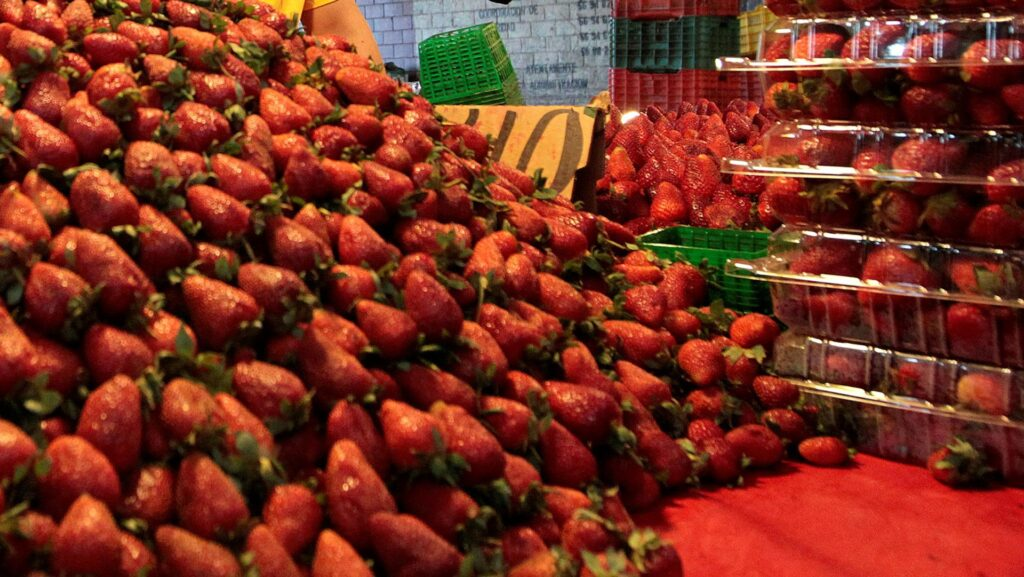

The Government of Mexico expressed its “serious concern” over the possible harm to the strawberry industry following the United States’ preliminary determination regarding “dumping” and warned that the case could become a precedent against other Mexican horticultural exports.
The official position, issued this Friday by the Secretariat of Economy, came after the U.S. Department of Commerce (DOC) estimated dumping margins this week ranging from 3.37% to 5.28%, depending on the company, and 4.83% for most Mexican exporters.
The United States considers strawberries to be part of a dumping scheme, meaning that the fruit imported into the country from Mexico enters at a price lower than that of the domestic industry.
However, Mexico’s Secretariat of Economy considered the application of seasonality and regionality criteria to be “arbitrary” and argued that they are not consistent with the World Trade Organization (WTO) Anti-Dumping Agreement or provisions of the United States-Mexico-Canada Agreement (USMCA).
The U.S. resolution is preliminary and is part of an investigation launched after Florida producers requested the imposition of antidumping duties on Mexican strawberries on December 31, 2025.
According to the Mexican agency, the U.S. International Trade Commission (ITC) concluded in March that there were no grounds to treat winter strawberries as a different product or to recognize a regional market, although it had previously determined that there was a reasonable indication of material injury to a U.S. industry and allowed the investigation to continue.
Mexico warned that, if the resolution is confirmed, it could affect nearly 5,000 strawberry producers, of whom 97% cultivate ten hectares or less, as well as approximately 151,000 people employed in the crop.
Mexico exported approximately 263,000 tons of strawberries to the United States in 2025, worth $1 billion, according to the Secretariat of Economy.
Previously, the National Agricultural Council (CNA) also rejected the measure and warned that extending seasonal or regional criteria to other food products would create uncertainty for investments, exporters, and consumers, as well as potential pressure on supply, prices, and inflation.
Aneberries, which represents producers and exporters, maintains that the two industries are complementary, since Mexico primarily supplies strawberries between November and March, when U.S. supply decreases, while it imports strawberries from California during the summer.
Likewise, the Mexican sector denies that its competitiveness is the result of unfair practices.
The Secretariat of Economy announced that it will continue coordinating with producers and exporters during the following stages.
Under U.S. rules, once the resolution is published in the Federal Register, Customs and Border Protection will require cash deposits equivalent to those margins.
The rates are temporary and may change before the DOC’s final ruling, which is expected around January 8, 2027.
Source: holanews