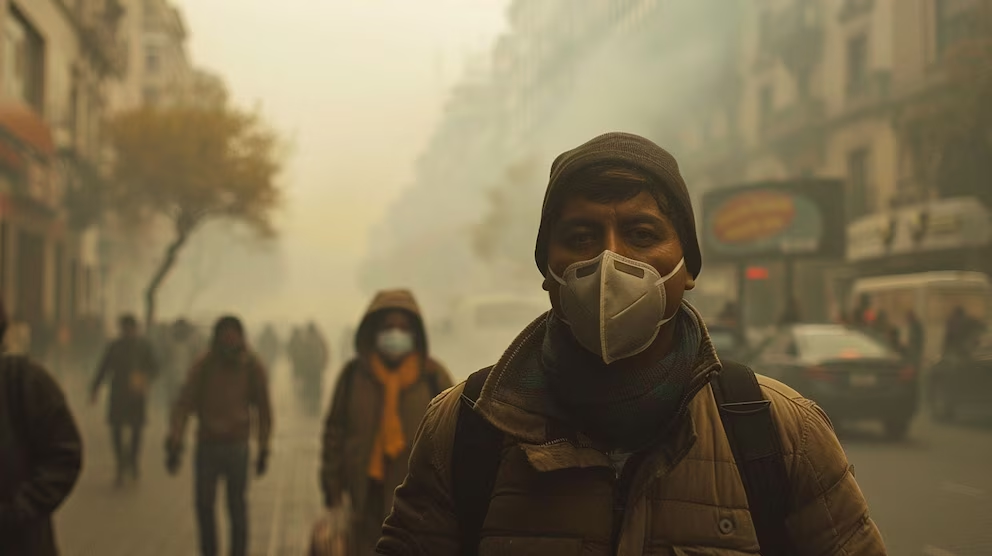

Pollution can cause a series of health problems for people who breathe oxygen in such conditions. For this reason, the Mexico City government, as one of the largest and most populated cities in the world, conducts constant monitoring of air quality.
Every day, every hour, the capital’s Atmospheric Monitoring Directorate publishes its air quality report for Mexico City and the metropolitan areas of the State of Mexico.
With each update, the capital’s authorities urge the public to take precautions regarding outdoor activities and even implement measures in this area, such as the Environmental Contingency and the double Hoy No Circula program.
This is the report from the Mexico City Atmospheric Monitoring Directorate for August 20, as of 3:00 p.m.
Air Quality in Mexico City and the State of Mexico
The capital government’s Air and Health Index reported that air quality is “Poor” this Thursday in Mexico City and the State of Mexico.
This means that the health risk is “High” for residents of Mexico City and the State of Mexico who engage in outdoor activities, particularly sensitive groups.
Regarding the Ultraviolet (UV) Index, a level 4 was recorded, meaning that “protection is needed” against the intensity of the sun.
In this regard, Mexico City authorities issued the following recommendations:
Take precautions if you are exposed to the sun. If your skin is sensitive, wear a hat and UV-filtering sunglasses and apply sunscreen with SPF 30+.

Where the Air Quality Is Worst in the Valley of Mexico
The Atmospheric Monitoring Directorate has 16 stations that monitor air quality in Mexico City. These were the results from each station according to the latest report:
Tlalpan (AJM): Poor
Benito Juárez (BJU): Poor
Azcapotzalco (CAM): No data or under maintenance
Coyoacán (CCA): Poor
Cuajimalpa (CUA): Poor
Gustavo A. Madero (GAM): Poor
Cuauhtémoc (HGM): Acceptable
Iztacalco (IZT): Poor
Venustiano Carranza (MER): Poor
Miguel Hidalgo (MGH): Acceptable
Álvaro Obregón (PED): Poor
Cuajimalpa (SFE): No data or under maintenance
Iztapalapa (SAC): Poor
Tláhuac (TAH): No data or under maintenance
Coyoacán (UAX): No data or under maintenance
Iztapalapa (UIZ): Acceptable
Meanwhile, the 13 monitoring stations located in the State of Mexico reported the following air quality:
Atizapán (ATI): Acceptable
Chalco (CHO): No data or under maintenance
Cuautitlán Izcalli (CUT): No data or under maintenance
Naucalpan (FAC): Acceptable
Nezahualcóyotl (FAR): Acceptable
Ecatepec (LLA): Acceptable
Tlalnepantla Annex (LPR): Acceptable
Nezahualcóyotl (NEZ): Poor
Ecatepec (SAG): Acceptable
Tlalnepantla (TLA): Poor
Tultitlán (TLI): Acceptable
Coacalco (VIF): No data or under maintenance
Ecatepec (XAL): Acceptable
It should be noted that some municipalities and boroughs appear more than once on the list because they have more than one atmospheric monitoring station.
The City with the Highest Level of Air Pollution
Mexico is among the Latin American countries with the highest levels of air pollution, with Mexico City slightly surpassing Santiago, Chile, in fine-particle concentrations.
The 2024 World Air Quality Report, prepared by IQAir, indicates that air pollution in the country is a significant problem, mainly due to the high concentration of PM2.5 fine particles, which are the most dangerous to health. In 2024, Mexico’s PM2.5 concentration was approximately 3.5 times higher than the annual reference value recommended by the World Health Organization (WHO).
The main pollutant in Mexico and in cities such as Monterrey is PM2.5, which consists of organic chemicals, dust, soot, and metals originating from vehicles, factories, and the burning of materials. These microscopic particles can enter the bloodstream and are associated with respiratory and cardiovascular diseases, as well as other serious health conditions.
Source: infobae