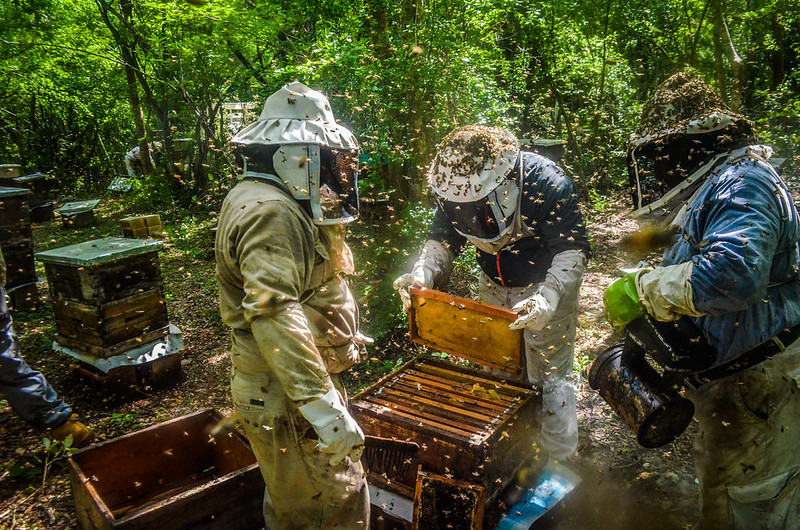

The five states with the highest honey production in Mexico last year were Yucatán with 9,893 tons, Chiapas with 6,071 tons, Jalisco with 6,029 tons, Campeche with 5,653 tons, and Veracruz with 5,297 tons, according to the Secretariat of Agriculture and Rural Development (Agriculture).
Mexico also stands out as a strategic and highly competitive player in the international honey trade, ranking as the ninth-largest exporter with a 3.8% share.
Between 2021 and 2025, Mexico exported an average of 27,200 tons of honey annually, representing a value of $94 million, according to data from the Secretariat of Economy and the International Trade Centre (ITC).
Honey exports continued to rise between 2024 and 2025, increasing from 20,000 to 26,000 tons. In 2025, Mexican honey reached consumers in 30 countries.
Germany and the United States remained the main trading partners and priority destinations for Mexican honey, jointly accounting for more than 63% of the total value exported in 2025. They were followed by the United Kingdom, Saudi Arabia, Switzerland, Belgium, Spain, the Netherlands, Japan, and Poland.
Based on records from the General Directorate of Agro-Food and Fisheries Information Service (DGSIAP) of Agriculture and the National Livestock Registry (PGN), Mexico currently has 2,201,329 honeybee colonies and 6,775 stingless-bee colonies (meliponines).
The country also has 34,699 Livestock Production Units dedicated to beekeeping and 221 focused on meliponiculture.
With this infrastructure, national honey production reached 60,297 tons in 2025. This represented a 5.0% increase compared with the 57,430 tons recorded in 2024 and an 11.4% increase compared with the 54,122 tons obtained in 2020.
The federal agency estimates that production will also exceed 60,000 tons this year.
However, last May, following the announcement that honey production for 2026 could reach more than 60,000 tons, beekeepers from several municipalities in Campeche expressed surprise, highlighting the difficulties they face in maintaining their apiaries.
Campeche is the third-largest honey-producing state in the Yucatán Peninsula, and much of the honey produced in the state is collected by companies from neighboring Yucatán. These companies are able to obtain greater commercial value because of their customers in Europe and the Middle East. Consequently, they pay Campeche producers better prices.
Benjamín Yeh Acosta, a beekeeper from San Francisco Suctuc, said that over the past 10 years they have faced deforestation caused by pesticides and agrochemicals that are harmful to the environment, as well as an increase in human settlements. He also pointed to Mennonite communities because of the impact their agricultural activities have on the Maya jungle.
Source: lajornadamaya