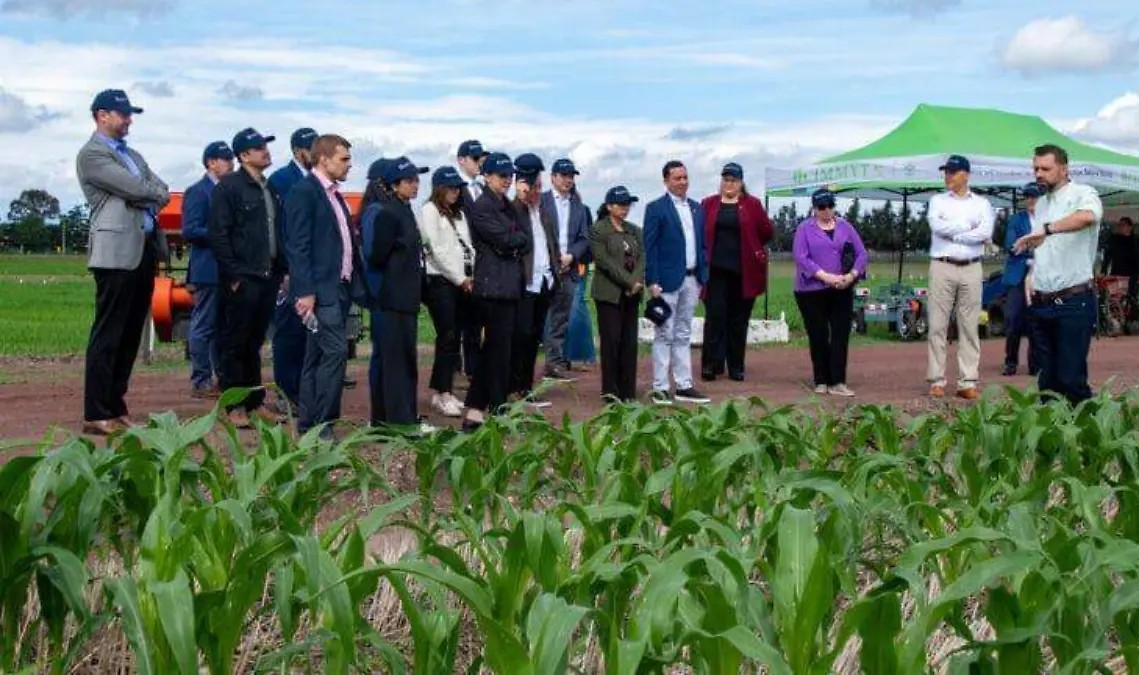

The project, which began in 2023, has achieved the cultivation of 11,400 hectares of yellow corn in areas previously unavailable in the states of Jalisco and Sinaloa through sustainable practices and producer training through the partnership between the International Maize and Wheat Improvement Center (CIMMYT) and Ingredion.
This was stated by CIMMYT Director General Bram Govaerts upon renewing its partnership with Ingredion Mexico with a new five-year agreement from 2025 to 2030.
“The partnership between Ingredion and CIMMYT, which we are renewing today, has created genuine opportunities for sustainable supply and production of yellow corn in Mexico,” he explained.
On Earth Day, Bayer proposed regenerative agriculture, a way of producing food that reduces environmental impact and regenerates natural resources.
“This marks the beginning of a new era for integrating science, innovation, and territorial action as a response to the current challenges of the country’s agri-food sector.”
According to CIMMYT, this partnership proposes a concrete strategy: to provide producers and their communities with agronomic innovations, adapted technologies, and technical support, as well as to promote sustainable, fair, and equitable supply models.
This is achieved through CIMMYT’s territorial articulation model, which links science with traditional and local knowledge, strengthening regenerative agricultural capacities and practices aimed at improving resilience, increasing productivity, and reducing environmental impact.
Jaime López, President and CEO of Ingredion Mexico, commented: “This collaboration is a clear demonstration that it is possible to implement economic practices that are also sustainable.”
“We do this because we believe in a more responsible and regenerative agriculture that benefits both producers and the country,” he added.
He noted that the company is about to celebrate its first 100 years in the country and added: “At the same time, we see the scale of the challenge, the growing population, climate change, and we feel a legitimate concern that is becoming urgent.”
He affirmed that beyond the numbers, in the face of climate change, geopolitical, and trade disruptions, agribusiness must be part of the solution.
“It’s not optional; we must all respond from our different roles in the agrifood chain,” he emphasized.
Govaerts recognized Ingredion’s leadership in committing “to a vision for the future, not only in strategic plans or goals, but with a firm, signed, and financial commitment lasting five years: from 2025 to 2030.”
He emphasized that the success in the sustainable production of yellow corn “is not insignificant because it is yellow corn with its own production and market challenges, grown in Jalisco and Sinaloa, regions where this had not been achieved before.”
He mentioned that they have managed to reduce greenhouse gas emissions by up to 20 percent through optimal and timely use of fertilizers.
“We built a successful model that has mobilized more than 100,000 tons of grain since 2023 and that we expect to exceed 400,000 tons by 2030.”
He explained that 430 producers are involved in the project, 15 percent of whom are women, with 11,400 hectares of land with increased production in the states of Jalisco and Sinaloa, resulting in the production of 120,000 tons of corn using sustainable practices.
To this end, 60 field training events were held, with the participation of 1,200 people, including producers and technical staff, in this program.
Source: oem