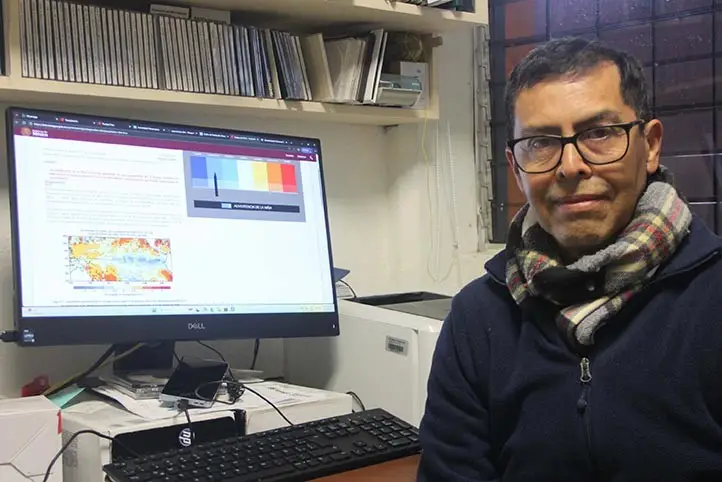

The presence of the La Niña phenomenon has been a determining factor in the current winter in Veracruz, which is characterized not only by low temperatures but also by increased humidity and rainfall, particularly in the southern part of the state, explained Juan Cervantes Pérez, an academic in the Atmospheric Sciences program at the University of Veracruz (UV). He emphasized the importance of understanding how atmospheric changes are measured and predicted.
The specialist stressed that there is a fundamental difference between astronomical seasons and climatological seasons. While the former are defined by the Earth’s position relative to the Sun and can be predicted with accuracy, the latter reflect the average behavior of variables such as temperature and precipitation.
“Astronomical seasons simply indicate the Earth’s position in relation to the Sun; that’s why we can know exactly when winter or summer begins,” he explained.
However, he added, these are indeed related to the climatic seasons, since the amount of solar energy received directly influences atmospheric conditions.
In the case of Veracruz, Cervantes Pérez recalled that a calendar of seasons and meteorological phenomena was established years ago in collaboration with the Civil Protection Secretariat.
According to this system, the meteorological winter, which includes cold fronts and northerly winds, begins in the second half of September and ends in mid-May.
The phenomenon known as La Niña originates in the equatorial Pacific Ocean, off the coast of Peru.
“Many people wonder why it lasts until May, if it’s already warm in April. The reason is that a cold front can still move through during those months,” he pointed out.
The academic also explained the difference between a climatological forecast and a meteorological forecast: The former refers to the average conditions expected over an entire season, while the latter describes the state of the atmosphere in the short term, generally between three and seven days.
“A climate forecast tells us what we can expect on average; the meteorological forecast is constantly being updated because the atmosphere is in motion,” he noted.
In this regard, he recommended that the public always check the date, time, and validity of weather bulletins.
Regarding the recent cold fronts, he indicated that no record minimum temperatures have been registered, so this is an average winter season, although with a distinctive characteristic: the influence of La Niña.
This phenomenon, associated with temperature anomalies in the equatorial Pacific Ocean, favors rainier winters in Mexico.
The National Meteorological Service forecasts indicate higher rainfall in southern Veracruz for March.
“Depending on its intensity, La Niña can generate more rain, and this winter we have had a combination of cold air and high humidity,” he explained.
This interaction of factors gives rise to a key concept for everyday life: the wind chill, which depends not only on the ambient temperature but also on the interaction between variables such as wind and humidity.
“In winter, if the temperature is low and the wind picks up, the wind chill makes us feel colder,” the academic commented.
Currently, the combination of low temperatures, humidity, and wind has caused cold fronts to feel more intense and prolonged, lasting up to three or four days.
Finally, the academic highlighted the social relevance of weather forecasts, as they allow for long-term planning, especially in sectors such as food production and water management: “This information is very useful for decision-makers and for society in general,” he concluded.
He also recommended consulting weather bulletins and noting the date and time of issuance, given that conditions can change within hours and in some cases there are drastic drops in temperature. Therefore, he recommended staying informed about warnings issued by the relevant authorities, such as the Civil Protection Secretariat.

Source: uv