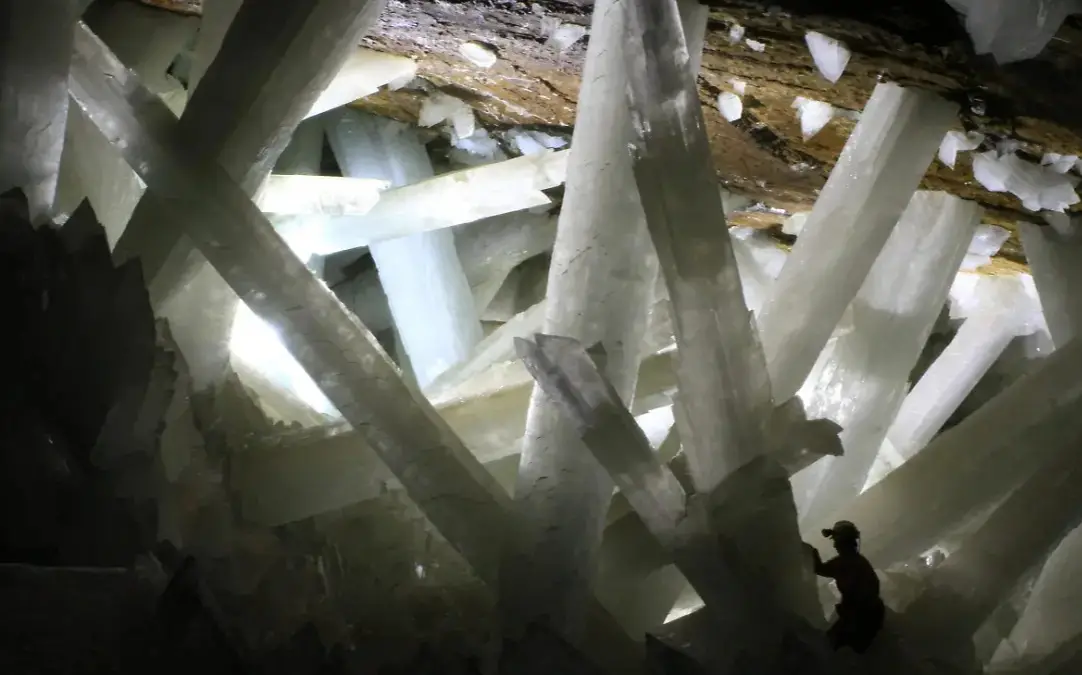

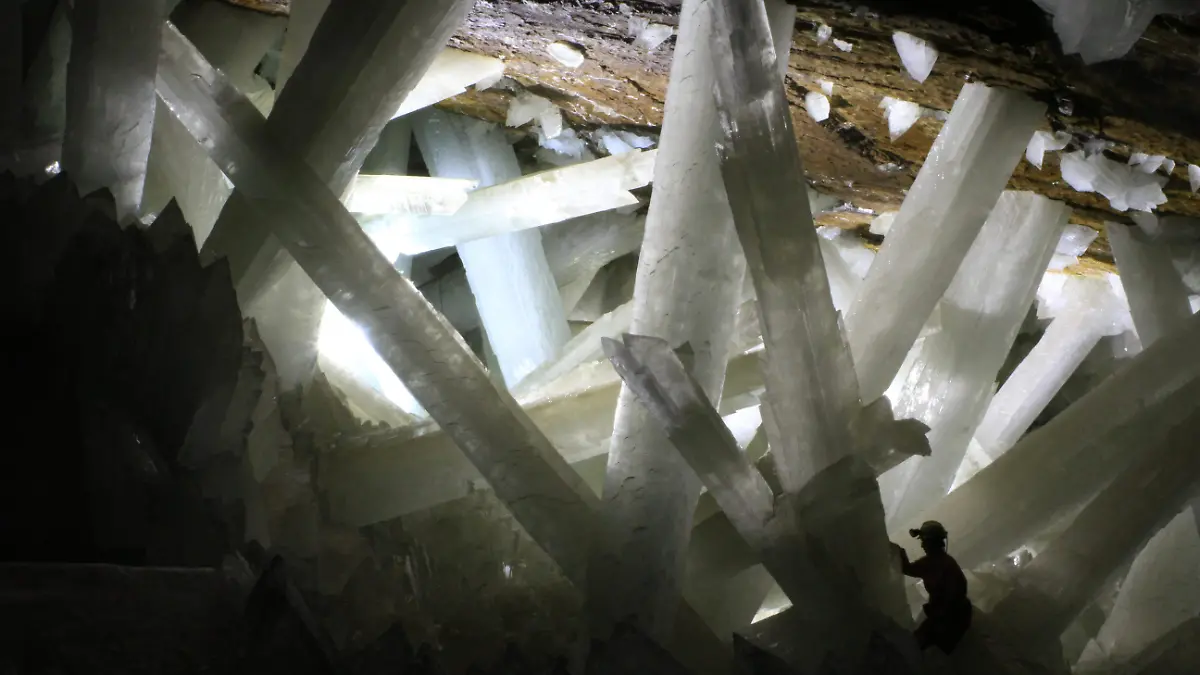
Nearly 26 years ago, in the southern part of the state of Chihuahua, the Cave of Crystals in Naica was discovered, one of the most extraordinary scientific finds in recent history, and its crystalline formations are the largest in the world.
In April 2000, brothers Eloy and Javier Delgado, miners, drilled to a depth of about 300 meters inside the Naica mine, located in the municipality of Saucillo. What they found was a natural chamber with the largest selenite crystals in the world.
The cave was formed by a hydrothermal system fed by a deep magma chamber. Approximately 26 million years ago, this geothermal heat warmed the groundwater, creating ideal conditions for the mineral anhydrite to dissolve and give rise to the formation of gypsum or selenite crystals.
It is estimated that the crystals grew for hundreds of thousands of years, under constant conditions of temperature (around 58 °C) and near 100% humidity.
The crystals adorning the cave are among the largest ever recorded by speleologists worldwide: some reach up to 12 meters in length and weigh more than 50 tons. However, the interior of the chamber is an extreme environment.
The high temperatures and humidity mean that a human can only remain inside for 6 to 10 minutes without protection. Therefore, even before its closure, access was restricted exclusively to scientific teams equipped with refrigerated suits.
In 2015, the Naica mine was closed and flooded, leaving the cave completely submerged. It is currently closed to the public, and access is nearly impossible.
However, during the 2000s, the cave was the subject of numerous studies. Scientists from the Naica Project and NASA even found dormant microorganisms trapped inside the crystals, estimated to be up to 50,000 years old, which sparked great interest in the study of extremophile life forms.
Although it remains inaccessible today, the Cave of Crystals in Naica continues to be a benchmark of geological and scientific richness.
Source: oem