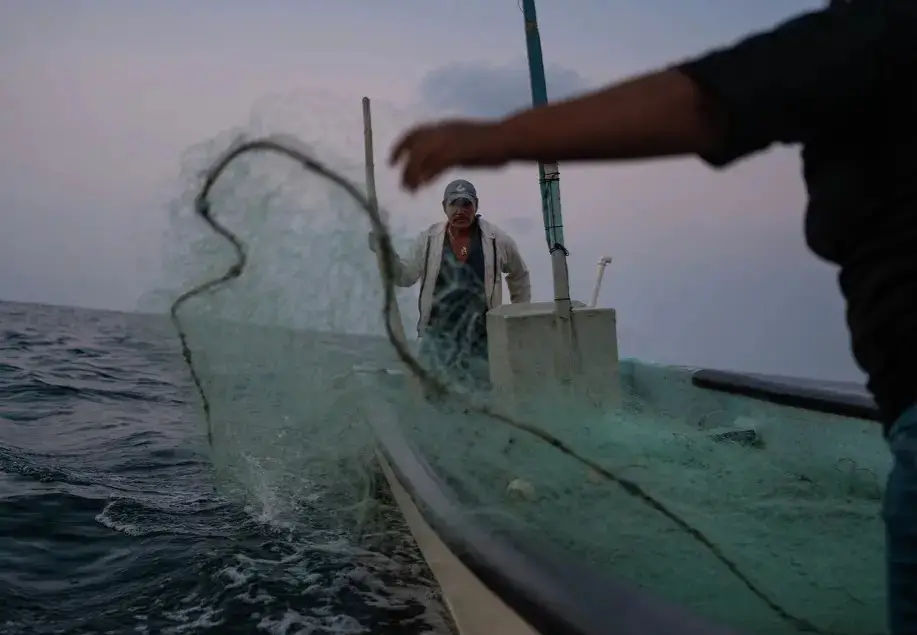

The sun has already set and a violet hue begins to tint the clouds when Mauricio Contreras and his daughter Eunices head out to fish in Los Arrecifes, in the southern Mexican state of Veracruz. Eunices is in charge of casting the heavy net into the water to catch snapper, pollock, or grouper while her father steers the small boat through the Gulf of Mexico.
With skin tanned by the sun and a chain with an anchor hanging from his chest, Contreras says he has been fishing for over 40 years, but now he fears that his family’s main source of income is at risk because of an underwater pipeline built last year to transport natural gas from the United States.
“When they started laying it, it affected us because the ships were dumping explosives, and you could hear it all the way here, right on the shore,” he recalls. Now that it’s operational, what worries him most is a possible leak. “It’s a constant danger that will always be there, and it’s a risk for the entire fishing industry.”
The pipeline, known as Puerta al Sureste (Gateway to the Southeast), was built by the Canadian company TC Energy in partnership with the Mexican state-owned utility CFE. It connects to an existing pipeline linking South Texas with Tuxpan, Veracruz, and extends it another 700 kilometers under the seabed to Paraíso, Tabasco. It is already supplying electricity to the Dos Bocas refinery, but its primary objective is to deliver gas to the Yucatán Peninsula by expanding another pipeline that is still under construction.
This project is part of a wave of initiatives across the country aimed at expanding existing infrastructure to import more natural gas from the United States. With this expansion, Mexico—already the world’s largest buyer of U.S. gas—seeks to meet its domestic electricity demand and re-export some of that gas to Asian and European markets.
However, the project is facing increasing resistance from the communities where it is slated to be built, from Los Arrecifes to the Gulf of California. It also faces criticism from the country’s leading environmental groups, who argue that the strategy increases the use of a fossil fuel that pollutes the air and moves Mexico further away from its climate commitments.
Contreras speaks of fishing as a way of life. In his community, it is almost the only source of employment, and throughout the state of Veracruz, more than 40,000 people depend on the sea for their livelihood. He was one of the residents of 15 coastal communities who filed a lawsuit last June against the gas pipeline. Although initially dismissed, it remains in litigation after an appeal was filed.
The lawsuit alleges that these communities, mostly indigenous Nahua and Nuntajiiyi’, were not consulted about the project before construction began, as required by the Mexican Constitution. “We don’t agree with this gas pipeline megaproject because we were never informed. We were never consulted, and therefore we don’t know the consequences,” says Maribel Cervantes, who also signed the lawsuit, from her patio in the community of San Juan Volador.
The government argued that it was a matter of national security and kept much of the information about the pipeline secret, including its exact route. When asked about the case at one of her morning press conferences last year, Mayor Claudia Sheinbaum said that “it’s well worth bringing natural gas to that area.”
When the pipeline construction was proposed, the environmental organization Greenpeace warned that the dredging work to bury the pipeline could affect deep-water reefs. These types of reefs, called mesophotic reefs, can live at depths of over 150 meters and are home to many marine species, including some that cannot be found in other types of reefs.
Pablo Ramírez, coordinator of Greenpeace’s energy and climate change program, also warns that this type of infrastructure “commonly leaks methane, and the leakage of this type of gas affects the water chemistry and nearby ecosystems.” Ramírez points out that the reefs of Veracruz “are home to many species of marine flora and fauna,” including green, hawksbill, and Kemp’s ridley sea turtles, which depend on them for food and nest on the beaches of communities like Los Arrecifes.
Source: expressnews