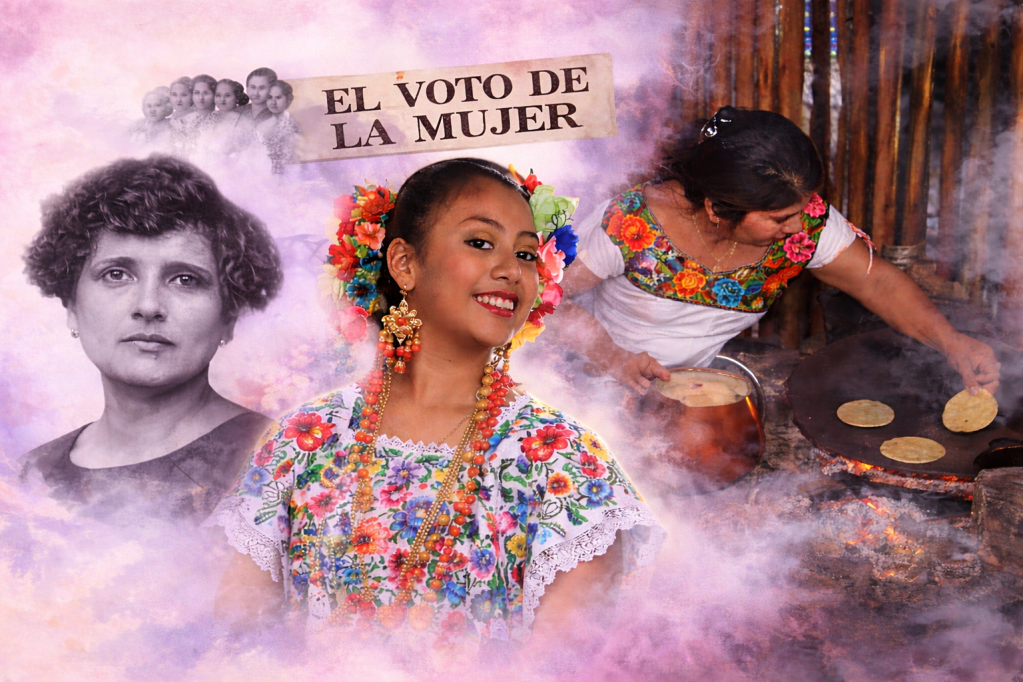
In January 1916, Yucatán hosted the country’s First Feminist Congress, considered one of the first in Latin America. More than 600 women debated education, legal equality, and civil rights, decades before the constitutional recognition of women’s suffrage in Mexico in 1953.
Among its main proponents were Elvia Carrillo Puerto and Rita Cetina Gutiérrez. This event positions the state as the epicenter of early feminism in the region.
First state to recognize women’s suffrage
In 1922, during the administration of Felipe Carrillo Puerto, Yucatán allowed women to vote and be elected in municipal and state elections, more than 30 years ahead of federal recognition.
On January 1, 1923, Rosa Torre González became the first woman in Mexico to hold an elected office, as a councilwoman in Mérida.
That same year, Elvia Carrillo Puerto was elected to the state legislature, establishing herself as one of the leading advocates for women’s suffrage and the peasant feminist movement.
Yucatán marked the beginning of women’s political participation in the country.
Greater female participation in the economy
In 2024, women’s participation in the Yucatecan economy reached its highest level: 44.9% of the employed population are women, according to INEGI data.
This trend has been sustained:
2003: 36.4%
2013: 41.6%
2023–2024: 44.9%
This growth reflects progress in economic inclusion, especially in sectors such as education, health, commerce, and tourism.
Historic representation in the State Congress
In 2021, the 63rd Legislature marked a milestone: for the first time in history, the State Congress had a female majority (14 out of 25 seats).
In the current legislature (2024–2027), women hold 17 of the 35 seats, consolidating the constitutional principle of substantive equality and political parity.
Women and Leadership in the Tourism Sector
Tourism, one of Yucatán’s economic engines, has a strong female presence in both employment and entrepreneurship.
According to the 2024 Economic Census by INEGI (National Institute of Statistics and Geography), women are predominantly involved in:
Accommodation services
Restaurants
Retail trade
Cultural and recreational activities
Furthermore, women’s groups in municipalities such as Maní, Valladolid, and Tekax are part of state gastronomic routes, strengthening community-based tourism.
Social and Community Leadership
Yucatecan women excel in:
Mayan artisan cooperatives
Mayan language preservation projects
Rural entrepreneurship
Civil society organizations
In many communities, they are the primary transmitters of ancestral knowledge, gastronomy, and culture.
Women in Science and Education
Yucatecan women are also breaking stereotypes in STEM fields (Science, Technology, Engineering, and Mathematics).
Scientists like Jessica Jesús Arcudia Muñoz, with international recognition, stand out.
Institutions such as ENES-Mérida promote science vocation programs for girls in coordination with SEGEY (Yucatan State Education Secretariat). As part of these efforts, the book “Stories That Inspire More: Women with Science,” featuring 30 stories of Yucatecan scientists, was published for children.
For its part, the Autonomous University of Yucatán (UADY) runs the STEM-UADY Program, which promotes the entry and retention of women in science careers through mentorship and academic support.
From local cooperatives to international organizations, Yucatecan women have been key players in the social, political, economic, and cultural development of the state.
Source: notirasa