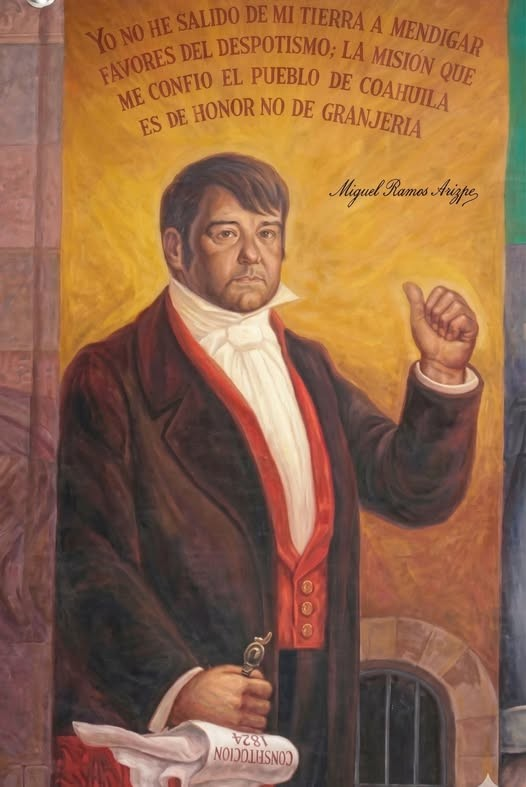

A priest who didn’t just preach from the pulpit. A politician who refused to bow to the powerful. A liberal who championed federalism when most still favored a centralist empire. His name is Miguel Ramos Arizpe. He was born in northern Mexico, in Coahuila, when the country was still a viceroyalty. He was a priest, a congressman, and a government minister. He was one of the architects of the 1824 Constitution, the first to attempt to organize Mexico as a federal republic. He was called the “Father of Federalism.” They weren’t exaggerating. Without him, Mexico would have been different. Without him, perhaps centralism would have prevailed forever. He died on April 12, 1843, leaving a profound mark, though few remember his name today.
In 1843, Miguel Ramos Arizpe, a prominent priest and liberal politician known as the “Father of Federalism,” died. He wasn’t a man of battles, like Hidalgo or Morelos. He wasn’t a military leader, like Santa Anna. He was a man of law, of debates, of speeches. And in those debates, in those speeches, he forged the idea of a decentralized Mexico, where the provinces would have autonomy, where power would not be concentrated in a single city.
Ramos Arizpe was born in 1775 in Valle de San Nicolás, Coahuila. At that time, Coahuila was a forgotten province, far from the center of power. Perhaps that is why he understood better than others that Mexico could not be governed from Mexico City with an iron fist. The regions had to be given a voice. Their differences had to be respected. He studied at the Seminary of Guadalajara, was ordained a priest, and served as a parish priest. But his true passion was not liturgy. It was politics.
In 1808, when Napoleon invaded Spain and King Ferdinand VII was taken prisoner, Ramos Arizpe spoke out in favor of popular sovereignty. It was a dangerous idea. The peninsular Spaniards, who controlled the viceroyalty, saw him as a subversive. But he did not remain silent. He was elected deputy to the Cortes of Cádiz, where he participated in drafting the Constitution of 1812, Spain’s first liberal constitution. There he defended the rights of the American provinces. There he displayed his oratorical talent.
Upon his return to Mexico in 1821, he found an independent but disorganized country. He disliked Agustín de Iturbide’s empire. It was centralist. It concentrated power in a single person. Ramos Arizpe opposed it. He was one of the signatories of the Plan of Casa Mata, which overthrew Iturbide. Later, as a constituent deputy, he drafted the Constitutive Act of the Federation, which was the basis of the Constitution of 1824. For this reason, he was called the “Father of Federalism.”
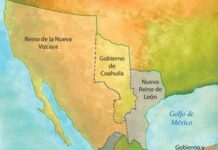
The Constitution of 1824 created the free and sovereign states we know today. The union of Coahuila and Texas into a single state was one of his creations. Ramos Arizpe was the first governor of that state. He governed with a firm hand, but with justice. He promoted education, agriculture, and commerce. He tried to balance the ambitions of the Anglo-Saxon settlers arriving in Texas with those of the Mexicans already living there. He could not prevent the Texas rebellion, but it was not for lack of trying.
In his later years, he served as Minister of Finance and Justice in the central government. He tried to bring order to the public finances, which were always in crisis. It was not easy. War, corruption, inefficiency—everything conspired against him. But he never lost faith in federalism. He never accepted that Mexico needed a dictator.
He died on April 12, 1843, in Mexico City. He was sixty-eight years old. His remains rest in the Rotunda of Illustrious Persons, but his name is not as widely remembered as it should be. Mexican children learn about Hidalgo, Juárez, and Zapata. They learn almost nothing about Ramos Arizpe. And yet, without him, federal Mexico would not exist. Without him, we might still be living under a centralist government, with the states subject to the will of the president in office.
Ramos Arizpe was not a perfect man. He had his contradictions. He defended the sovereignty of the provinces, but he also supported measures that limited freedom of expression. He was liberal in politics, but conservative in religion. He was a man of his time. But what cannot be denied is his consistency: he dedicated his life to building a federal Mexico, a Mexico where the regions had a voice, a Mexico where power was not concentrated in the hands of a few.
Today, as the country once again grapples with the choice between centralism and federalism, between the concentration of power and its distribution, the figure of Miguel Ramos Arizpe acquires a relevance he could never have imagined. He was a precursor. A visionary. A man who understood that Mexico’s greatness lies not in its uniformity, but in its diversity. That’s why, even though it sounds like a cliché, he remains the “Father of Federalism.” And fathers, even if their children forget them, will always be fathers.

Source: asombroso