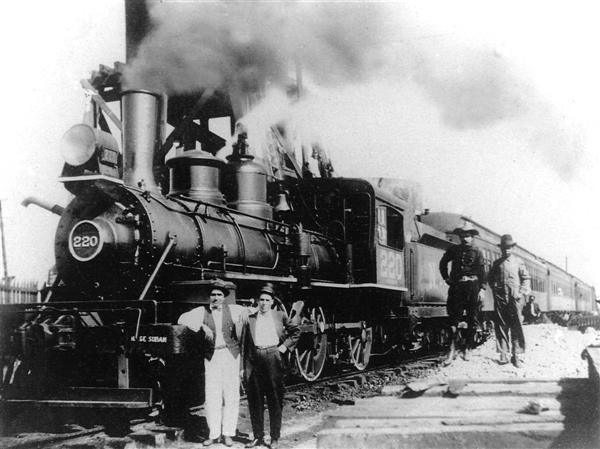

At the beginning of the Porfiriato, the only railroad in the country was the Mexico City-Veracruz line. Porfirio Díaz dedicated a significant portion of his efforts and capital to building railway lines that connected major Mexican cities with the main ports and borders. By 1910, an astonishing 19,280 km had been built (out of the 23,389 km that exist today in Mexico).
Simultaneously, postal and telegraphic communications were expanded to cover almost the entire national territory, and local telephone service was introduced in cities. The ports of Veracruz, Tampico, Salina Cruz, Coatzacoalcos, Mazatlán, Manzanillo, and Guaymas were expanded and modernized.
Social peace attracted foreign investment in industry, and the first steel foundry and the first factories for cement, flat and blown glass, beer, paper, and cardboard in all of Latin America were built. Large-scale extraction of iron, copper, oil, and coal began. The first banks and department stores were established, such as El Puerto de Liverpool, Las Fábricas de Francia, El Palacio de Hierro, and El Puerto de Veracruz. Horse-drawn carriages began to be replaced by the first automobiles, and cities began to be illuminated with electricity.

By 1894, Mexico’s external debt problem, which stood at 97 million pesos at that time, had been resolved, and that year, for the first time in the history of independent Mexico, the government had a financial surplus of two million pesos, which began the formation of monetary reserves for a possible emergency.
All of this led President Díaz to declare:
“The Mexican people, with vigorous drive and clear judgment, have gone from anarchy to peace, from misery to wealth, from disrepute to credit, and from international isolation to the broadest and most cordial friendship with all civilized humanity.” At the same time, in a more private setting, Porfirio Díaz defined the people as follows:
“Mexicans are content to eat junk food indiscriminately, get up late, be public employees with influential patrons, arrive at work late, get sick frequently and obtain paid leave, have endless fun, marry very young and have children in abundance, spend more than they earn, and go into debt to throw birthday parties.”

Source: humbertovaldez