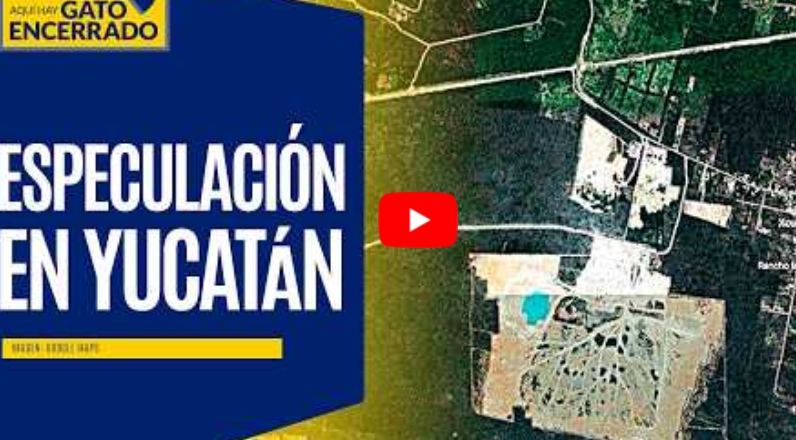

The lands of Mérida and northern Yucatán, a state with rainforests, mangroves, and cenotes, are being invaded by real estate developments that target them as areas for sale and investment. This has also intensified mining activity for construction materials.
Some projects shut down by the Federal Attorney for Environmental Protection (Profepa) in recent years involved deforestation due to the conversion of forest land use without environmental permits, the clearing of mangroves to open roads and lots, or the filling of wetlands in ecological reserves.
As part of this real estate boom without clear land-use planning, the environmental agency has also received complaints from residents of Xculur Sur, Tebec, and Yaxcopoil against nearby stone quarries such as Grupo Zamudio, Materialies Ku, and Procon’s Ticimul plant, due to the presence of dust and explosives.

But when Mayan communities have opposed the privatization and exploitation of their land and water for urbanization, they have been intimidated or even criminalized, Mayan councils warned Chief Justice Hugo Aguilar and federal authorities in recent meetings in the nation’s capital. This warning was reiterated during a demonstration in Mérida on Saturday, March 21, by residents of Dzitznup, Ixil, Kinchil, Molas, Santa María Chi, Sisal, and other communities.
The 2024 National Agrarian Registry documents that in Yucatán, the number of parcels with “full ownership,” which were transferred from communal landholdings (ejidos) to private property, grew by 133 percent from 2010 to 2024, increasing from 7,406 parcels (33,295 hectares) to 17,316 parcels (99,279 hectares). This is legal under the 1992 Salinas-era Agrarian Law, whose Program for the Certification of Ejido Rights and Titling of Urban Plots (PROCEDE) allowed the privatization of land for highways and urban, tourism, and agro-industrial developments in preparation for the then-NAFTA agreement.
Using figures up to 2019, a report by the Mexican Civil Council for Sustainable Forestry determined that the six-year term in which the most ejido land was converted into private property was that of Enrique Peña Nieto (2012-2018), when Jorge Carlos Ramírez Marín, now a Senator for the Green Party of Mexico (PVEM), headed the Ministry of Agrarian, Territorial and Urban Development (Sedatu) from 2012 to 2015, as can be seen in the graph.

Although legal, the Yansa Foundation, which supports community processes for defending territory in the Yucatán Peninsula, has also detected some methods of dispossessing ejido lands through the falsification of assembly minutes or cabinet minutes by lawyers or real estate developers who, through deception or bribery of ejido commissioners and collusion with agrarian officials, transfer communal ejidos to private property.
“The real estate boom is offering our territory to the highest bidder. These are projects that aren’t discussed with us, and we only find out about them once the land has been handed over to people who want to exploit it and don’t care that we live here. Those of us who live on this land aren’t statues; we’re here and we live here. And that’s what we say: we Maya are here,” stated Peregrina Cutz, from the Ixil Community Council, one of the rural municipalities that the state government wanted to include in the Mérida Metropolitan Area.
The Federal Attorney for Environmental Protection (Profepa) has identified this unregulated real estate boom and has temporarily closed several properties in recent months for changing the land use of forest land without permission from the Ministry of Environment and Natural Resources (Semarnat), for cutting down mangroves, or for filling in wetlands.
“This is a problem we’ve had for several years, particularly in coastal states, where there’s a large influx of tourists. Although Mérida isn’t a coastal area, the surrounding areas are, and it has been a very attractive place due to its natural wealth. For many years, there has been a real estate boom, disorderly growth without permits, and that’s why we’ve had such a strong presence there; we’re going to be very vigilant to ensure that land use regulations and the protection of our country’s forest lands are respected,” Environmental Attorney Mariana Boy told SinEmbargo’s Data Unit.

On October 27, 2025, the Federal Attorney for Environmental Protection (Profepa) temporarily shut down construction of the “Savia Residencial” real estate project, located in the town of Xcunya, municipality of Mérida, Yucatán, due to the removal of natural vegetation affecting five hectares for the construction of roads and streets without the required permits from the Ministry of Environment and Natural Resources (Semarnat). However, this development, to date, offers 369 premium residential lots starting at 200 square meters on its website, with amenities such as a swimming pool and recreational park.
The environmental agency has also carried out closures of illegal construction projects in the coastal town of Sisal and in the protected natural areas of the Ría Celestún Biosphere Reserve, Dzibilchaltúnla National Park, and the Cuxtal Ecological Reserve.
This includes temporary closures of construction projects in the coastal town of Chelem, in the municipality of Progreso. This area falls within the buffer zone of the Ciénagas y Manglares de la Costa Norte de Yucatán State Reserve, home to all four mangrove species found in Mexico (red, black, white, and buttonwood), as well as other native flora species protected and listed under NOM-059-SEMARNAT-2025. There, women are undertaking arduous mangrove reforestation efforts in response to the real estate boom.
Maya women like Shirley Galaz Hernández, from the Community Council of Sisal, a coastal town in northern Yucatán, are urging people not to invest in construction projects at the expense of their communities’ suffering and the devastation of their jungle, mangroves, and cenotes.
“Yucatán is beautiful and Sisal is a paradise, but we are immersed in a very destructive real estate boom. We ask you not to buy land because behind these properties, behind these sales that enrich real estate companies, lies the pain of the Mayan communities who are being dispossessed of their territories and criminalized for defending the lands where our ancestors have lived; the Mayan people want to continue living in their communities,” he stated.
Among various cases is the real estate agency École, which is advertising land for sale around Mérida, either for personal use or for long-term investment (resale, rental, etc.).
Its advertising—including digital ads on Google Maps—offers residential lots of 225 square meters with delivery in 2027 in the exclusive Country Club area for 1,010,497 pesos. Or in the coastal area of Progreso and Laguna Rosada, it sells commercial/residential lots with immediate delivery, totaling 2,265,361 lots of 575 square meters each, among other areas and prices.
The agency shares testimonials of “successful investments,” such as that of a woman from Mexico City, who stated that a friend told her that “there’s a boom right now” in Mérida, and at the end of 2022—when the Maya Train station in Mérida had not yet opened—she decided to invest in installments and remotely. In other words, she doesn’t know the land, but through WhatsApp she knows its appreciation potential and that—unlike other emerging areas without urbanization—there are basic services (electricity, drainage, water) and secondary services (businesses) nearby. This is a property in the Cholul-Conkal-Chicxulub corridor, where a 187 m2 plot is priced at 590,000 pesos and is expected to be delivered in 2029.
“Don’t delay because it’s getting more and more expensive. The price has risen a lot (since 2022), and it’s not even finished. I know it’s a very peaceful place to live, and it’s growing a lot right now. (…) I see it as a retirement home, but I might decide to sell the land or turn it into an Airbnb later, since it’s a very touristy area where (it’s said) the meteorite that wiped out the dinosaurs fell,” the buyer stated in a video from the real estate agency.
Another buyer from Atizapán, State of Mexico, commented that while looking for land, she noticed that “just as Mérida is growing, so are the scams” involving properties that lack state government certifications.

Another real estate case is “Paraíso Sisal.” Sisal is a coastal town in the municipality of Hunucmá, now part of the recently decreed Mérida Metropolitan Area, which includes the El Palmar and Ciénegas del Norte de Yucatán ecological reserves and is highly coveted for tourism and real estate development.
Particularly since it was declared a “Pueblo Mágico” (Magical Town) in December 2020, land has been sold off unchecked, and construction has destroyed wetlands and mangroves to make way for roads and lots due to the lack of sustainable land-use planning. Furthermore, it holds the “Platinum Beach” certification for the clean-up efforts of local residents, which real estate companies exploit in their advertising.
“They put Sisal in the spotlight by designating it a ‘Pueblo Mágico’ (Magical Town). It’s amazing how social media was flooded with ‘Sisal, Sisal, Sisal,’ and that brought in so many people. We know that’s all about selling off Sisal. Who owns the land? Who has the concessions? Who are the owners? We work ourselves to the bone cleaning the beach here, and the next day the real estate companies come and take a pretty picture of it all clean, and that’s the one they post to sell their land,” explained resident Teresa Hernández.
Shirley Galaz Hernández, from the Sisal Community Council, recalled that during the administration of former PRI governor Ivonne Ortega (2007-2012), lands now adjacent to the El Palmar Ecological Reserve were expropriated and became the property of the real estate company “Paraíso Sisal,” according to Decree 294 issued in 2010. The company shares this decree on its website to provide legal certainty to those interested in investing “in the last virgin beach on the Yucatán coast,” where they have already sold more than 200 lots without access to potable water (they offer cisterns and water trucks).
Private roads in Sisal
A traditional road used by the residents of Sisal has been closed off with boundary markers that extend even into the sea. Photo: Special for SinEmbargo.
In 2018, the company obtained permission from Semarnat (the Ministry of Environment and Natural Resources) to change the land use designation of more than 17,000 square meters of forest land. The Environmental Impact Statement indicates that of the 994,000 m² of the property, 235,000 m² (23%) are within a conservation area. The Federal Attorney for Environmental Protection (Profepa) conducted an inspection in 2019, but it did not result in a closure order.
However, in 2023, Profepa temporarily shut down the construction project of the real estate company “Paraíso Sisal” because it had opened roads through coastal dune scrub vegetation and installed geotubes to prevent the sea from reaching the lots. In a statement, the environmental authority warned investors:
“The area is authorized only for subdivision; each person who purchases a lot must complete the necessary procedures with the corresponding authority to be able to build,” Profepa stated in April 2023.
Shirley commented that “Paraíso Sisal” continues to offer lots for sale. On its Facebook page, its last post, from November 2025, offers 750 m² for 5 million pesos. “With all the real estate developments around, all the land sold, wetlands and mangroves destroyed, and roads closed off by individuals who have bought land in these areas, we are losing this ‘magical town’ designation,” said the Mayan woman.
Teresa stated that enormous efforts and partnerships are needed for development in her “magical town” to be planned and organized by the authorities and the community, since, thanks to that designation, some locals now depend on tourism.
“It not only damages the flora and fauna, but it also leads to overpopulation and water quality issues. We are a community of 2,000 inhabitants according to the last census (INEGI, 2020), but these real estate projects have an impressive number of subdivisions,” she affirmed.
In February and March of 2025, inspectors from the Federal Attorney for Environmental Protection (Profepa) detected three areas on the Sisal coast affected by the removal of mangroves, covering 37,784 square meters. Profepa placed seals on the affected areas, but these were repeatedly broken to continue the clearing of vegetation and even the subdivision of land without authorization. Consequently, the environmental protection agency filed a complaint with the Attorney General’s Office (FGR).

Source: sinembargo