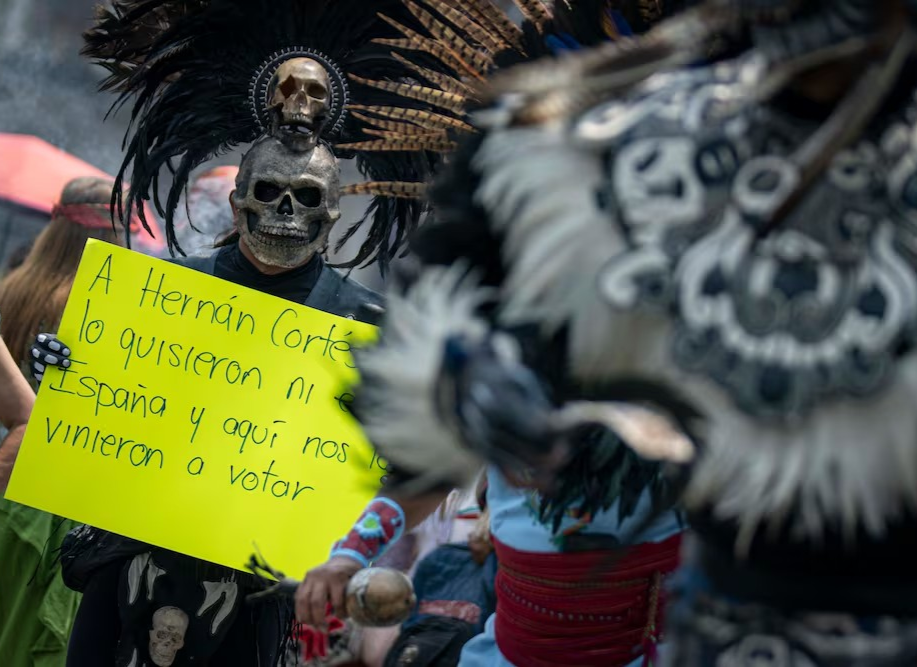

We know that Isabel Díaz Ayuso, president of the Community of Madrid, did not come to Mexico to support the movement of her allies on the Mexican right. If that was her objective, she has failed spectacularly. It is more logical to think that, from Mexico, she was speaking to her electoral base, the Spanish right wing that considers Hernán Cortés one of its most important symbols; as is her custom, her goal is to gain media attention, and she has certainly achieved that. Most of the Mexican population did not know her, and the majority of that population now condemns her statements about Cortés and the Conquest. President Claudia Sheinbaum has responded to this matter without mentioning Díaz Ayuso by name; voices from Spain have also condemned her statements, such as Manuela Bergerot in the Madrid Assembly.
Díaz Ayuso has not gone unnoticed; she even canceled the rest of her tour, accusing the Mexican government of sabotaging it to perpetuate the controversy. But let’s remember, Díaz Ayuso isn’t speaking to Mexico as a whole; she’s speaking to a voter base she’s trying to broaden through a well-known, and often successful, strategy: polarization. To the timid acknowledgment by the King of Spain and the Spanish government of the abuses committed during the Conquest, Díaz Ayuso counters with a narrative in which her country should be proud of the atrocities committed with the establishment of colonization.
The Mexican right and the very weak far right that embraced Díaz Ayuso’s visit have long suffered from a complete lack of political imagination, resorting to importing foreign formulas to gain relevance. They recently tried to replicate in Mexico the so-called One Piece Revolution led by Generation Z in Indonesia. They failed, as they have in every attempt at social mobilization. Now they’ve opted to take refuge under the discursive umbrella of a born provocateur who has gained prominence through controversial statements.
Díaz Ayuso’s discourse on Hernán Cortés is nothing new in Mexico. The groundwork had been laid; in 2025, Ricardo Salinas Pliego and his wife, María Laura Medina, announced they would bring the musical Malinche by Nacho Cano, a close friend of Díaz Ayuso, to Mexico. Another producer of this show is David Hatchwell, also very close to the president of the Community of Madrid and known for having been one of the main donors to Benjamin Netanyahu’s campaign in Israel.
In this right-wing narrative, celebrating Hernán Cortés is necessary because without him, mestizaje (racial mixing) would not have occurred; for them, Mexico’s existence is owed to Cortés, as Nacho Cano clearly stated at the event held at the Frontón México. Díaz Ayuso, for her part, declared that “mestizaje is hope and joy”; she took these ideas to a ridiculous extreme when she said that what has happened here has been 500 years of love.
It is interesting how the discourse of mestizaje (racial mixing) is being co-opted by the right wing, given that for many decades it has been the foundation of post-revolutionary Mexican nationalism. Within their conceptual framework, the atrocities associated with the establishment of colonialism were a price to pay for mestizaje to exist. However, as is often the case, they confuse mixing with mestizaje. Mestizaje is a political process through which the Mexican population was de-indigenized. This was achieved through racist mechanisms that stripped Indigenous and Afro-descendant peoples of their languages and cultural practices, transforming them into Spanish-speaking mestizo Mexicans. A mestizo is a population that has ceased to identify as Indigenous or Afro-descendant based on violent and structural mechanisms.
Mestizaje is not synonymous with cultural and genetic mixing, nor does it have to be. Mestizaje is an ideological and political operation to de-indigenize the native population; cultural and genetic mixing is a characteristic of all human societies. No culture is pure; races don’t exist as biological categories; therefore, all people in the world are mixed. This leads us to another possible narrative, an alternate history in which there were cultural and genetic exchanges between the many worlds that inhabited this continent and the worlds that inhabited Europe. There could have been mixing without conquest, an intense exchange of knowledge without genocide, musical exchanges and fusions without slavery, the exchange and fusion of culinary traditions without the dominion of the Spanish crown, and the adoption of the best of all worlds without colonialism.
Source: elpais