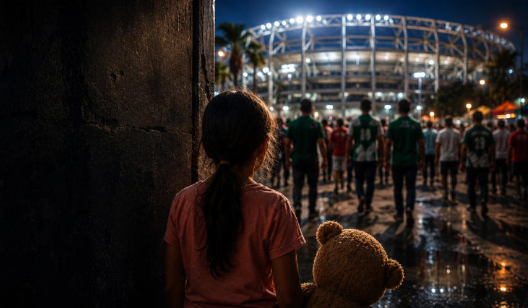

On June 11, 2026, the World Cup organized jointly by the United States, Mexico, Canada, and FIFA begins, and millions of people will arrive in our country. There will be money, cameras, tourists from every continent, and a level of international exposure the country has not experienced in decades.
Behind this sporting celebration lies a reality that many prefer to ignore: a warning that specialists, legislators, and international organizations have been raising for some time—sex tourism.
In Mexico, this is neither an isolated phenomenon nor a marginal distortion of the tourism sector. It is a form of exploitation fueled by impunity, social vulnerability, institutional weakness, and criminal networks operating in some of the country’s most visited destinations.
In the context of a mega-event such as the World Cup, the risk is not hypothetical: international experience shows that these types of mass gatherings often stimulate already existing illicit markets.
Talking about sex tourism means talking about who sustains it, how it is organized, who its victims are, and why Mexico approaches the 2026 World Cup from a particularly delicate position.
What Is Sex Tourism and Why Does It Exist?
The World Tourism Organization (UNWTO), in the Declaration of the World Congress Against Commercial Sexual Exploitation of Children in June 1996, defines sex tourism as a form of exploitation in which a person travels—within or outside their country—with the purpose of engaging in sexual activities in contexts where they perceive less surveillance, greater impunity, or greater social vulnerability among potential victims in exchange for financial compensation.
When minors are involved, the term changes to: child sex tourism. It ceases to be merely morally questionable conduct and becomes a crime that violates the most fundamental human rights.
However, if we examine the issue more closely, sex tourism cannot be reduced to the idea of “traveling to have sex,” because that definition minimizes a much deeper and more structured phenomenon, especially when discussing vulnerable individuals and, even more so, when the victims are children.
The fundamental question is why it exists and what leads an offender to cross a border in order to abuse a minor. Studies by organizations such as ECPAT International, INTERPOL, and the United States Department of Justice have identified several factors. One of the main factors is the perception of anonymity: while outside their home country, some offenders believe they are less likely to be identified, reported, or punished.
Another factor is cultural distortion: many offenders convince themselves that relationships with minors are “more tolerated” or “less stigmatized” in certain countries, even when this belief is false. Economic rationalization also plays a role: they believe the money they provide “helps” the victim or their family, as though payment could erase violence and harm.
ECPAT International, one of the organizations with the longest history of documenting this phenomenon, distinguishes two common profiles. The first is the offender linked to clinical pedophilia, with a specific attraction to prepubescent boys and girls.
The second is what the United States Department of Justice describes as a transitional or situational abuser: someone who does not necessarily identify as a pedophile, who may have a job, a family, and an apparently normal social life, but who acts when they perceive opportunity, anonymity, and a low probability of punishment.
Research by ECPAT International and specialized authorities has documented that offenders involved in child sex tourism are predominantly men and do not fit a single economic or professional profile. They include people capable of international travel from various regions of the world, including Western Europe and the United States. They travel with money, valid documentation, and the belief that laws are not enforced with the same rigor in certain destinations. The problem is that, for too long, that perception has found real conditions that allow it to persist.
Mexico: A Place in the Statistics No One Would Want
For more than a decade, civil society organizations, legislators, and specialists have repeated the same warning. In 2012, Mexico’s Chamber of Deputies stated in an official communication that Mexico ranked second worldwide in incidents of child sex tourism. More than ten years later, those warnings have not significantly diminished.
Between January 2015 and February 2025, Mexico’s Executive Secretariat of the National Public Security System recorded 2,835 minor victims in human trafficking cases: 2,119 girls and 716 boys. The figure alone is alarming, but it represents only the visible portion of a crime characterized by severe underreporting.
The scale of impunity helps explain the magnitude of the problem. Less than one percent of child sexual abuse cases in Mexico result in a conviction. This means impunity is neither partial nor exceptional—it reaches levels close to 99 percent.
The organization Reinserta has estimated that at least 20,000 girls, boys, and adolescents become trafficking victims each year in the country. Three out of every ten trafficking victims in Mexico are minors, and among that group, seven out of ten are girls and female adolescents. These numbers do not describe isolated incidents but rather a persistent crisis.
There is another statistic that further aggravates the situation. Mexico accounts for approximately 60 percent of the production of child sexual abuse material in the Americas. This is not a matter of perception or international image but a documented reality identified by organizations and observatories monitoring the expansion of these crimes in both physical and digital environments.
In Mexico City, the Citizen Council for Security and Justice has indicated that 62 percent of cases classified as human trafficking correspond to what was previously referred to as child pornography and is now correctly identified as child sexual abuse material. The remaining cases involve forced prostitution, labor exploitation, and forced labor.
Meanwhile, the number of visitors entering the country continues to rise. In 2025 alone, Mexico received 98.2 million foreign visitors. Simultaneously, the International Organization for Migration has warned that a proportion of international travel may be linked to sex tourism and that a small but alarming percentage of travelers exhibit pedophilic tendencies or behaviors associated with this phenomenon.
The Victims: Who They Are and How They Are Recruited
The most widespread image of trafficking for sexual exploitation is often incomplete. It does not always involve a child kidnapped by a stranger. The reality is far more complex, which is precisely why it is more difficult to detect and combat.
In 51 percent of trafficking cases involving children and adolescents—excluding those related to child sexual abuse material—the recruitment occurs through a family member or someone within the victim’s close circle. In other words, the danger does not always come from outside. In many cases, it is already present within the victim’s everyday environment.
In the digital world, recruitment methods have also diversified. Victims are contacted through Facebook, Instagram, and WhatsApp, but also through dating applications, online video games, and virtual environments where an offender can build trust over weeks or months before requesting photographs, meetings, or sexual favors. What begins as friendship or affection ultimately becomes a process of manipulation and control.
Among migrants, deception also plays a central role. Sixty-three percent of those who reported experiencing trafficking situations said they had been lured with false promises of employment, assistance crossing borders, or opportunities for a better life. In other words, exploitation is built upon real needs: poverty, displacement, economic hardship, and lack of protective networks.
The primary victims come from economically and socially vulnerable backgrounds. Various studies document that some minors are forced to attend to multiple abusers each week. A troubling increase has also been detected in cases involving children under ten years old, exposing an extreme level of violence and lack of protection.
The United Nations Office on Drugs and Crime reported more than 200,000 trafficking victims worldwide between 2020 and 2023, while warning that the true figure is considerably higher due to underreporting. According to its analysis, 74 percent of the cases studied were linked to organized criminal structures, either through violent territorial control or systematic exploitation schemes.
In Mexico, it is also estimated that more than 30,000 minors have been recruited by criminal groups. This figure reflects not only insecurity but also the ease with which criminal organizations incorporate children and adolescents into networks of exploitation, surveillance, or violence.
Who Controls Sex Tourism in Mexico?
There is no visible company, formal organizational chart, or clearly identified owner. Sex tourism in Mexico does not operate under a corporate name or business registration. It functions through networks involved in human trafficking, pimping, and organized crime that strategically establish themselves in tourist destinations characterized by high demand, significant cash flow, and constant visitor mobility.
Cancún, Playa del Carmen, Tulum, Tijuana, Acapulco, and Guadalajara appear repeatedly in investigations and reports concerning these practices. In these locations, various journalistic investigations have documented the presence of groups that collect fees, control physical spaces, engage in extortion, conceal illicit activities, and profit from environments where oversight is insufficient or compromised by corruption.
Control of these networks is not accidental. It is territorial, economic, and violent. It grows stronger precisely because it can camouflage itself within the legal tourism industry. The hotel that fails to ask questions, the bar that does not report suspicious activity, the platform that does not verify users, the authority that chooses not to intervene, or the establishment that normalizes suspicious conduct all become part of an environment that facilitates exploitation.
Human trafficking does not survive on its own. It is sustained by chains of institutional complicity, omission, and tolerance that allow it to operate in places where protection should exist. Sex tourism establishes itself not merely where visitors are present, but where rules can be bent, relaxed, or ignored.
World Cup 2026: A Test Mexico Cannot Ignore
In just a few hours, Mexico will open its doors to the world for the 2026 World Cup. Mexico City, Guadalajara, and Monterrey will host matches and concentrate unprecedented flows of people. There will be domestic and international visitors, intense consumption, hotel overcrowding, pressure on public services, high levels of economic activity, and tourism infrastructure pushed to its limits.
This context has triggered warnings that specialists, legislators, and international organizations have been raising for months: major sporting events often generate spikes in demand for sexual exploitation.
The United Nations Office on Drugs and Crime has documented this pattern during previous international events. UNICEF Mexico has also warned about the specific risks these scenarios pose to children and adolescents.
The logic is well known: when massive mobility, anonymity, accelerated consumption, and perceptions of impunity converge, illicit economies activate, reorganize, and seek to take advantage of the moment.
Mexico does not enter the World Cup from a neutral position. It does so with a history of being identified for years as one of the countries with the highest incidence of child sex tourism, with extreme levels of impunity, and with criminal networks already established in several of the nation’s principal tourist destinations.
In response to this situation, the Senate has discussed specific measures. A proposal was introduced to amend the General Law to Prevent, Punish, and Eradicate Crimes Related to Human Trafficking by incorporating an article specifically focused on major international events.
Among the proposed measures are interagency protocols involving security, migration, tourism, and child protection authorities; enhanced surveillance at airports, ports, and land crossings; active monitoring of digital lodging and transportation platforms; and streamlined reporting mechanisms with multilingual support.
At the same time, Senate committees approved amendments to the General Tourism Law requiring hotels and tourism service providers to verify the legal guardianship of minors accompanying visitors. If such guardianship cannot be verified, establishments would have the authority to deny service and notify authorities.
The question remains whether all of this will be enough. International precedents show that risks increase before, during, and after major events, and that prevention depends not only on laws but also on the real capacity of institutions to enforce, coordinate, and respond effectively.
It Is Not Tourism: It Is Trafficking, Abuse, and Modern Slavery
Calling it sex tourism can create a false sense of neutrality. But when exploitation, coercion, recruitment, minors, criminal networks, and the exploitation of vulnerability are involved, the appropriate terms are not leisure or travel—they are trafficking, abuse, and contemporary forms of slavery.
This crime can hide behind a beach destination, a digital screen, a promise of employment, a manipulated emotional relationship, or even someone close to the victim. That is precisely why combating it requires more than occasional public outrage.
While the world watches football, there will also be individuals attempting to exploit the celebration. This is not alarmism but a warning supported by documented precedents, reports, and patterns observed during other major sporting events. Football itself is not the problem. The real challenge for Mexico is not merely welcoming millions of visitors, but doing so without allowing that international showcase to become an opportunity for exploiters.
The questions, therefore, are unavoidable. How prepared are Mexican authorities to identify risk profiles before the tournament begins? What information-sharing mechanisms exist with other countries regarding known sexual offenders? How capable are hotels, platforms, and service providers of detecting warning signs? And what reporting mechanisms will be available to potential victims or witnesses in a context of high mobility and institutional saturation?
The 2026 World Cup will test not only the country’s logistical capacity but also the true strength of its protection systems. In this area, omission also has consequences.
Source: msn