
Eight new rock art sites, estimated to be between 600 and 1,200 years old, have been identified in the Valdecañas mountain range, in the municipality of Fresnillo, Zacatecas.
The discovery expands knowledge of the state’s archaeological heritage and provides new evidence for understanding the symbolic expressions of the groups that inhabited the region during the pre-Hispanic period.
Archaeologists from the INAH Zacatecas Center located the remains during systematic field surveys conducted this year as part of the project “Images on Rocks: Rock Art Manifestations in the State of Zacatecas,” developed through a collaboration agreement with the mining company Fresnillo plc. With this discovery, the Valdecañas mountain range now has nine documented rock art sites.
The National Institute of Anthropology and History (INAH) reported in a statement that Mexico’s Secretary of Culture, Claudia Curiel de Icaza, said the findings confirm that the country’s archaeological heritage “continues to offer new clues for understanding our history.”
She added that scientific research, the protection of this heritage, and collaboration between institutions contribute to generating knowledge, strengthening conservation efforts, and expanding public access.
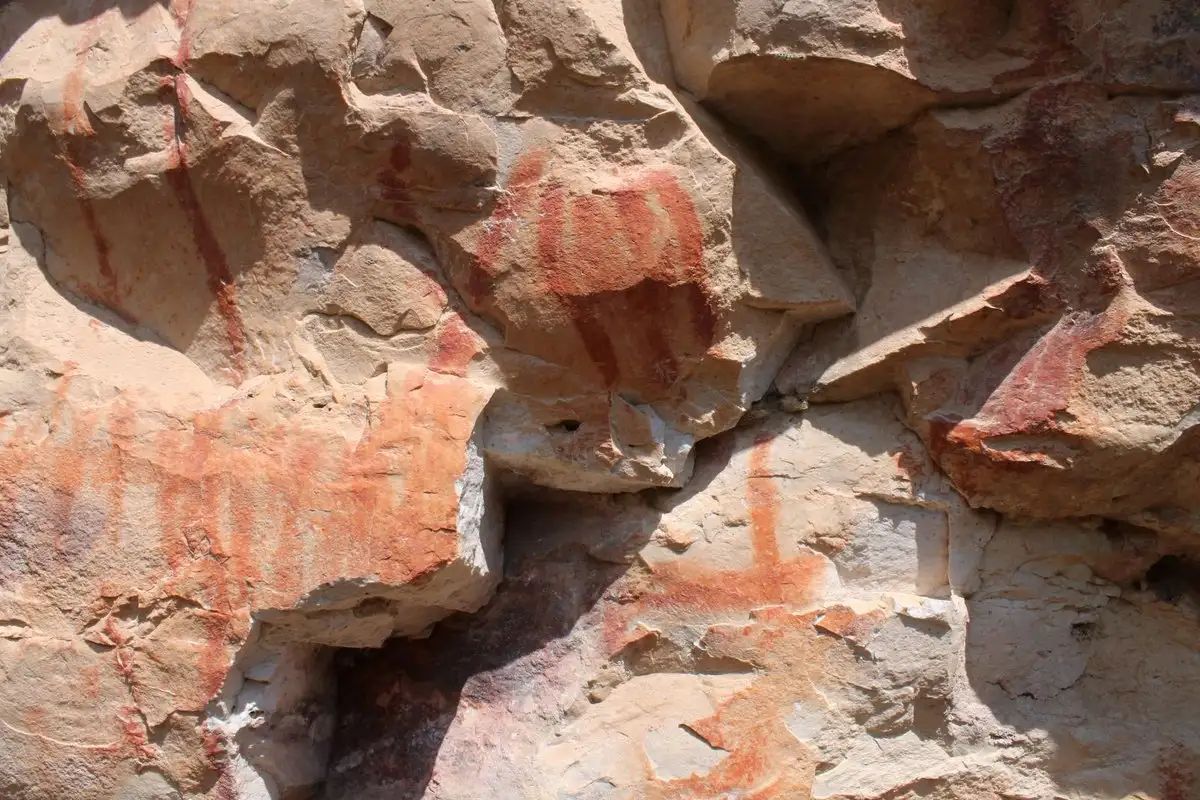
The evidence is distributed across an area of approximately five kilometers. Some sites consist of panels up to 20 meters long, covered with painted motifs on the walls and ceilings of rock shelters. Others are located on hillside rock faces, where archaeologists documented between eight and ten figures. The team also identified a ritual gallery in the bed of a stream, associated with fertility and hunting ceremonies.
Exploration efforts intensified after local residents reported the existence of rock art beyond Cañada de Linares, where INAH carried out survey and conservation work in 2024. That site contains more than 1,500 pictographic elements distributed across 17 panels and eight isolated groups.
Building on those findings, Paola Moulinie Córdova and Jorge Rafael Quiroz Martínez expanded the survey this year through expeditions coordinated by Carlos Alberto Torreblanca Padilla, leading to the discovery of the new evidence.

Geometric motifs predominate, including straight lines, zigzags, intersecting and wavy lines, as well as sequences of dots, triangles, and circles. In smaller numbers, there are schematic representations of animals and, more rarely, human figures. The color red dominates the compositions, applied through outlines and solid fills.
The same pattern appears across all nine documented sites, suggesting a pictorial tradition developed during a prolonged pre-Hispanic occupation of the region, according to Torreblanca Padilla.
The archaeologist noted that the study of rock art in Zacatecas is still in its early stages. Since 2021, the project “Images on Rocks” has been compiling information from archives, bibliography, and historical sources to create a broader understanding of these artistic expressions and identify possible regional styles.
Until recently, Cañada de Linares was the only known site in the Valdecañas mountain range, characterized exclusively by geometric compositions. It is now joined by a second documented style found at El Capulín (El Dominguejo), where archaeologists observed some representations of goats and a small number of human figures.
“Our hypothesis suggests at least two styles: Valdecañas and Dominguejo, but the research is only beginning, and much remains to be studied before confirming this,” Torreblanca Padilla said.

He added that recent work points to a rock art tradition created by groups whose ethnic affiliation remains unknown. Nearby Cañada de Linares, archaeologists have also identified circular residential settlements, although it has not yet been determined whether they were connected to the creators of the paintings.
“There are many questions still to answer in order to understand the pre-Hispanic past of Fresnillo,” he stated.
As part of ongoing conservation efforts, INAH and Fresnillo plc are working to establish protected zones around each of the newly documented sites to reduce risks associated with rock climbing, a common activity in the area.
During inspections, researchers found footprints and climbing anchors installed on some of the rock shelters, a situation that poses a threat to this archaeological heritage.
Temporarily, each of the new sites has been assigned a name consisting of the abbreviation CDL, for Cañada de Linares, followed by a consecutive number from one to eight.
In Zacatecas, 480 archaeological sites have been registered. Of these, only 61 contain rock art. According to INAH, most had previously only been recorded and identified, making the project “Images on Rocks: Rock Art Manifestations in the State of Zacatecas” the first systematic effort aimed at interpreting this archaeological heritage.

Source: jornada