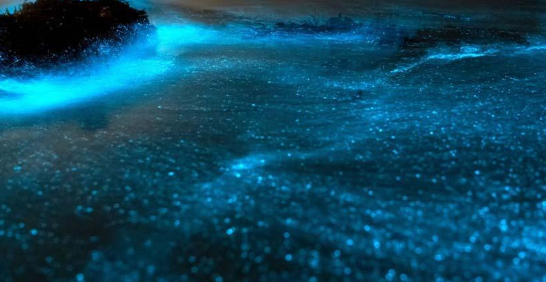

On certain nights of the year, the waters of Baja California Sur (BCS) offer a spectacle as astonishing as it is captivating: bluish flashes that seem to light up the sea with every wave, every movement of the sand, or even as a person walks along the shore. Behind this scene, which for many seems straight out of fantasy, lies a scientific phenomenon known as bioluminescence.
With the goal of bringing this knowledge closer to society, Daniela Pérez Collazo, a Geology student at the Autonomous University of Baja California Sur (UABCS), is conducting research on this phenomenon under the supervision of Dr. Tatiana A. Acosta Pachón, professor and researcher in the Department of Earth Sciences.
The university student explains that bioluminescence is one of nature’s most fascinating phenomena because it combines chemical, biological, and ecological processes that can be observed with the naked eye.
She explains that this phenomenon results from the ability of certain living organisms to produce and emit light, a process that occurs through a series of highly specialized biochemical reactions involving molecules such as luciferin and the enzyme luciferase. When these interact in the presence of oxygen, they trigger a reaction that generates energy in the form of visible light.
One of the most interesting aspects of this mechanism, she explains, is its efficiency. The enzyme responsible for the process can be reused once the reaction is complete, allowing light production to continue as long as suitable conditions remain. This phenomenon can occur both inside organisms and directly in the surrounding water.
According to one of the most widely accepted theories regarding its origin, bioluminescence emerged millions of years ago as a defense strategy developed by microorganisms against oxygen, a substance that, during the earliest stages of life on Earth, was considered toxic. Over time, this ability evolved and diversified across numerous groups of organisms.
Today, it is estimated that up to 76 percent of the inhabitants of the deep ocean exhibit some form of bioluminescence. These include jellyfish, deep-sea fish, squid, eels, and numerous marine microorganisms.
Another finding highlighted in the study is that the variety of colors observed in bioluminescent organisms is due to the existence of different types of luciferins and luciferases. For example, dinoflagellates, the marine microalgae responsible for many of the glowing events seen along coastlines, produce a different type of light than insects such as fireflies because of the chemical differences in their compounds.
Throughout evolution, this ability has acquired a variety of functions. Some organisms use it to communicate with members of their own species or attract mates during reproduction. Others use it to lure prey, confuse predators, or even camouflage themselves within their environment.
According to the university student, beyond its ecological importance, bioluminescence has become a highly valuable tool for science and technology. Luciferases are used in biomedical research related to tumor growth, tracking cancer cells, monitoring diseases, and evaluating new treatments.
“Understanding how bioluminescence works has made it possible to develop technologies that now help visualize complex biological processes and improve tools for medical research,” highlights Daniela Pérez Collazo.
Its applications also extend to environmental science. For example, she notes that genetically modified bacteria capable of emitting light are used as biosensors to detect pollutants and toxic substances in bodies of water. When environmental conditions change, the intensity of their glow also changes, providing valuable information about environmental quality.
In addition, there are ongoing research efforts exploring the possibility of using bioluminescent systems to develop more sustainable and energy-efficient forms of lighting. Although this remains an emerging field, the potential of these technologies continues to generate interest across different scientific sectors.
Daniela Pérez reveals that, in Baja California Sur, this phenomenon can be observed in certain areas of La Paz Bay, particularly in the area known as El Saltito, where the presence of dinoflagellates in warm waters creates bluish flashes that are activated by the movement of the waves or any disturbance in the water.
These natural displays usually occur between the months of June and December. To observe them at their peak, specialists recommend visiting during moonless nights and at low tide, conditions that provide the best opportunity to appreciate the phenomenon.
For the UABCS student, bioluminescence represents an opportunity to bring science closer to people through a phenomenon that inspires wonder and curiosity, helping them better appreciate the complexity of marine ecosystems and recognize that there are still many natural processes worth understanding and preserving.
Source: diarioelindependiente