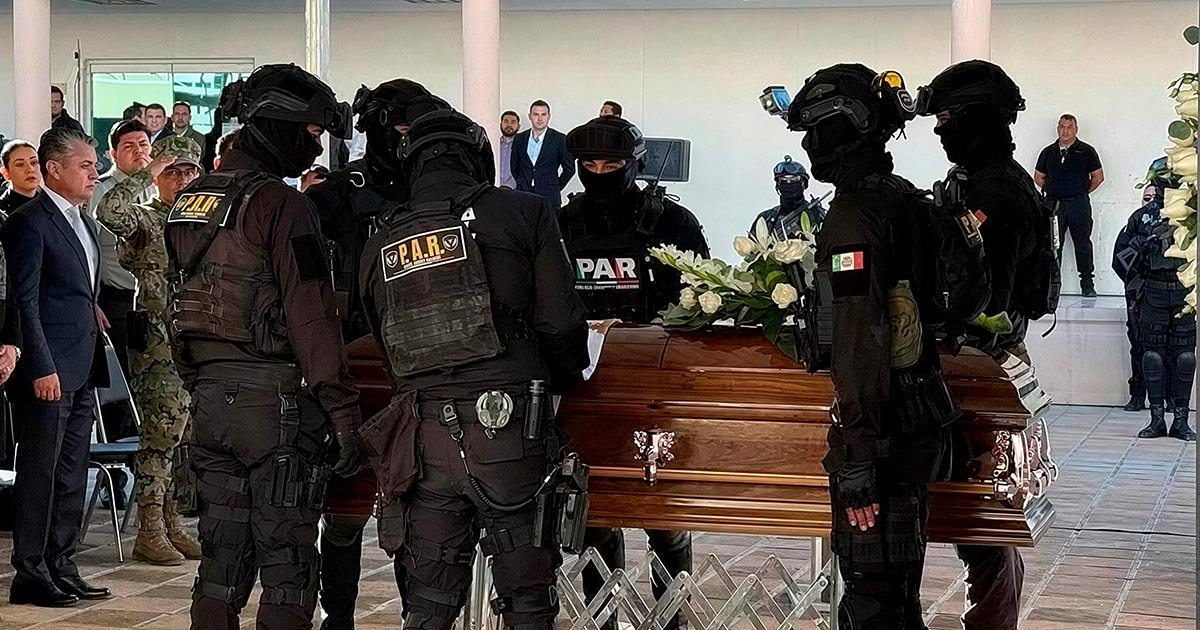

It was 4:30 in the morning on August 25 when a convoy of the Coahuila Police of Action and Reaction (PAR) was patrolling an area of dirt roads in Candela. The territory, desert-like and mountainous, very close to Mesa de Catujanos, along the border with Nuevo León, revealed the headlights of a vehicle in the distance.
Seeing a vehicle traveling at that hour and along those roads can always be alarming. The PAR convoy consisted of three units with armed officers in the truck beds, an imposing sight for anyone traveling in the early hours of the morning through a deserted area. And yet, the occupants of the vehicle did not obey the order to stop and opened fire.
During the exchange of gunfire, officer Mauro Flores Rodríguez was wounded in the side. Although he was wearing a bulletproof vest, fate had it that the shot entered through a vulnerable area where a bullet is unlikely to reach… but it happened.
Two criminals were killed and several others fled into the surrounding terrain, leaving their vehicle abandoned with long guns and tire-puncturing devices. It was impossible to pursue them in the darkness at that hour, and the priority was to get Flores Rodríguez to safety. He was taken to a hospital in Monclova, but it was too late. Mauro Flores died.
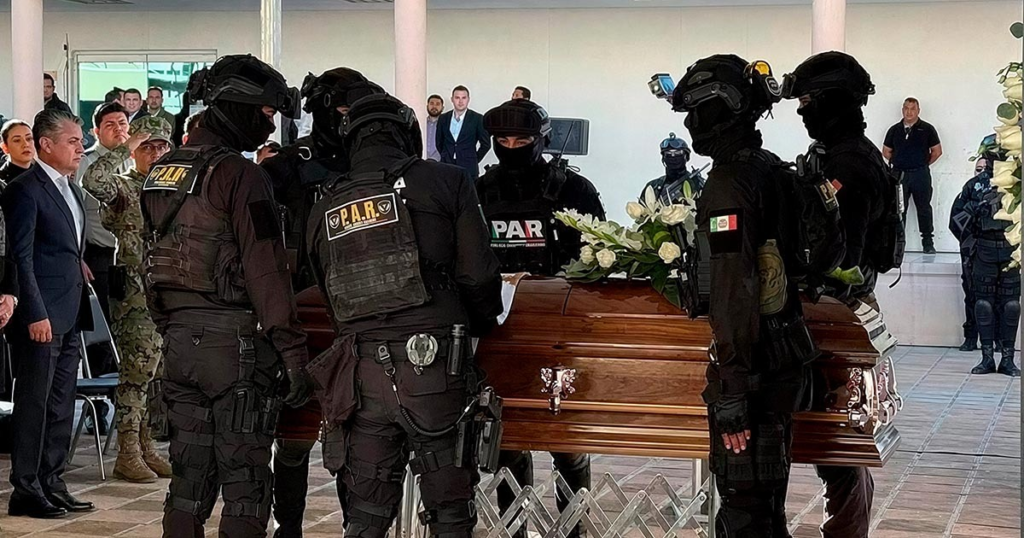
His death was deeply mourned among members of the political class. Six hours later, the State Congress paid tribute to him and observed a minute of silence. He was the brother of Héctor Flores, “Jaguar,” the undersecretary of Police Operations and the senior commander of Coahuila’s police forces.
Just a month ago, around his birthday, the Coahuila Model released a documentary-style video in which various regional commanders shared work-related anecdotes about Héctor Flores. As the state commander, he would go to the front line of fire; he was capable of driving his armored vehicle through gunfire to protect a police group under criminal attack and allow them to regroup. There was even an occasion when a bullet became lodged in his helmet.
But what was presented in those recorded video testimonies does not compare with the accounts shared privately and off camera by police officers, commanders, and those who have been part of his close-knit group since 2012 or 2013, the group that led efforts to expel criminal organizations and establish the security conditions achieved over the past ten years. Their accounts express something close to devotion.
There were many police officers killed during the first stage of the Coahuila Model, yet the security forces continued to grow under Héctor Flores, an agricultural engineer who entered the state police at the beginning of the century and by 2015 was already recognized as the highest operational commander.
Never, until August 25, had mourning reached his closest circle.
A Born Police Officer
Those who knew Mauro Flores Rodríguez describe him as a born police officer, and as proof of that claim, they point to the day of his final mission, because during the patrol he was riding in the truck bed, exposed like any other officer without privileges.
“Being the brother of who he was, he continued working with the troops… pure vocation,” says an officer who knew him during his early years in the state police, when Mauro arrived around 2014 to patrol the Cinco Manantiales region.
The territory was dangerous. As is known, its proximity to the United States border, as well as to the borders with Nuevo León and Tamaulipas, made the communities of Allende, Morelos, Zaragoza, Nava, and, notably, Villa Unión, risky areas. All of them had experienced years of territorial control by the group known as Los Zetas, whose members, under the same or another criminal affiliation such as the Northeast Cartel, frequently operated in the area and were repelled in violent confrontations.
The largest city in the region is Piedras Negras, which has since maintained its position as the safest border city and one of the safest cities in Mexico, an assertion based on reports submitted to the Executive Secretariat of the National Public Security System, as well as on citizen perception measured by INEGI.
Figures from the Executive Secretariat show a high incidence of minor crimes, particularly domestic violence and neighborhood disputes that result in threats. In addition, the region has high numbers of case files opened for retail drug dealing, which authorities justify by saying that cases are actually opened and arrests and investigations are carried out in the area. As for high-impact crimes, nothing. More or less, that is how the Cinco Manantiales region stands, escaping many measurements because of the small size of its communities.
Mauro Flores came from the Mexican Army. He had an impeccable military record when he decided to request his discharge and join the security model being implemented under the orders of his brother Héctor. But he did not ask for privileges. Nor were any given to him. He joined the ranks and had the opportunity to participate in different critical situations.
Originally from a small community in Parras de la Fuente, Mauro chose to patrol the north and remained there, under the orders of commander Miguel Barajas Hernández, “Hummer,” who became widely known as the commander responsible for coordinating operations along the northern border. As the regional commander of the north, Commander Barajas personally participated in confrontations and perhaps is the commander who has had the greatest number of corridos and northeastern hip-hop lyrics composed about him.
Before “Hummer” was replaced by commander Jordán Espino, “El Oso,” in September 2025, Mauro Flores had been assigned to the Candela area in November 2024. The territory is commanded by another of Undersecretary Héctor Flores’ trusted operational commanders: Commander Luis Ángel Estrada Picena, “El Boxer.”
Since the 19th century, those dirt roads have been used for smuggling. Located 50 kilometers in a straight line from the border, along rugged and sparsely populated roads, the area was once the territory of the Lipan Apaches, who used it as a hunting ground but also as a place of confrontation with the armed forces of the then recently established Mexican nation.
By the middle of the 19th century, Mesa de Catujanos was a rudimentary logistical station for smuggling, under the local control of Santiago Vidaurri, who, related by family to the Milmo and Madero families, trafficked textiles and ammunition from Parras de la Fuente to the Confederate Army. The historical reference highlights the area’s importance for the movement of contraband and the determination of the Coahuila Model to reject the presence of armed criminal groups.
The “Shield”
The security enjoyed by Coahuila’s urban communities in general, and those in the north in particular, has one of its keys in what happens along the border. Incidents and some confrontations are frequent, but they occur in isolated areas, dirt roads, and paths without inhabitants, or near sparsely populated rural communities. That is as far as criminal convoys’ attempts to enter reach.
Governor Manolo Jiménez Salinas and Attorney General Federico Fernández Montañez often refer to these operations as “the shield,” whose purpose is to prevent armed groups from entering the state.
Since October 2025, when officer Miguel Ángel Hernández, “La Pluma,” was wounded and died several days later during a confrontation on the Ribereña highway in Hidalgo, this territory, which connects to Nuevo Laredo, has typically experienced the highest number of confrontations, as well as the most violent ones.
Over the past two years, at least ten PAR officers have been wounded and survived thanks to their protective equipment. All of the cases occurred in the area extending from Candela to Hidalgo along the entire border with Nuevo León, approximately 173 kilometers of high-risk territory.
However, so far this year, confrontations have been scarce. Taking 2025 onward into account, Miguel Ángel and Mauro, Coahuila police officers, have died in the line of duty. In contrast, Nuevo León and its Civil Force have recorded nine fatalities, only one of them along the border with Coahuila, since most of its operations are concentrated in the Monterrey metropolitan area.
Thus, while Coahuila has recorded seven total confrontations between 2025 and 2026, five of which can be considered major, Nuevo León has recorded 259 confrontations during the same period. The border area is not a priority for Nuevo León’s commanders.
It was precisely in that area, between the communities of Candela, Coahuila, very close to Lampazos, near the so-called Mesa de Catujanos, where Mauro Flores Rodríguez lost his life. And it was in that area that the Security Council in Coahuila reinforced patrols by sending additional personnel and, one day later, on August 26, implemented complementary actions for the so-called “shield” of the state, as well as a meeting between Governor Manolo Jiménez and the country’s Secretary of Security, Omar García Harfuch.
Source: elcoahuilense